


By Mitch Phillips
CORTINA D'AMPEZZO, Italy, Feb 2 (Reuters) - Below is a selection of facts about bobsleigh, luge and skeleton at the Winter Olympics:
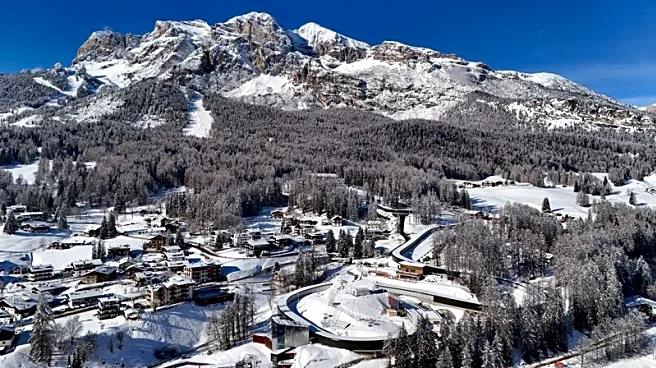
The Eugenio Monti Sliding Centre track in Cortina D'Ampezzo is named after the Italian bobsledder who won two Olympic golds and nine world championships in the 1950s and 60s.
It is a new track purpose-built for the 2026 Games on the site of an original constructed in 1923 which hosted the 1956 Olympic sliding events but was abandoned in 2008 after a series
of accidents.
===
Athletes across all three sports have identified turn four - named Labirinti and effectively three curves in succession - as the key to a successful run at these Games. If the approach height is not perfect it will sling racers out of position and they will lose potentially critical tenths of a second as they try to wrestle themselves back on to the optimum racing line.
===
Feet-first luge is narrowly the fastest of the three sliding sports, due to a combination of factors. Average speeds are around 90mph, with a top recorded speed in the World Cup of 96mph (154kph) by Austria's Manuel Pfister in Whistler, Canada ahead of the 2010 Olympics. Bobsleigh is generally slightly faster than skeleton - with both commonly hitting the high 80s mph.
===
Bobsleigh and skeleton are governed by the International Bobsleigh and Skeleton Federation but luge has its own governing body - the International Luge Federation.
===
One of the anomalies of separate federations is that luge times its races to the thousandth of a second but bobsleigh and skeleton round off to the 100th. This has led to several dead heats over the years, including in 2018 when there was a shared gold in the two-man bob and shared silver in the four-man bob. In luge it was a dead-heat for gold in the men's doubles in 1972 that led the federation to introduce "thousandths" to avoid a repeat.
===
Britain is the second-most successful nation in Olympic skeleton - behind the United States - despite the country not having a track. Athletes perfect their start on a 140-metre concrete push track at their base at the University of Bath but have to travel to Europe or North America to hone their skills on the ice.
===
Germany is by far the dominant nation in luge. Since the sport joined the Games in 1964, the country, in its various guises, has 87 medals, comprising 38 gold, 26 silver and 23 bronze. The next-best is Italy with 18 (seven, four and seven). Germany won all four golds in Beijing 2022 and have won all three team relays since that event was introduced in 2014.
====
Germany also leads the way in bobsleigh, though not quite so impressively. In 2022 they won the three traditional races but were denied a clean sweep when American Kaillie Humphries claimed the first running of women's monobob.
==
Humphries will defend her title this year, having previously won two golds in the two-woman event for Canada before switching allegiance after falling out with the Canadian federation.
===
France provides the name for luge (French for sledge) but has made precious little other contribution to Olympic sliding having won a solitary medal across all three sports - a shared bronze in four-man bobsleigh in 1998.
===
There are two new sliding events for these Olympics - women's doubles in luge and team relay in skeleton, where the times of one man and one woman are totalled. Four years ago women's monobob was added to the bobsleigh programme. It means there are five golds up for grabs in luge, four in bobsleigh and three in skeleton.
===
Four summer Olympians will participate for the first time at these Winter Olympics as brakewomen in the bobsleigh events: Kelsey Mitchell of Canada (gold medallist in track cycling), Salome Kora of Switzerland (100m and 4x100m relay), Briton Ashley Nelson (4x 100m relay in three Olympics) and Christania Williams, who won a silver medal in the sprint relay for Jamaica but is competing for Austria at these Games.
===
Jamaica's debut at the 1988 Olympics inspired the film "Cool Runnings" and though almost no media mention of the country here can go without referencing the film, this will be their 10th Winter Olympics. None of this year's Jamaican bobsledders were alive at the time of their breakthrough moment, though 37-year-old Joel Fearon, who will race for Jamaica after switching from Britain having won bronze in the 2014 four-man, was born a few months after.
====
Among other "non-traditional" bobsleigh countries who will be in action in Cortina are Trinidad and Tobago, South Korea and Brazil, though Edson Bindilatti will be competing at his sixth Olympics for the South Americans.
(Reporting by Mitch Phillips, editing by Ed Osmond)