

By Julien Pretot
PARIS, March 26 (Reuters) - The chess Candidates tournament opens on Sunday with a throwback feel — eight players, long-time controls and the game in its purest form — but also with a sense that this could be the last stand for a generation of players who have shaped elite chess for more than a decade.
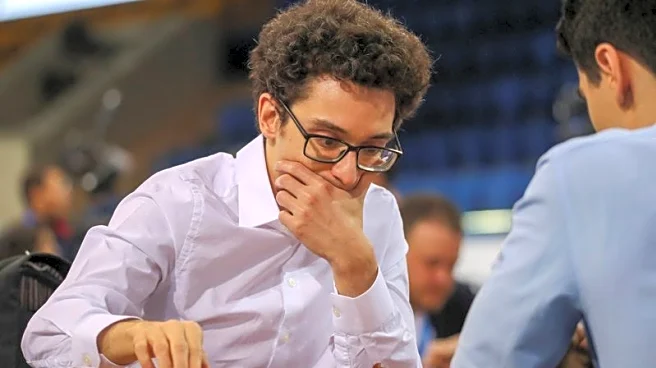
Top seed Fabiano Caruana meets Hikaru Nakamura in a headline first-round clash. Both have come close to the summit before, and now face an increasingly youthful field with a shot at
the world title against India’s Gukesh Dommaraju looming later this year.
Around them, the shift is unmistakable.
India’s R Praggnanandhaa is among a new wave of players who play without deference, while Germany’s Matthias Bluebaum and the Netherlands’ Anish Giri bring contrasting, battle-hardened styles. Russia’s legacy, once dominant, is now carried more quietly by Andrey Esipenko, and China’s Wei Yi adds further firepower to a field in transition.
WIDER CONTEXT
The tournament, running until April 16 in Western Cyprus, will unfold in a wider context that is impossible to ignore. The conflict in the Middle East has had a direct impact on the event, with India’s Koneru Humpy withdrawing from the women’s Candidates citing safety concerns linked to the regional situation.
That decision underlines a broader tension for a sport that has long prided itself on detachment from politics but has repeatedly found itself pulled into geopolitical realities.
“It's not a good sign when power goes out completely in parts of Cyprus and doesn't come back for an extended period of time,” Nakamura said.
An Iranian-type drone caused slight damage when it hit facilities at the Akrotiri airbase in southern Cyprus this month, with two others later intercepted.
“As a precautionary measure, the hotel (where the tournament is played) is equipped with its own shelter facilities. While such scenarios are purely theoretical, appropriate infrastructure is in place to ensure the safety of all participants and guests,” FIDE said.
Within the tournament hall, however, the format remains deliberately austere — almost defiantly so in an era of speed chess and digital spectacle. There are no rapid or blitz games to bail players out during the main phase, no Armageddon deciders, no online boards nor increment-heavy shortcuts. Each game is a full classical contest, often running five, six or seven hours, where a single error can linger for dozens of moves before it is punished.
It is that slow burn that is the beauty of over-the-board classical chess — a contest not just of ideas, but of stamina and nerve, where the margins are thin and the consequences enduring.
For Caruana and Nakamura, both veterans of world championship cycles, the stakes are clear. Another shot at the title remains within reach, but opportunities are narrowing as the younger generation grows.
The women’s field looks similar, even after Humpy’s withdrawal. India’s Divya Deshmukh faces Ukraine’s Anna Muzychuk, while Rameshbabu Vaishali meets Kazakhstan’s Bibisara Assaubayeva.
Russia’s Aleksandra Goryachkina — among the pre-tournament favourites with her direct, aggressive style — takes on Kateryna Lagno, while China’s Zhu Jiner faces former world champion Tan Zhongyi.
(Reporting by Julien Pretot, editing by Ed Osmond)