

By Julien Pretot
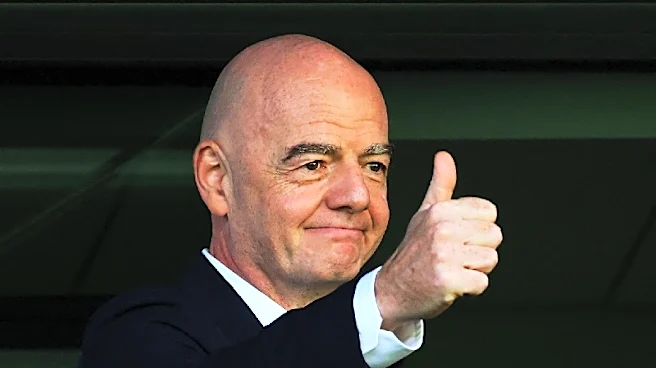
Sept 10 (Reuters) - FIFA President Gianni Infantino can count on enough votes to win re-election, meaning his opponents will need to shift strategy and focus on curbing his powers, a sharp reversal weeks after senior football figures believed his position was untenable, multiple sources familiar with the discussions told Reuters.
“Three weeks ago, I thought he was dead,” one global football source with first-hand knowledge of discussions among senior officials said of Infantino's chances
of keeping his job.
“What I didn’t realise was the extent to which, after 10 years in power, the relationships he has built are almost unbreakable.”
Swiss-Italian Infantino, 56, faced the biggest challenge to his presidency this year following the collapse of his proposal to sell a 20% stake in FIFA competitions, including the World Cup, to private investors.
The plan prompted fierce opposition, with UEFA, the Asian Football Confederation and North America's CONCACAF among those calling for change at the top of FIFA.
Several European national associations have since withdrawn backing for Infantino’s re-election, with France becoming the latest on Thursday.
Despite FIFA Secretary General Mattias Grafstrom lamenting what he called the “sad and reproachable series of events” that led to the project being abandoned, he later reaffirmed his full support for Infantino after a crisis meeting in Rabat.
But as the immediate crisis has receded, the electoral arithmetic has become increasingly daunting, opponents to Infantino's re-election say.
No challenger capable of commanding sufficient support across FIFA’s 211 member associations has yet emerged ahead of the March election, while Infantino retains strong backing among smaller football nations and important blocs outside Europe.
At the FIFA Congress, every national association will have one vote, meaning any successful challenge requires a coalition extending well beyond European governing body UEFA’s 55 members.
That leaves Infantino's opponents facing a potentially dangerous calculation: challenging the President and losing could strengthen rather than weaken his grip on FIFA.
“I think the direction of travel has changed,” the source said. “It is even more of a risk for UEFA to go to a vote and not win.”
UEFA and FIFA have been approached for comment.
AL-KHELAIFI RULES HIMSELF OUT OF RUNNING
Paris St Germain president Nasser Al-Khelaifi is regarded by senior football figures as one of the few potential candidates capable of assembling the cross-confederation coalition needed to beat Infantino.
Sources with an understanding of the situation believe Al-Khelaifi could mount a serious challenge, but he has ruled himself out, saying through a spokesperson that he has no ambition, intention or interest in becoming FIFA president.
CONCACAF President Victor Montagliani is another name to have circulated, but said he was unlikely to stand without first believing he had sufficient support to win, another source within world football told Reuters.
No other heavyweight candidate has emerged, although an African or Asian candidate could still be nominated before the November 18 deadline, the same source said.
Even among confederations that continue to support Infantino, there have been calls for stronger governance, greater transparency and tighter checks on major commercial decisions at FIFA.
The durability of Infantino’s support is illustrated by Oceania, where Steeve Laigle, president of the New Caledonia Football Federation, said most federation chiefs remained firmly behind him.
“Most of the presidents of Oceania have given their support to Mr Infantino,” Laigle told Reuters. “We will support him until the end.”
Laigle said Infantino had built loyalty among smaller federations by paying greater attention to their needs and helping develop the game.
“When we give our word, when we are loyal to someone, we are loyal until the end,” he said.
The mood in Africa is similar, according to a senior Confederation of African Football source, who said the vast majority of federation presidents remained satisfied with Infantino and believed continued support would bring increased development funding.
The source said none of the African federation presidents he was aware of had expressed the kind of concern voiced in Europe over the proposed World Cup stake sale.
MOROCCO AMONG INFANTINO'S PUBLIC SUPPORTERS
Morocco, one of Africa’s most influential federations, has been among Infantino’s public supporters.
A senior CAF source told Reuters some people within African football believed Royal Moroccan Football Federation President Fouzi Lekjaa had been promised the 2030 World Cup final in return for helping maintain African support for Infantino.
FIFA has denied reports that Morocco was promised the final in exchange for political support. Lekjaa said on Thursday it would be staged in the Casablanca area, although FIFA has not formally announced the venue.
The Moroccan federation did not respond to a Reuters request for comment.
Infantino also retains the support of South America’s CONMEBOL, while CAF remains supportive despite the AFC and CONCACAF joining UEFA in calling for change.
France illustrated the opposition’s dilemma on Thursday by withdrawing its backing for Infantino without identifying who should replace him.
“The trust placed in the FIFA president has been broken,” French Football Federation President Philippe Diallo told reporters after its executive committee unanimously withdrew support.
“Our mission now is to make sure that a programme and a candidate emerge — and then, with that programme and that candidate, to make sure they win,” Diallo said.
NO OBVIOUS CHALLENGER
Candidates must be nominated by November 18, leaving just over two months to agree an alternative programme, identify a willing candidate and assemble commitments across the world.
“The project cannot be a purely European one,” Diallo said. “It has to bring together all continents.”
With no obvious challenger, some of Infantino’s opponents are considering whether to shift their efforts towards changing FIFA’s governance structure.
The two global sources said officials were examining whether powers concentrated in the presidency could be reduced or redistributed if they conclude that Infantino cannot realistically be beaten at the ballot box.
That would mark a significant change from weeks ago, when senior figures believed the crisis surrounding the abandoned investment proposal could end Infantino’s presidency.
Attention could instead turn to stronger checks on major strategic and commercial decisions and a rebalancing of authority within FIFA’s leadership.
Diallo confirmed that the distribution of power inside FIFA was among the issues under discussion.
Asked about suggestions that some powers could be taken from the president and given to an appointed secretary general, he said: “That is part of the debate we now need to have within UEFA.”
Without a candidate capable of turning European opposition into a global coalition, officials say attention may increasingly shift from removing Infantino to restricting the powers of the presidency itself.
The FIFA presidential election will take place in Rabat on March 18, 2027.
(Reporting by Julien Pretot; Additional reporting by Iain Axon and Mark Gleeson; Editing by Ken Ferris)