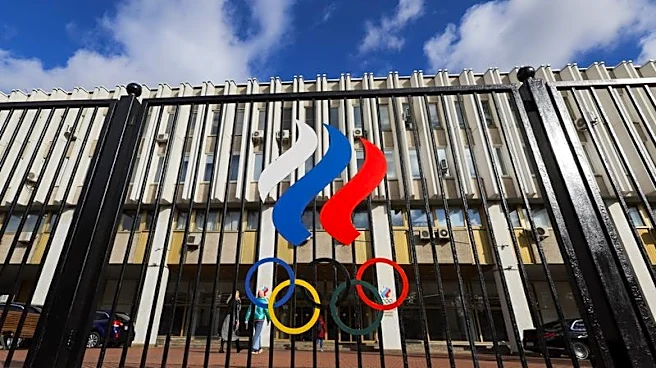








LAUSANNE, Switzerland, July 7 (Reuters) - The International Olympic Committee provisionally lifted its ban on the Russian Olympic Committee on Tuesday, paving the way for a return to international competitions including at the Los Angeles 2028 Olympics.
The IOC had recommended that Russian and Belarusian athletes and officials be banned from events since 2022 following Russia's invasion of Ukraine.
Here is a timeline of events:
February 24, 2022: Russia invaded Ukraine. Belarus is used as a military
staging ground by Russia.
February 28, 2022: The International Olympic Committee's executive board recommends sports federations ban Russian and Belarusian athletes and officials from competing in events.
The IOC says the decision is made "in order to protect the integrity of global sports competitions and for the safety of all the participants" and that the body is acting with a "heavy heart".
Soccer governing bodies FIFA and UEFA, as well as other sports federations, follow suit and also suspend Russia's national and club teams from all competitions until further notice.
The IOC withdraws the Olympic Order from all persons who have an important function in the government of the Russian Federation, including Russian President Vladimir Putin. The Olympic Order is the highest award granted by the Olympic movement and Putin was the recipient of a gold honour in 2001.
October 12, 2023: The Olympic body suspends the Russian Olympic Committee in October 2023 for recognising regional Olympic councils for Russian-occupied regions of Ukraine -- Luhansk, Donetsk, Kherson and Zaporizhzhia -- following Russia's invasion.
The IOC said this violated the Olympic Charter and the territorial integrity of Ukraine’s Olympic Committee.
February 23, 2024: Russia loses its appeal at the Court of Arbitration for Sport (CAS) against the IOC's suspension over its recognition of regional bodies in Russian-annexed areas of Ukraine.
July 2024: A handful of vetted and cleared Russian and Belarusian athletes are allowed to compete as neutrals without their flag or anthem at the Paris 2024 Summer Olympics. No participation of these countries in any team event is allowed.
September 27, 2025: The International Paralympic Committee (IPC) readmits Russia and Belarus as full members of the IPC, lifting sanctions on participation at the 2026 Milano Cortina Winter Paralympics.
December 11, 2025: The IOC urges federations to readmit Russian and Belarusian youth athletes (under-23s) to compete in international events without access restrictions, in a first clear step to ease sanctions.
The IOC says standard protocols regarding flags and anthems should apply and that these principles should be in place at the 2026 Dakar Youth Olympic Games.
February 2026: A small number of Russian and Belarusian athletes are again cleared to compete as neutrals at the 2026 Milano Cortina Winter Olympics. No participation in team events is allowed.
March 2026: A handful of Russian para athletes get spots to compete under their nation’s flag at the Milano Cortina Winter Paralympics.
They had won an appeal at the Court of Arbitration for Sport against a ban from the International Ski and Snowboard Federation. Several nations, including Ukraine, boycott the Paralympics opening ceremony over Russia's full participation.
May 7, 2026: The IOC recommends that all restrictions be lifted on Belarusian athletes competing in international events. Russian athletes remain restricted.
July 7, 2026: The IOC provisionally lifts its ban on the Russian Olympic Committee, paving the way for the country's athletes to compete in international competition.
The IOC says its executive board has not decided yet on whether Russia can display its flag, colours and anthem at the 2028 Olympic Games in Los Angeles.
(Reporting by Karolos Grohmann; Editing by Toby Davis and Hugh Lawson)