
By Agnieszka Flak and Elvira Pollina
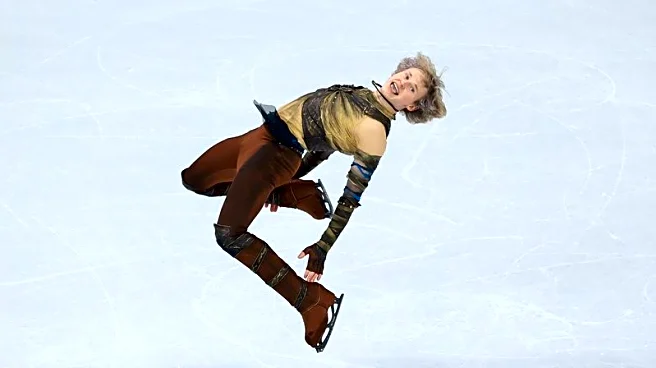
MILAN, Jan 26 (Reuters) - Figure skating will arrive at the Milano Cortina Olympics in the grip of a technical revolution led by Ilia Malinin, whose multiple‑quad programmes have reset the bar and reignited debate over whether artistry can keep pace with athletic extremes.
The 21-year-old American "Quad God" in December broke his own free skate world record with 238.24 points, landing seven quad jumps, including his signature quadruple Axel — a jump only he has
completed in competition.
His dominance caps a two-decade race that has made quads the price of admission to the podium — and forced a reckoning over the sport's identity.
Canada's Elvis Stojko knows the debate well. The three-times world champion and twice Olympic silver medallist, nicknamed "Mr Quad" in the 1990s for pioneering the element, finds the current era thrilling but says something has been lost.
"There's so much packed in a programme that a skater doesn't get a chance to take a breather and allow the audience to come in," he said. "Back in the day, you'd have moments where a (American figure skater) Michelle Kwan could do a beautiful spiral and have a moment ... that’s kind of been lost."
Three-times world champion Patrick Chan called Malinin "an athletic freak ... the Michael Jordan of figure skating” and framed the trade-off as a slam dunk versus Wayne Gretzky orchestrating a game - instant exhilaration versus nuance.
"It’s the amazement of seeing seven quads in one programme," he said. “That’s the excitement now. It’s just a different era."
Chan expects Malinin to push the technical frontier — perhaps even towards a quint — but says longevity is the true test: delivering championship performances repeatedly over time.
“He’s still early days; this will be his first Olympics. It’ll be interesting to see if, after winning the first one and setting the bar so high, he keeps up that pace.”
A SYSTEM OUT OF BALANCE
The current scoring system, introduced after the 2002 Salt Lake City judging scandal, was designed to balance technical and artistic elements. That balance has been stretched by the value of quads.
“The system was created when skaters were doing two quad toe loops,” said Paolo Pizzocari, a council member of the Italian Figure Skating Federation and a former international judge.
“Now juniors are doing two quads. The value has been unbalanced toward the technical side.”
Nathan Chen’s Olympic gold at Beijing 2022 underscored the trend: his technical element scores dwarfed his programme components.
“You can see even in junior categories that skaters learn to jump before they learn to skate properly,” Pizzocari said. “Many coaches and athletes focus immediately on jumps because that’s where the points are.”
Concerns are rising about the toll on young athletes.
Pizzocari noted injuries have increased as skaters push their bodies to execute ever more difficult elements.
“It’s not always the big injury from a fall — it’s the microtrauma from repetitive stress that damages athletes over time,” he said.
Stojko, drawing on his martial arts background, said the sport’s one-sided loading batters the body, pointing to Russian great Evgeni Plushenko — a double Olympic champion who has had multiple surgeries including knee operations and spinal surgery involving metal hardware — as a cautionary example.
Behind the scenes, rule tweaks are being debated.
Pizzocari favours two distinct programmes — one purely technical without limits and one with restrictions to emphasise artistry. The idea faces resistance from federations wary of capping jump values or imposing limits.
He added that for next season, the International Skating Union was planning to add choreographic elements and reduce the number of jumps — a modest step toward rebalancing.
THE CASE FOR CO-EXISTENCE
Not everyone sees an identity crisis. French choreographer Benoit Richaud - who has built programmes for contenders including Kaori Sakamoto and Adam Siao Him Fa for Milano Cortina - argues the sport has never been more artistic.
He says today’s top skaters blend difficulty with genuine expression better than previous generations, pointing to programmes that now pack more choreography, complex spins and step sequences alongside multiple quads.
“In the past, when skaters were doing two quads in the programme, they were barely doing any choreography in the first part,” he said. “Now skaters have much more choreography, many more spins, many more steps, and they do five quads ... the level is incredible.”
As the sport next month comes to Italy - a nation steeped in artistic tradition — that tension will play out on Olympic ice.
Rather than seeking resolution, the answer may be to celebrate what makes figure skating unique: the quest to push human limits while creating art.
“The essence of sport is pushing your own limits, understanding how far you can go,” said Carolina Kostner, Italy’s most decorated singles figure skater and the 2014 Olympic bronze medallist.
“That’s the beauty of sport ... the desire of the new generations to move forward ... to dream big and see where life takes them.”
(Reporting by Agnieszka Flak and Elvira Pollina; Additional reporting by Lori Ewing; Editing by Ken Ferris)