
By Lori Ewing
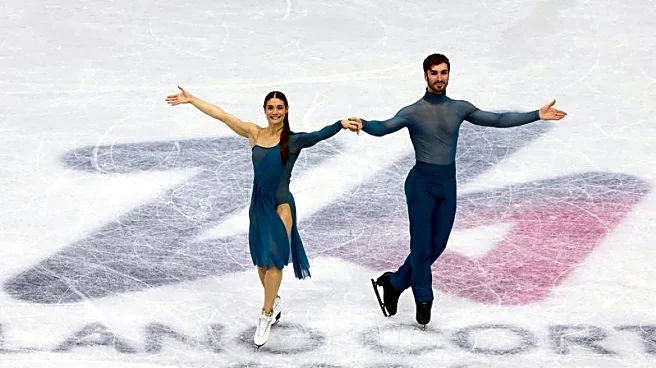
MILAN, Feb 13 (Reuters) - The International Skating Union (ISU) on Friday defended the judging of the ice dance event at the Milano Cortina Olympics after the silver-medal performance by Americans
Madison Chock and Evan Bates sparked widespread debate among fans.
Much of the outrage stemmed from the fact French judge Jezabel Dabouis favoured French competitors Laurence Fournier Beaudry and Guillaume Cizeron by nearly eight points over the three-time world champion Americans in the free dance.
The outcome prompted a fan petition on Change.org calling for the ISU and International Olympic Committee to investigate the scoring.
As of Friday evening, the petition had garnered just shy of 17,000 signatures.
In a statement, the ISU said it had "full confidence in the scores given," adding that multiple layers of review are built into the judging system to reduce discrepancies and ensure fairness.
"It is normal for there to be a range of scores given by different judges on any panel," the ISU said in a statement.
"To mitigate these variations and ensure fairness, several mechanisms are in place. The highest and lowest scores for each element are typically dropped, reducing the impact of any outliers.
"Scores are averaged across the remaining judges, and technical elements are reviewed and verified by a technical panel to ensure consistency with the rules."
Fournier Beaudry and Cizeron won the gold with a total of 225.82 points, while the Americans earned 224.39.
The ISU also said an Officials' Assessment Committee provides additional oversight, and that judges undergo regular training "to maintain a high standard of scoring accuracy."
Bates had told reporters on Thursday that he and Chock had not read the petition but were aware of it.
"It means a lot that people are voicing their opinions on our behalf," he said.
Chock said that the controversy pointed to a broader issue within the sport.
"Anytime the public is confused by results, it does a disservice to our sport," she said. I think it's hard to retain fans when it's difficult to understand what is happening on the ice.
"There needs to be a lot more clarity for the skaters, for the coaches, and for the audience in order to just have a solid fan base moving forward. People need to understand what they're cheering for and be able to feel confident in the sport that they're supporting."
The sport's scoring system was overhauled following the judging scandal at the 2002 Salt Lake City Winter Games, where duplicate gold medals were awarded to Canadians Jamie Sale and David Pelletier after an investigation amid allegations of vote swapping and vote rigging.
Russians Elena Berezhnaya and Anton Sikharulidze had initially been presented with gold.
Figure skating is turning to artificial intelligence (AI) and computer vision technology to try to bring greater consistency and transparency to how performances are scored.
The ISU has been testing high-resolution camera systems at competitions over the past two years that use AI to track skaters' movements and analyse technical elements such as jump rotation, height, distance travelled and spin positions in real time.
(Reporting by Lori Ewing, editing by Pritha Sarkar)