



By Alexander Hübner and Paolo Laudani
Jan 27 (Reuters) - China's biggest sportswear brand Anta Sports Products has struck a deal to buy a 29.06% stake in Puma from the Pinault family for 1.5 billion euros ($1.8 billion), making it the biggest shareholder in the German sportswear maker.
Anta said it would use its expertise to help struggling Puma increase its sales in the lucrative Chinese market. The deal also helps Fila owner and Salomon backer Anta in its quest to become a more global business.
Pinault
family investment vehicle Artemis, which also controls Paris-listed luxury conglomerate Kering, will sell its stake to the $27.8 billion Hong Kong-listed sportswear company for 35 euros per share in cash.
The deal will help Artemis reduce its debt load, a spokesperson for the company said.
Puma shares surged 17% initially and were up 9% by 1130 GMT, still near their lowest levels in a decade.
The offer represents a 62% premium to Puma's closing share price of 21.63 euros on Monday, and comes as the 3.2 billion euro ($3.79 billion) company tries to revive its fortunes after losing ground to Nike, Adidas, and newer brands like On Running.
Reuters was first to report the deal earlier this month.
ANTA PLANS TO GROW PUMA IN CHINA
Puma has more scope for growth in China, a senior Anta executive told Reuters.
"Puma has more potential in the Chinese market, where they are underrepresented with only 7% of their global revenues. We have a lot of insight on how to make Puma more successful in China," said Wei Lin, Anta global vice-president for sustainability and investor relations.
Anta, which has a track record of acquiring and revamping Western sports labels, said Puma complements its existing brands and could help it compete better internationally.
Anta is the largest shareholder of Amer Sports, which owns Salomon, Arc'Teryx, Wilson, and other brands. Amer has grown Salomon into a major sneaker brand and reported strong revenues even as Nike and Adidas struggled.
Anta also directly owns Fila, Jack Wolfskin, Kolon Sport and Maia Active.
"Anta has already shown with other brands that it can successfully support them (e.g. Amer Sports)," said Christian Reindl, portfolio manager at Union Investment, a Puma shareholder.
"Operationally, however, Puma remains a restructuring case for the time being."
Anta said it would seek Puma board seats once the deal was finalised but would not seek a full takeover of the company. Anta shares gained 2% on the announcement.
PUMA UNDER PRESSURE
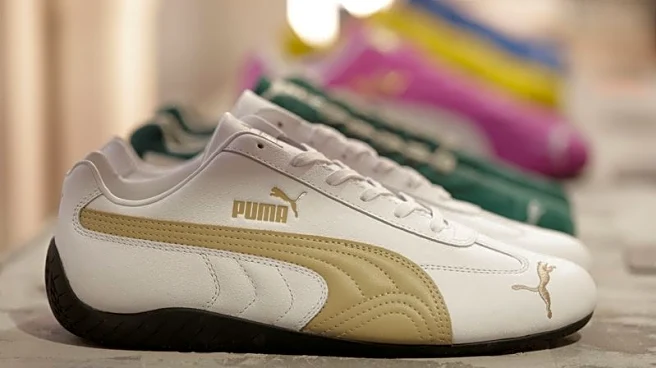
Puma has been under pressure as sportswear competition has intensified and recent sneaker launches, including the Speedcat, failed to generate the momentum executives hoped for.
CEO Arthur Hoeld, who took over last July, announced a turnaround plan and 900 job cuts in October, on top of 500 layoffs earlier last year.
Lin said Anta had confidence in Hoeld and his team.
Puma is set to report fourth-quarter results on February 26, giving investors a first sense of how its plan to limit discounting, improve marketing and cut its product range is playing out.
Reuters reported in early January that Anta had offered to buy about 29% of Puma from Artemis and had secured financing for the acquisition, although talks at the time had stalled over valuation given Puma's steep decline.
Artemis, run by Kering chairman Francois-Henri Pinault, had previously described its Puma stake as non-strategic. The Pinault family took the holding from Kering in 2018, when the group repositioned itself as a pure luxury player.
"This disposal is consistent with the ongoing strategy implemented by Artemis to focus on controlled assets and to redeploy its resources towards new value-creating sectors," Artemis said in a statement.
The deal is subject to antitrust clearances, shareholder approval at Anta, and regulatory approvals in China and other jurisdictions.
($1 = 0.8433 euros)
(Reporting by Alexander Huebner in Munich, Paolo Laudani in Gdansk, Tassilo Hummel in Paris, Scott Murdoch in Sydney and Roushni Nair in Bengaluru, Writing by Helen Reid; Editing by Rashmi Aich, Anne Marie Roantree, Thomas Derpinghaus and Kate Mayberry)