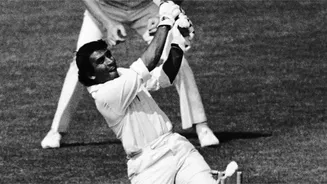





The first-ever Cricket World Cup began at Lord’s on June 7, 1975, but the match between England and India is remembered for a reason nobody expected. It was supposed to introduce the world to a new era
of international cricket. Instead, Sunil Gavaskar’s extraordinary 36 not out became one of the most debated innings in ODI history.
England had set India a huge target of 335 after scoring 334/4 in their 60 overs. Dennis Amiss led the way with a brilliant 137 off 147 balls, while Keith Fletcher added 68 and Chris Old smashed 51 not out from just 30 balls.
India’s chase never really began as Gavaskar opened the innings and stayed there for the entire 60 overs. He faced an astonishing 174 balls but scored only 36 runs, finishing with a strike rate of just 20.68 and hitting only one boundary. India eventually reached 132/3, losing by 202 runs.
The beginning of the World Cup and Gavaskar refused to score.
#OnThisDay in 1975, Sunil Gavaskar scored just 36 runs (not out) off 174 balls while chasing England’s 335 in 60 overs in the opening game of World Cup 1975. https://t.co/icjJeT9HNe
— Cricketopia (@CricketopiaCom) June 7, 2025
The number 36 became famous but the bigger story was what the innings represented. ODI cricket was still in its early days. The format itself was different, with matches lasting 60 overs rather than the 50 overs used today. India were also far less experienced in limited-overs cricket than they would become in the following decades.
But even by the standards of the time, Gavaskar’s approach was extraordinary. India needed more than five runs an over from the beginning, yet Gavaskar barely attacked. Gundappa Viswanath scored 37 from 59 balls, while Brijesh Patel made 16 from 57. India never seriously threatened the target.
Read More : Prasidh Krishna injury update: Fast bowler to miss three weeks of action with hamstring injury; New Zealand series participation in doubts
The reaction to the knock was brutal
India manager GS Ramchand publicly criticised the performance, while the innings became a source of embarrassment for Indian cricket. Gavaskar later offered his own explanation, but the controversy surrounding the knock never really disappeared.
Interestingly, the defeat did not completely ruin India’s tournament. They bounced back to beat East Africa by 10 wickets, but then lost to New Zealand and were eliminated in the group stage. England won all three of their group matches before losing to Australia in the semi-final.
Gavaskar’s 36 did more than produce an unusual scorecard. It showed how far Indian cricket still had to travel in adapting to limited-overs cricket. Within a few years, India would begin developing a much stronger ODI side and go onto lift the 1983 World Cup under the leadership of Kapil Dev.