




The decision comes after BCCI asked KKR to remove Bangladeshi star pacer Mustafizur Rahman from their IPL 2026 squad, whom they bought him for 9.2 Crores.
Following the murder of a Hindu man, Dipu Das in Bangladesh and similar attacks on the Hindu minority across the border over the past few days have created a huge furore in India. With public protests and demand over the removal of Bangladeshi players from the IPL promoted the Indian board to step in and make a decision.
While the Bangladesh Cricket Board (BCB) has made it clear that it is not withdrawing from the tournament, it has formally asked the ICC to relocate all of Bangladesh's matches out of India, preferably to co-host Sri Lanka.
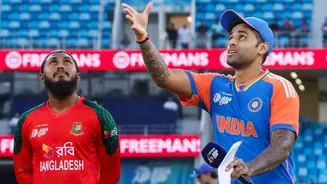
With the ICC considering the request, attention has now shifted to an intriguing question: how many times can India and Bangladesh potentially face each other in the competition?
At the group stage level, there is no immediate India vs Bangladesh fixture. India have been placed in Group A, while Bangladesh are part of Group C. Bangladesh's scheduled group matches - against West Indies, Italy, England and Nepal - were originally allotted to venues in Kolkata and Mumbai. If the ICC approves the venue shift, these matches are likely to be moved to Sri Lanka, but that change would not directly impact India during the opening phase.
Scenario 1
The first possible India vs Bangladesh clash could come in the Super 8 stage. If both teams finish among the top two in their respective groups, they would advance to the second round, where cross-group fixtures are played. According to the current schedule, an India vs Bangladesh Super 8 match is pencilled in for March 1 in Kolkata. However, if Bangladesh's request is accepted, this fixture would almost certainly be shifted to a neutral venue in Sri Lanka, making it the earliest potential meeting point between the two sides.
Scenario 2
The second and final possible encounter is the tournament final itself. Both India and Bangladesh would need to navigate the Super 8 stage and win their respective semi-finals to set up a title clash. The final venue has been planned with a contingency in mind: Ahmedabad will host the summit clash if India qualify, while Colombo will stage it if India fail to make the final. This creates a unique dilemma if both India and Bangladesh reach the final. India would naturally prefer Ahmedabad to capitalise on home support, whereas Bangladesh, given their stated position, would push strongly for the match to be played outside India, most likely in Colombo.
Beyond logistics, the situation places the ICC in a delicate position. Agreeing to Bangladesh's request may ease tensions, but it will once again set a precedent where bilateral political disputes influence tournament venues. Operationally, any shift would involve reworking schedules, ticketing, broadcast plans and team travel at short notice.
In summary, India and Bangladesh can face each other a maximum of two times in the T20 World Cup 2026 - once in the Super 8s and once in the final. Whether either, or both, of those matches actually take place - and where - now hinges on the ICC's imminent decision.