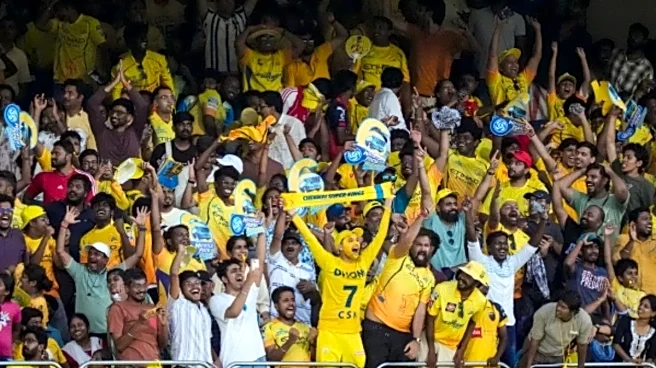




For years, IPL franchises were viewed purely through the lens of sport and entertainment. Today, they are increasingly being discussed in the language of private equity, long-term valuation, and alternative investments.
At the centre of that shift sits Chennai Super Kings Cricket Ltd. (CSKL) - a franchise that has evolved from one of cricket's most successful teams into one of India's most closely watched unlisted sports assets.
With growing investor interest around franchise equity, CSK's unlisted shares are now becoming a fascinating example of how sports businesses are redefining private markets in India, .
Why CSK business model attracts investors
Unlike traditional startups that rely heavily on uncertain growth projections, IPL franchises operate within one of the most commercially
secure sporting ecosystems in the world.
A major pillar of that stability comes from the BCCI's central media rights structure.
CSK reportedly earns a ₹282.74 crore share from the IPL media rights pool, creating a predictable revenue stream that acts as a financial cushion regardless of on-field fluctuations.
Beyond broadcasting income, the franchise also benefits from multiple commercial verticals.
Match-day revenues at the MA Chidambaram Stadium continue to remain among the strongest in the league due to CSK's massive fan base and consistently high attendance. Sponsorship deals, merchandise sales, licensing partnerships, and digital engagement further strengthen the franchise's commercial ecosystem.
Together, those streams have helped transform CSK from simply a cricket team into a diversified entertainment and media business.
The power of scarcity in IPL franchise ownership
One of the biggest reasons behind rising investor attention is scarcity.
There are only 10 IPL franchises, and very few sports assets in India possess comparable brand strength, recurring revenue, and cultural influence.
CSK consistently ranks among the most valuable IPL brands globally. That combination of brand loyalty and limited supply creates what market observers often describe as a "scarcity multiplier" - where investor demand rises because access remains extremely limited.
The franchise's association with MS Dhoni over the years has only amplified its emotional and commercial appeal, helping CSK maintain one of the strongest fan ecosystems in world cricket.
Why unlisted shares remain risky despite the hype
Despite growing excitement, CSK shares remain an unlisted asset.
That means they are traded privately through Over-The-Counter (OTC) markets rather than on traditional exchanges like the NSE or BSE.
As a result, investors face lower liquidity, higher volatility, and more complex price discovery mechanisms compared to publicly listed companies.
Unlike listed stocks, exiting positions quickly can become difficult depending on market demand. Valuations are also often negotiated privately through intermediaries rather than determined transparently through exchange trading.
This makes unlisted sports equity both potentially lucrative and considerably riskier.
Could IPL franchises eventually move toward public markets?
While there is currently no official indication of a CSK IPO, global sports trends continue to fuel speculation around the long-term future of franchise listings.
International examples such as Manchester United, Juventus, and other publicly traded sports entities have demonstrated how elite sports brands can eventually evolve into mainstream financial assets.
As IPL valuations continue rising alongside India's sports economy, franchises like CSK could increasingly attract institutional investors, family offices, and high-net-worth individuals looking for exposure to the business of sport.
The IPL's overall media rights ecosystem - currently valued at ₹48,390 crore - has further strengthened that perception.
The rise of sports as an investment category
The bigger story extends beyond CSK itself.
India's sports economy is slowly beginning to intersect with technology, media, entertainment, and private capital in ways that barely existed a decade ago.
Franchises are no longer judged solely by trophies. Investors now evaluate fan engagement, digital reach, sponsorship scalability, media monetisation, and long-term brand equity.
In many ways, IPL franchises are becoming hybrid entities - part sports team, part entertainment company, part financial asset.
And as that transition accelerates, CSK's growing relevance in India's unlisted market could become an early blueprint for how sports franchises are valued in the future.
/images/ppid_59c68470-image-1778737596073864.webp)





/images/ppid_a911dc6a-image-177873861396683474.webp)

/images/ppid_a911dc6a-image-177873857805267250.webp)
/images/ppid_a911dc6a-image-177873853705875092.webp)