
/images/ppid_a911dc6a-image-177618006957719389.webp)
/images/ppid_a911dc6a-image-177618003055147105.webp)
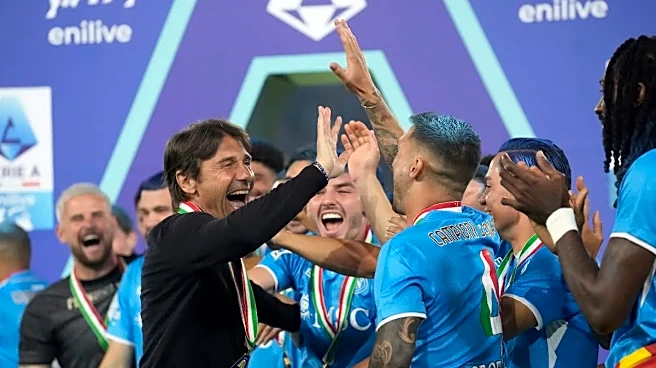
The traditional structure of European football is under threat, and according to Napoli's eccentric and visionary owner, Aurelio De Laurentiis, the sport is facing an existential crisis. Speaking from his Beverly Hills residence this Easter Sunday to The Athletic, the 76-year-old Italian movie mogul outlined a drastic manifesto to overhaul the beautiful game. His primary concern? The dwindling attention span of modern audiences and the outdated mechanics of the sport itself.
"Soccer will lose the younger generation," De Laurentiis declares, pinpointing the core demographic issue driving his push for revolutionary changes.
The Attention Span Crisis & The "FIFA" Generation
De Laurentiis believes that the current pacing of the game is entirely incompatible with the digital age. He is particularly
critical of the prolonged downtime during matches, taking aim at VAR delays and the traditional half-time interval.
"The matches are too long," he shrugs. To illustrate his point, he uses the viewing habits of his own family as a prime case study of where football is losing its grip. "Imagine the stupidity!" he says regarding the mandatory 15-minute half-time break. "You think my grandchild of six years old, who knows everything (about football) because he plays with the PlayStation. he will escape. and you think you will recoup him after 15 minutes? Never! Because he goes to his room. He starts to play FIFA. "
While he acknowledges that the live stadium atmosphere still captivates younger demographics, the Napoli president warns that the television product is failing. Children, he argues, "do not have the patience to see a very slow-paced match on television. "
He poses a blunt, rhetorical question regarding the current viewer experience: "If you watch a match on TV, especially if it is a terrible match what do they do?"
To combat viewer fatigue and eliminate time-wasting tactics, De Laurentiis proposes a seismic shift in how the sport's clock is managed. He wants to transition from the traditional 90-minute format to a condensed, action-packed structure.
"Number one: I will reduce from 45 minutes each (half) to 25 minutes," he states.
In this proposed 50-minute game, the match would strictly track actual in-play time. The clock would stop whenever the ball goes out of bounds or during an injury, effectively removing the reliance on match officials to calculate arbitrary stoppage minutes at the end of each half.
Eradicating Play-Acting and the "Sin-Bin" Solution
Furthermore, the Napoli owner wants to drastically overhaul on-field discipline to eradicate simulation and diving tactics that heavily contribute to the "slow-paced" nature of the game he despises.
"But also you cannot stay down on the field and play around like an actor!" he moans. Feigning an injury to prove his point, he adds: "AGHHHH! NO you will go OUT! What I will do also. I will never use a red card and a yellow card. "
Instead of the traditional card system that leaves teams permanently disadvantaged or players walking a tightrope without immediate consequence, De Laurentiis advocates for a dynamic "sin-bin" concept commonly seen in rugby or ice hockey.
"I would say 'YOU - get out for five minutes (for a yellow card)! ' And 'YOU - get out for 20 minutes for a red card! '"
Rebuilding the Super League: A Democratic €10 Billion Vision
While the on-field changes are radical, the second part of De Laurentiis's master plan targets the financial architecture of European football. Addressing the controversial European Super League ruling, he acknowledges that the initial closed-shop format was flawed, but believes the underlying financial necessity remains urgent.
"The Super League was a wrong move, which however brought about this change," he explains. "Now we need to do some serious thinking. " De Laurentiis argues that the current continental formats simply do not reward the massive investments made by club owners. "The system doesn't work anymore. The Champions and Europa League don't generate sufficient income for the clubs to justify participating in it," he says.
Instead of a closed breakaway, he envisions a highly lucrative, merit-based continental tier that completely bypasses UEFA's current structures. "We create a European league with a democratic system of entry, based on what teams achieve in their domestic competitions. I have examined a project ready to bring €10bn to the European game, but we need willingness and total independence. "
Taking on UEFA and FIFA: The Player Insurance Battle
De Laurentiis's push for total club independence also extends to international duty. He launched a scathing attack on FIFA and UEFA regarding the lack of financial protection for clubs when their star assets are injured during national team breaks.
"If a player is out for a month, they should pay you a certain amount of money. If he cannot play for a year, they should give you the money to let you buy a player of the same level," the Napoli chief demanded. "If they want our players, they must pay for them. If a yearly salary is 10 million, if they have the players for a month, they must give me a million. Why should I give them for free? They are my property, not theirs. "
Whether the sport's governing bodies will ever entertain such revolutionary concepts remains to be seen. However, as the digital landscape evolves and the financial stakes skyrocket, the Napoli owner has made one thing clear: if football refuses to adapt its formatting and economic structures, it risks alienating the very audience and investors required to sustain its future.