
/images/ppid_a911dc6a-image-177066504785467952.webp)

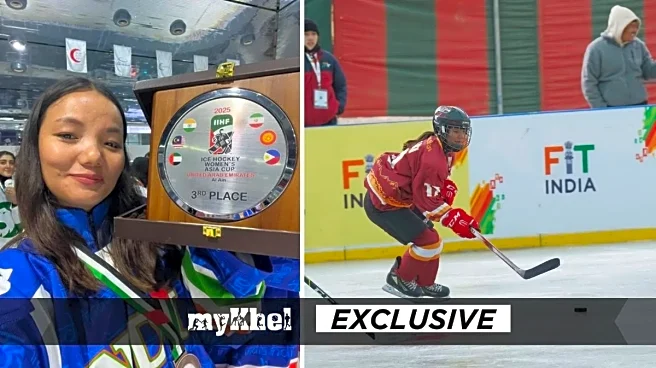
Long before women's ice hockey found space in India's sporting conversation, a small group of girls in Ladakh were already playing the sport - often without equipment, exposure, or a clear pathway ahead.
Padma Chorol belongs to that first generation. As one of the earliest women to represent India in ice hockey, she has lived through the sport's formative years, when simply stepping onto the ice as a woman was an act of persistence rather than opportunity.
On Day 1 of the ice-hockey competition at the Khelo India Winter Games 2026, Padma once again underlined her importance to that journey, scoring a hat-trick in Ladakh's emphatic 19-1 win over minnows Telangana.
Now the assistant captain of the Ladakh side and a senior member of the Indian women's
national team since its formation in 2016, she represents continuity between the sport's earliest struggles and its present ambitions.
In an interaction with myKhel, Padma spoke at length about what it meant to be among the first women ice hockey players in the country - starting out at a time when there was no women's team, no structured competition, and little awareness that Indian women even played the sport.
Early National Team Days: Learning at the Deep End
When the Indian women's national ice hockey team was first formed in 2016, opportunities came quickly, but preparation lagged behind. Players, who could navigate on the ice rinks and do the basics right, were selected to represent the country without any real exposure to international conditions, competition levels, or infrastructure.
Padma explained that simply being selected for the national team felt overwhelming, but the realities of international ice hockey soon set in. Talking about the early days of ice hockey in the country, Padma said, "When the team was formed for the first time in 2016, we didn't really have an idea about international ice hockey. Suddenly, we were selected for the national team. Representing India itself was a very big thing for us, but we were not prepared at all. "
India's first international assignment took place in Chinese Taipei, where the team encountered artificial ice for the first time - something vastly different from what players were used to in Ladakh.
"We practise on natural ice for only about two months in a year. Internationally, we had to play on artificial ice, which is much smoother and faster. When we fell, it was difficult even to stand properly. Controlling the puck was a big challenge for us," Padma added.
Playing Without Equipment, Competing Without Experience
Beyond the unfamiliar playing surface, a lack of basic equipment made the initial years especially difficult. At a time when women's ice hockey was still finding recognition in India, access to proper gear was extremely limited.
Padma recalled that many players, including herself, had no option but to borrow equipment from male players. "We didn't even have proper equipment. We used to borrow skates and sticks from the boys. I was playing with skates that were too big and sticks that were longer than required. The first year was very difficult for all of us. "
Despite these obstacles, the team continued to compete, using each match as a learning experience rather than focusing solely on results.
First Win and the Start of Progress
The turning point came not in medals, but in belief. After initial heavy defeats, the Indian team gradually began to understand the pace and structure of international ice hockey.
Padma pointed to India's first international win as a moment that changed the team's mindset. "The next time we went to play internationally, we could already see improvement. We got our first win against Malaysia. That win showed us that we could actually compete at this level. "
That belief translated into a historic bronze medal at the IIHF Women's Challenge Cup of Asia Division I in 2019, marking India's first major achievement in women's ice hockey.
"In 2019, we won the bronze medal, but at that time, not many people in India even knew about it. Many didn't know that ice hockey is played in India, or that women play this sport. "
From Limited Recognition to Nationwide Support
The years following the 2019 bronze medal were disrupted by the Covid-19 pandemic, which limited international competition and training opportunities. India narrowly missed another podium finish before finally returning to the medals in 2025. At the IIHF Women's Asia Cup in the United Arab Emirates, the team secured a historic bronze medal between May 31 and June 6, 2025.
This time, the response was very different. "When we won the bronze medal again in 2025, the whole of India supported us. People across the country were celebrating the win. That change-from nobody knowing about us to nationwide support-was very special. "
For Padma, the shift in recognition reflects how awareness of the sport has grown alongside performance.
Family Influence and Entry into the Sport
Padma's involvement in ice hockey predates the formation of women's teams. She began skating at the age of 10, influenced heavily by her family background.
Her elder brother, Navang Stupdan, was an ice hockey player, while her younger brother, Tsiang Dorje, currently represents the Army ice hockey team. With no women's team available at the time, Padma initially focused on speed skating.
"Earlier, there was no women's ice hockey team. Only the men used to play. I started with skating because my brothers were involved in ice hockey. Later, when the women's team was formed, most girls shifted to ice hockey. "
Expanding Opportunities for Girls in Ladakh
The situation began to change in 2015 with the formation of the Ladakh Women's Ice Hockey Foundation, which aimed to introduce more girls to the sport and challenge existing perceptions.
Padma said the foundation played a crucial role in changing mindsets. "Earlier, this sport was considered only for boys. We started the foundation so that girls could also get opportunities. This sport is not only for boys-it is for girls as well. "
The results are now visible at national platforms like Khelo India Winter Games, where multiple women's teams are competing regularly. "Now you can see seven women's teams at Khelo India Winter Games 2026. That itself shows how many girls are coming forward to play. "
Equipment Costs and the Reality of Playing the Sport
Despite progress in participation and performance, financial challenges remain a constant concern. Ice hockey is an expensive sport, and replacing equipment is not easy.
Padma explained the cost involved at the professional level. "A professional pair of skates can cost around ₹1 lakh. A stick costs between ₹20,000 and ₹25,000, and it breaks very easily. I have already changed four or five sticks. "
She also recalled a significant moment in 2018, when an Olympian ice hockey player, Hayley Wickenheiser, helped Indian women access proper equipment during a visit to Canada. Hayley Wickenheiser is a former Canadian ice hockey star, widely regarded as the greatest female player of all time. Wickenheiser, a four-time Olympic gold medallist, currently serves as an assistant general manager with the NHL side Toronto Maple Leafs.
"In 2018, an Olympian Hayley Wickenheiser took us to Canada, where we finally got proper gear - helmets, chest guards, skates. I am still using that equipment. "
Leagues, Infrastructure and International Qualification
According to Padma, the biggest change in recent years has been the emergence of domestic leagues and improved infrastructure. She explained that qualifying for the World Championships now depends on meeting specific criteria, including league matches and structured training.
"There is a criteria to qualify for the World Championships. Players need league exposure, goalkeeping coaching, and regular matches. Earlier, we didn't have these opportunities. "
She credited Khelo India and domestic leagues in Dehradun for providing that match exposure. "Because we are playing leagues now, I am confident that we can qualify for the World Championships. This is a big step forward. "
Infrastructure development has also contributed, with artificial ice rinks now available in Ladakh, Dehradun and Pune.
Role of Khelo India and Institutional Support
Padma emphasised the importance of platforms like Khelo India Winter Games in sustaining women's ice hockey, particularly at the grassroots and state levels. "Khelo India tournaments are very important for us. Even if a team does not reach the national level, the certificate and exposure matter a lot. Players train harder knowing that this platform can open doors. "
She acknowledged the support provided by the Sports Authority of India and the Ladakh UT administration in helping the sport grow.
Looking Ahead: World Championship Goals
Currently competing in the fourth international division, the Indian women's ice hockey team has its sights set firmly on qualifying for the World Championships in 2027.
"Our ultimate goal is to play in the World Championships. If we continue to get support from associations, federations and local bodies, it won't take long to move from bronze to silver and then to gold. "
As the Khelo India Winter Games 2026 continue in Leh, Padma Chorol's journey offers a clear picture of how Indian women's ice hockey has evolved-step by step-through opportunity, exposure and sustained competition.



/images/ppid_a911dc6a-image-177060802130265096.webp)