
/images/ppid_59c68470-image-176985502641660530.webp)

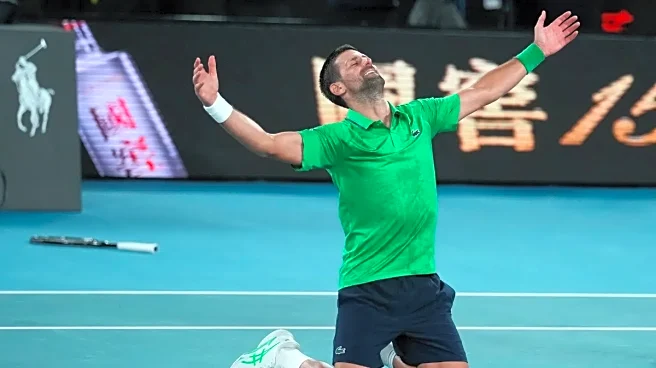
On Sunday, tennis will pause and take a deep breath. One man will try to stretch history beyond what once felt humanly possible. That man is Novak Djokovic.
The stage is the Australian Open, the court is Melbourne Park, and the prize is monumental: a record-extending 25th Grand Slam title and an astonishing 11th Australian Open crown.
Djokovic has already turned Melbourne into his personal kingdom. Ten titles. Ten finals. From 2008 to 2023, this tournament has repeatedly bent to his will: 2008, 2011, 2012, 2013, 2015, 2016, 2019, 2020, 2021 and 2023. No man (men's singles) in history has owned one Grand Slam the way Djokovic owns the Australian Open.
Yet, on the eve of this final, the numbers tell only half the story. What makes this moment extraordinary
is not dominance alone, but survival.
At 38, Djokovic has reached his 11th Australian Open final and his 38th Grand Slam final overall. No tennis player has ever matched this kind of longevity. While generations have come and gone, Djokovic remains. He bends time, resets expectations, and rewrites the definition of greatness.
This run to the final did not follow a smooth, familiar script. For once, Djokovic arrived as an underdog. His mere presence in the semi-finals owed something to fortune, something rarely associated with him. There were doubts, real doubts, about his body, his rhythm, and his sharpness.
Then came the semi-final against Jannik Sinner, the two-time defending champion and second seed. Djokovic fell behind, two sets to one. The stadium sensed the end. But champions do not exit quietly. In the early hours of Saturday morning, Djokovic summoned one of the greatest comebacks of his career, winning 3-6, 6-3, 4-6, 6-4, 6-4. It was not just a win; it was a reminder. When pressure peaks, Djokovic grows calmer, sharper, and stronger.
That victory completed one of the great semi-final days in Australian Open history, as the tournament finally burst into life with back-to-back five-set epics. And now, fittingly, the final brings a rivalry that defines tennis's present and future.
Across the net stands Carlos Alcaraz. For Djokovic, it is a chance to become the oldest men's Grand Slam champion in history and move alone to 25 majors, already tied with Margaret Court on 24 and ahead of Rafael Nadal and Roger Federer.
Their rivalry already carries weight. Djokovic defeated Alcaraz in the Australian Open quarter-finals last year. Alcaraz responded by beating him in the US Open semi-finals and lifting the title. Sunday is not just a final; it is a generational checkpoint.
To understand Djokovic's journey, one must remember where it began. When he won his first Grand Slam here in 2008, Roger Federer already had 12 majors and Rafael Nadal ruled clay.
Fans were divided into camps, and Djokovic was the outsider. Even after that breakthrough, he waited until 2011 for his next major. But he never hid his ambition. He wanted to be the greatest of all time.
He has kept that promise.
Djokovic outlasted Federer. He outlasted Nadal. He endured criticism, pressure, and doubt. And now, as the last remaining member of the "Big Three," he stands alone, still winning, still fighting, still rewriting records.
Sunday night will make history one way or the other. Either Djokovic lifts his 11th Australian Open trophy and claims Grand Slam number 25, or Alcaraz announces a new era with his 7th career Grand Slam. But one truth is already settled.
Melbourne Park has a king. And for more than a decade, his name has been Novak Djokovic.





/images/ppid_a911dc6a-image-176985552435688483.webp)

/images/ppid_a911dc6a-image-176985555415027350.webp)
/images/ppid_a911dc6a-image-176985552885584518.webp)

![[WATCH] T20 World Cup 2026: Yuzvendra Chahal reveals his pick for Player of the Tournament](https://glance-mob.glance-cdn.com/public/cardpress/binge-magazine-card-generation/spaces/IN/en/crictracker-spaces/images/ppid_49c02804-image-176985502767924357.webp)