
/images/ppid_a911dc6a-image-177074805788931893.webp)
/images/ppid_a911dc6a-image-177074817751365859.webp)
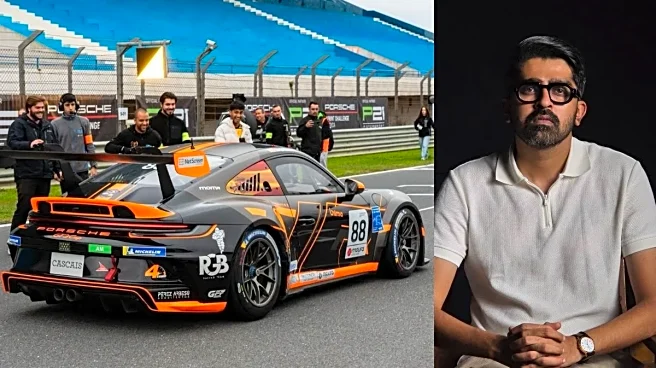
As 2025 comes to a close, one of the most under-recognised shifts within India's mobility and engineering ecosystem has been the growing seriousness with which motorsport is being viewed not as spectacle, but as a skills-driven, applied engineering pathway.
What changed this year was not noise or visibility alone, but intent. Motorsport began moving closer to the mainstream by aligning itself with talent development, systems thinking, and real-world engineering relevance.
This shift must be understood against the backdrop of India's technical education landscape. According to the All India Council for Technical Education (AICTE), India had over 1.6 million approved engineering seats for the academic year 2024-25, with enrolments consistently exceeding
1.2 million students annually across disciplines.
This places India among the world's largest producers of engineering graduates. Historically, however, only a small fraction of this talent found pathways into highly specialised, performance-led global industries such as motorsport and advanced automotive engineering. In 2025, early signals emerged that this gap is beginning to narrow.
One reason is the changing relevance of motorsport itself. As India's automotive sector accelerates its shift toward electrification and software-driven vehicles, motorsport-derived skills have moved from niche to necessary.
Data from the Ministry of Road Transport and Highways' VAHAN dashboard shows that India recorded over 1.9 million electric vehicle registrations in FY 2024-25, spanning two-wheelers, passenger vehicles, and commercial segments. This rapid adoption has intensified demand for expertise in telemetry, data analytics, thermal management, energy optimisation, and systems integration areas, where motorsport training has long been considered best-in-class.
2025 also marked a noticeable evolution in how motorsport was communicated. The narrative moved away from machines and lap times to include engineers, data analysts, pit crews, and preparation processes. This mattered because credibility increasingly comes from transparency.
By making the ecosystem intelligible rather than exclusive, motorsport became more accessible to technically inclined audiences who may never have followed racing previously but recognise its relevance to engineering excellence.
From a training and capability-building perspective, the year reinforced the importance of immersion. Global motorsport development frameworks governed by bodies such as the Federation Internationale de l'Automobile (FIA) have consistently highlighted that exposure to live racing environments where decisions have immediate consequences accelerates learning far beyond classroom or simulation-only models. In 2025, this thinking gained traction among Indian aspirants seeking international benchmarks and real-world validation of skills.
Another important signal this year was the diversity of aspiring motorsport professionals. The talent pool now spans school students, undergraduate engineers, working professionals, and Indian students pursuing higher education overseas. This diversity mirrors the reality of modern motorsport engineering, which is inherently multidisciplinary.
Race-weekend challenges rarely arrive in silos; they demand collaboration across mechanical systems, electronics, data, and human decision-making. Teams with varied perspectives tend to resolve problems faster and more effectively, a principle equally relevant to advanced automotive and mobility sectors.
The growing overlap between motorsport and broader mobility narratives also became clearer in 2025.
As electric vehicles, performance analytics, and software-defined platforms enter mainstream automotive discourse, motorsport increasingly functions as a high-pressure testbed rather than a parallel universe. Skills honed in racing environments are directly transferable to electric mobility R&D, battery systems engineering, and high-performance vehicle development.
Looking ahead to 2026, several expectations stand out.

/images/ppid_a911dc6a-image-177075157301840277.webp)


/images/ppid_59c68470-image-177075003745079834.webp)

/images/ppid_59c68470-image-177075003659953644.webp)