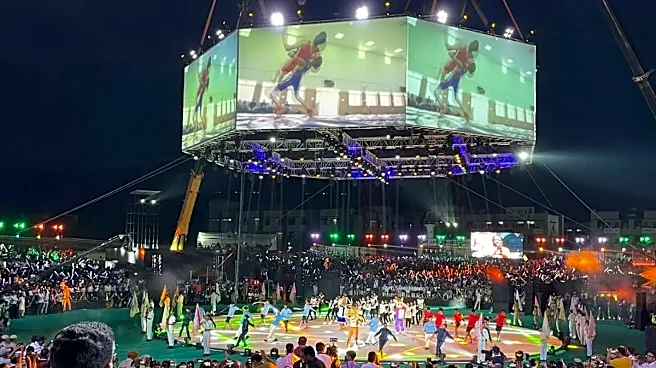



The Union Cabinet's approval of a ₹36,441-crore investment in Indian sports is far more than just a budget announcement. It represents a structural overhaul of the country's sporting ecosystem-right from identifying a talented child in a remote village to preparing an Olympic medallist.
Spread over the next five years (2026-31), the revamped Khelo India Scheme and enhanced funding for National Sports Federations (NSFs) are designed to transform India from a nation that occasionally produces champions into one that consistently competes with the world's sporting powers.
With India preparing bids for the 2030 Commonwealth Games and the 2036 Olympic and Paralympic Games, the timing of the announcement is no coincidence.
What Has the Government Approved?
The Cabinet has sanctioned
two major schemes:
- ₹29,054 crore for the revamped Khelo India Scheme
- ₹7,387 crore for the Assistance to National Sports Federations (ANSF)
Together, they amount to ₹36,441 crore, making it the biggest investment in sports development since Independence.
The government says the new Khelo India outlay is nearly eight times larger than the previous version of the scheme.
Why Is This Such a Big Deal?
For years, Indian sports has suffered from three major problems:
- Talent often goes unnoticed until it is too late.
- Many athletes struggle financially before reaching the elite level.
- Sports federations lack the resources to consistently provide world-class coaching, exposure and infrastructure.
The new policy attempts to address all three simultaneously.
Instead of investing only in elite athletes, the government wants to create a much wider talent pipeline while also strengthening the organisations responsible for producing champions.
More Athletes Will Receive Government Support
Currently, around 2,800 athletes are part of the Khelo India programme and receive financial assistance for training, nutrition, coaching and competition.
One of the biggest changes is the introduction of Emerging Khelo India Athletes (E-KIA).
According to the government, this new category will expand the structured athlete development programme by nearly ten times, bringing thousands of additional youngsters under professional coaching and long-term monitoring.
That means promising athletes who previously may have missed out on support could now receive scientific training, nutrition, physiotherapy and international exposure much earlier in their careers.
Talent Identification Will Begin in Schools
Perhaps the most significant long-term reform is the creation of two new initiatives:
Khelo India Feeder Schools (KIFS)
Schools will become the first point for identifying sporting talent.
Rather than waiting for athletes to emerge through state competitions, talented children can now be spotted during their school years and guided into specialised training programmes.
Khelo India Utkrishta Vidyalayas (KIUV)
These institutions aim to integrate academics and elite sport, allowing children to pursue education without compromising on high-performance training.
Countries such as Australia, China and Japan have long relied on similar school-based sporting systems.
India is now attempting to build one of its own.
A Bigger Role for Sports Science
The revamped scheme places greater emphasis on professional athlete management.
- The government plans to create a nationwide system involving:
- High Performance Directors
- High Performance Managers
- Talent Scouts
- Zonal Committees
These professionals will monitor athletes throughout their development rather than leaving talent identification solely to competitions.
Sports science, nutrition, recovery, biomechanics and performance analytics are expected to play a much larger role in athlete preparation.
One Digital Platform for Indian Sport
One of the more futuristic aspects of the policy is the creation of a Unified Digital Sports Platform.
Instead of athlete records being maintained separately by different federations and institutions, the new platform will integrate:
- athlete databases
- competition results
- coaching records
- infrastructure mapping
- funding details
- talent assessments
Fit India participation
The objective is to make athlete development more transparent while allowing administrators to take data-driven decisions.
National Sports Federations Get a Massive Financial Boost
The government's second major announcement concerns the National Sports Federations. For the next five years, ₹7,387 crore has been allocated under the Assistance to National Sports Federations scheme.
This is a substantial increase considering the annual allocation for 2026-27 under the previous structure stood at ₹425 crore.
The additional funding can be used for:
- hiring foreign coaches
- overseas exposure trips
- sports science support
- modern training equipment
- national coaching camps
- domestic competitions
- participation in international tournaments
For Olympic sports like athletics, boxing, wrestling, shooting, badminton, weightlifting and archery, the enhanced funding could significantly improve athlete preparation.
Greater Focus on Women and Para Sport
The policy also places special emphasis on expanding opportunities for:
- women athletes
- para athletes
- indigenous sports
This reflects India's growing success in para sport and the government's intention to create a more inclusive sporting ecosystem.
It also aligns with India's ambition of becoming a leading sporting nation rather than focusing only on Olympic disciplines.
More International Events in India
The revamped Khelo India framework also supports the organisation of major international competitions in India.
This includes assistance for:
- National Games
- International Championships
- Multi-sport events
Hosting more world-class competitions would allow Indian athletes to compete against elite international opposition without travelling abroad while simultaneously strengthening India's credentials as a future host of the Commonwealth Games and Olympics.
What Does This Mean for Athletes?
For aspiring athletes, the changes could be transformational. A promising child identified through the new school network could now progress through Khelo India with access to structured coaching, sports science, scholarships, high-performance centres and international competition.
Elite athletes, meanwhile, stand to benefit from stronger federations, better coaching support and improved exposure.
What Does It Mean for India's Olympic Dream?
The announcement is closely linked to India's long-term ambitions. The country is aggressively pursuing the hosting rights for the 2036 Olympic and Paralympic Games and has also expressed interest in staging the 2030 Commonwealth Games.
Hosting such events requires more than stadiums-it demands a robust sporting ecosystem capable of producing champions across multiple disciplines.
The ₹36,441-crore investment is designed to build exactly that.
If implemented effectively, it could fundamentally reshape Indian sport over the next decade, creating a larger talent pool, stronger federations and a high-performance system capable of competing consistently with the world's sporting powers.
Rather than being remembered as just another budget announcement, the revamped Khelo India programme could become the blueprint for India's sporting future.




/images/ppid_59c68470-image-178524005594570834.webp)