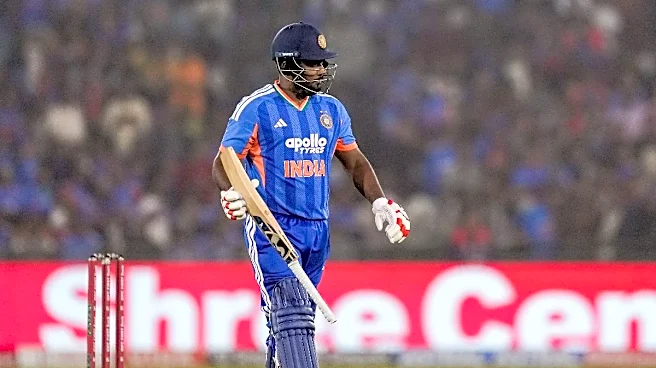

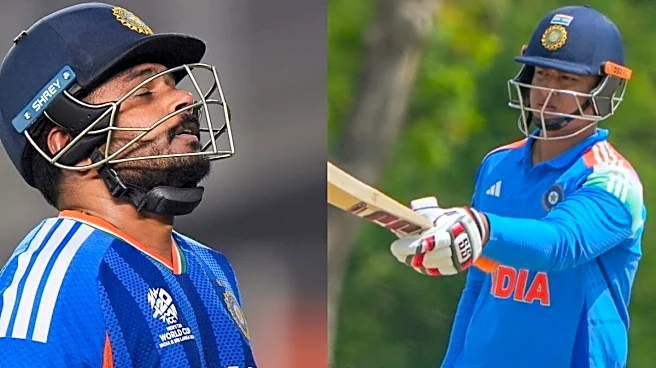
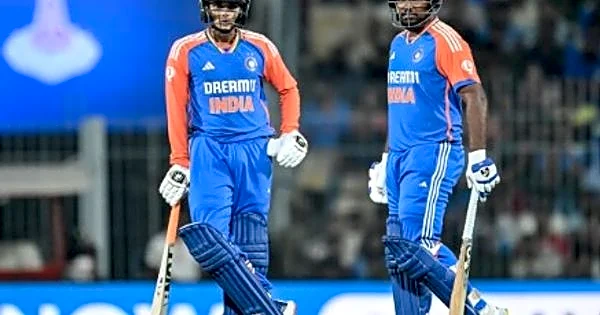


Just four months after producing one of the greatest ICC tournament campaigns by an Indian batter, Sanju Samson finds himself battling an alarming slump in T20 internationals. The wicketkeeper-batter's struggles continued in the first T20I against England on Tuesday, when he managed just one run before falling to Saqib Mahmood, extending a worrying sequence of low scores.
Samson's dismissal at Chester-le-Street once again raised questions over the dramatic contrast between his World Cup heroics and his recent bilateral performances. The right-hander, who was India's standout batter during their triumphant ICC Men's T20 World Cup 2026 campaign, has now failed to reach double figures in each of his last three T20I innings, with two of those ending
in first-ball ducks.
England struck early after Saqib Mahmood removed Samson for just one off seven deliveries. Attempting to drive a full ball outside off stump, Samson hit it firmly but couldn't keep it down. Tom Banton produced a superb diving catch at backward point to send the Indian opener back.
The dismissal added another disappointing entry to Samson's recent record. His last three T20I innings now read 5 (4), 0 (1), and 1 (7), underlining the prolonged struggle to rediscover the rhythm that made him one of the stars of the World Cup.
Sanju Samson Recent T20I Form
Samson's last five T20I innings perfectly capture the inconsistency that has often defined his international career.
His most recent innings came against England, where he scored just 1 off 7 balls before edging his drive to backward point. Before that, he suffered a golden duck against Ireland after being trapped lbw on the first ball, having earlier managed only 5 off 4 balls in the same series.
Those scores stand in stark contrast to what preceded them. In the T20 World Cup semifinal against England, Samson blasted a breathtaking 89 off just 42 balls, striking at over 211 to power India into the final. He then repeated the feat in the title clash against New Zealand, smashing another match-winning 89, this time from 46 deliveries, to help India lift the World Cup trophy.
The sequence of scores - 89, 89, 5, 0 and 1 - highlights one of the sharpest swings in form seen from an Indian batter in recent times. From dominating the world's best attacks on cricket's biggest stage, Samson has struggled to survive the opening exchanges in bilateral cricket.
Downward Trend For Samson
Perhaps the most striking indicator of Samson's downturn is the dramatic fall in his scoring rate.
During India's victorious T20 World Cup campaign, Samson accumulated 321 runs at an astonishing strike rate of 199.37, emerging as one of the most destructive batters in the tournament. His fearless approach at the top allowed India to consistently dominate the power play, and he was instrumental in their run to the title.
Since the World Cup, however, that attacking intent has all but disappeared. Across his three bilateral T20I innings after the tournament, Samson has scored only 6 runs from 12 balls, giving him a strike rate of 50.00.
That marks a staggering decline of 149.37 strike-rate points compared to his World Cup campaign. Even before his latest dismissal against England, the drop had already become a talking point after consecutive first-ball ducks against Ireland.
More concerning than the numbers is the manner of the dismissals. Samson has barely spent time at the crease, denying himself any opportunity to build an innings or regain confidence. The aggressive strokeplay that dismantled bowling attacks during the World Cup has been replaced by brief stays ending before he can make an impact.
With India entering another important T20 cycle, the pressure is beginning to mount on the opener. While his World Cup exploits reaffirmed his ability to single-handedly win major matches, his recent returns have once again brought consistency into focus.
For Samson, the challenge now is not proving his talent-it is rediscovering the fearless, free-flowing approach that made him India's World Cup hero just months ago.
![[Watch] Sanju Samson meets fans in England ahead of 1st T20I, melts hearts with his kindness](https://glance-mob.glance-cdn.com/public/cardpress/binge-magazine-card-generation/spaces/IN/en/crictracker-spaces/images/ppid_49c02804-image-178283502333115326.webp)