
/images/ppid_a911dc6a-image-177105882330714950.webp)
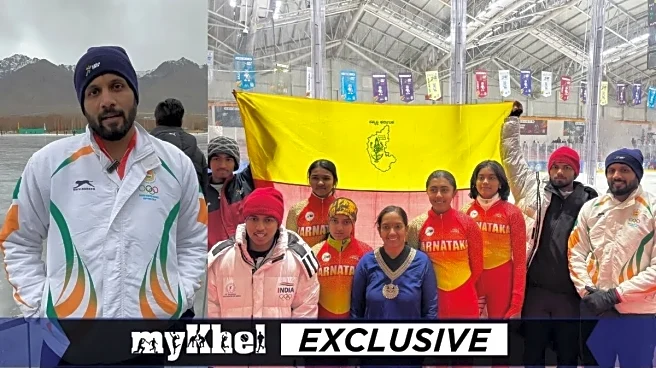
Leh (Ladakh): At an age when most athletes have long transitioned into full-time coaching or administration, Raghavendra Somayaji continues to compete at the highest domestic level, driven by habit, passion and an unyielding love for skating.
The 38-year-old from Bengaluru, a senior speed skater and short-track ice skater, has seen Indian skating evolve from a fringe pursuit to a slowly structured ecosystem-and his own journey mirrors that transformation.
At the Khelo India Winter Games 2026, Raghavendra was part of the Karnataka men's 3000m short-track relay team, which finished with a silver medal at the Nawang Dorjay Stobdan (NDS) Stadium. The result, however, came with a sense of what might have been. Karnataka were leading Haryana for most
of the race before losing gold by a fraction of a second in the closing stages.
Reflecting on the race in an interaction with myKhel, Raghavendra admitted that a momentary lapse proved decisive. "We lost the race in the last 60 odd meters, as we got complacent with the lead we had. But kudos to the Haryana team for making such a strong comeback, congratulations to them. It was a good race nevertheless," he said.
For Raghavendra, the silver was still a testament to longevity and discipline. His sporting roots lie firmly in roller skating, where he was once a national champion. Ice skating entered his career much later-almost two decades into competitive roller skating-after encouragement from his coach.
He recalled how his first exposure to ice skating came under challenging circumstances, with minimal preparation. "I was a national champion in roller skating and my coach suggested I try ice skating. Our first nationals were in Kolkata, and we trained on ice for just about a week before the competition. Even then, I managed to score two goals in my first national championship," he said.
The technical transition, he explained, was less daunting than expected for someone with a strong skating base. "There isn't a huge difference once you get used to both. If you already have control and balance from roller skating, adapting to ice doesn't take very long. "
Raghavendra began competing seriously in short-track ice skating around 2006, and over time, the Ice Skating Association of India (ISAI) started sending Indian skaters to international camps and competitions. "We were sent for world championships and training camps abroad, and slowly the performances started improving. In 2017, I was selected for the Asian Games and we did fairly well there," he recalled.
Coming from Karnataka, however, meant battling structural disadvantages. Ice rinks are scarce in India and largely concentrated in the north. "We are from Karnataka, where there is no ice and no cold weather. The first time I came to Ladakh, the temperature was around minus 15 degrees, while Bengaluru was at 25 degrees. That 40-degree difference and the altitude meant we had to rest for two days just to adjust," he said.
Despite these challenges, Raghavendra believes infrastructure has begun to improve in recent years. "Earlier, facilities were limited to places like Shimla and Ladakh. Now we have an international rink in Dehradun, and another one is coming up in Delhi. Our ISAI president Amitabh (Sharma) ji is working very hard to develop facilities across the country. "
Still, he remains frank about the limited government support available to athletes like him. "From the government side, support is very minimal. The association helps us a lot, but if we are going for national or world championships, most of the funding still comes from our own pockets," he said.
At KIWG 2026, Raghavendra also competed in the long-track 500m race at Guphuks Pond, but missed out on a podium finish as he couldn't give his 100 per cent. The setback, he revealed, was linked to an old injury.
"I'm still nursing a shoulder injury that I picked up during the nationals last year. It affected my performance, especially in long track," he said.
Even at 38, the fire to compete burns strong-a mindset he attributes to habit and mentorship. "Once you get into sport competitively, it becomes an addiction. I wanted to retire almost 10 years ago, but my coach kept pushing me. That's why I'm still trying to stay fit and compete," he said.
Now also a coach and academy owner in Karnataka, Raghavendra is optimistic about the next generation of Indian skaters. "Our federation is sending skaters abroad for training, and camps in Dehradun have helped a lot. Even without ice in Karnataka, roller skating gives a strong foundation. I genuinely believe Indian athletes can be competitive at world championships and Youth Olympics in the coming years. "
For Raghavendra Somayaji, medals may come and go, but the journey - across roller rinks and frozen tracks-continues with undiminished resolve.


/images/ppid_a911dc6a-image-177105956122469810.webp)

/images/ppid_a911dc6a-image-177105952513238219.webp)
/images/ppid_a911dc6a-image-177105952399574919.webp)