
/images/ppid_59c68470-image-17754625379708585.webp)

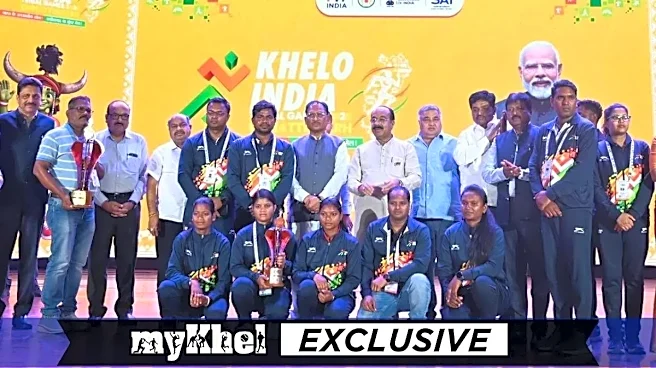
As the inaugural edition of the Khelo India Tribal Games concluded in Chhattisgarh's capital Raipur, Deputy Director General (DDG) of Khelo India, Mayank Srivastava, termed the event a great success and a milestone for both the state and the Khelo India programme.
KITG 2026 featured participation from around 3,800 athletes representing 30 states and Union Territories, competing across nine disciplines. The programme included seven competitive sports-archery, athletics, football, hockey, swimming, weightlifting and wrestling - along with two demonstration sports, mallakhamb and kabaddi, making it the largest multi-sport events dedicated to tribal athletes in the country.
Speaking to myKhel, Srivastava - who also happens to be an IPS Officer from
Chhattisgarh cadre - reflected on the scale and execution of the first edition of the Games, noting that the event demonstrated Chhattisgarh's capability to organise a multi-discipline national competition.
He also pointed to the involvement of local administration and public participation, while highlighting the significance of taking the Games to regions like Bastar and Surguja, where a large number of athletes come from. These areas also badly impacted by Naxalism.
"A Very Satisfying Experience on All Fronts"
Hosting a multi-discipline national event of this scale for the first time was always going to be a test for Chhattisgarh. But for Shrivastava, the outcome exceeded expectations. He said, "Chhattisgarh has hosted a game of this stature for the first time. and it's been a very satisfying experience on all fronts. "
He credited the seamless coordination between government officials, organisers, and local stakeholders for the smooth execution. "Considering the involvement of government people, the officers. and the way they organised everything, including vendors - it has been excellent. "
Beyond logistics, what stood out most was the response from the public. "I was delighted to see such a good crowd for a hockey match featuring Chhattisgarh. That was a very delightful thing. "
Taking Sport to the Heart of Tribal India
One of the defining aspects of KITG 2026 was its decentralised hosting model, with events spread across Raipur, Jagdalpur, and Ambikapur. Shrivastava explained that this was a deliberate decision. "The idea was to take the Games to tribal-majority regions like Bastar and Surguja," he added further.
Athletics being held in Jagdalpur, for instance, was both a logistical and symbolic choice. "The competition managers felt the Bastar track was better, and also we wanted to take the Games to those areas. "
The move ensured that sport reached communities that are often on the margins of mainstream sporting infrastructure.
"Khelo India Is Built Around Grassroots"
Responding to questions about long-term infrastructure, Srivastava emphasised that the Khelo India programme is fundamentally designed to address grassroots gaps. "The whole philosophy of Khelo India is to address grassroots athletes' issues - provide institutions, academies, accredited centres," he added further.
Pointing to the existing investments in the state, he claimed, "There is already a Khelo India State Centre of Excellence in Bilaspur. with sports science facilities, strength and conditioning, nutrition support - all funded by the Government of India. "
For him, KITG is not an isolated event, but part of a larger ecosystem being built.
Bastar's Story: From Conflict to Opportunity
Perhaps the most powerful aspect of Srivastava's reflections came when he spoke about Bastar - a region long affected by Maoist insurgency.
Interacting with athletes, particularly the women's football team from Bastar, left a deep impression. "The stories they told were very inspiring. most of the girls come from that region. "
He described how sport is now emerging as a pathway for transformation. "Earlier, because of Naxalism, many young people were drawn into violence. Now they will have something creative to do instead of picking up guns. "
In one line, he summed up the shift, "Now the Bastar region will realise its true potential - and its potential is limitless. "
Untapped Talent Waiting for Opportunity
Srivastava believes tribal communities possess natural athletic advantages that can be harnessed with the right support. "They are tailor-made for certain sports - middle and long-distance running, race walking, even gymnastics and diving. "
While he acknowledged this as an intuitive observation, the performances at KITG reinforced the belief that India's next generation of athletes could emerge from these regions. "Very soon, we will see national-level talent from Bastar," he claimed.
A Model Host for the Future
Given the success of the inaugural edition, Chhattisgarh has positioned itself as a strong candidate to host future editions of the Tribal Games. "There is a very high possibility that it will continue to be organised in Chhattisgarh," he hinted.
Srivastava noted that both the hosting experience and the state's demographic alignment with the purpose of the Games make it an ideal venue. "We have taken the Games to tribal-majority areas. and the overall experience has been very good," he continued.
Whether the event becomes annual or biannual is yet to be finalised, but continuity appears likely.

/images/ppid_59c68470-image-177564252853167528.webp)




/images/ppid_59c68470-image-177539253707972278.webp)