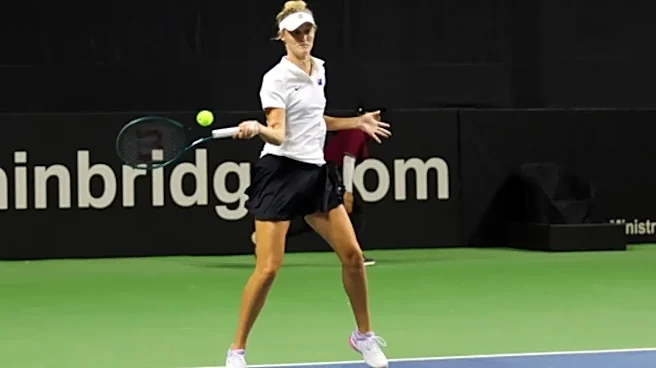




Fresh off her second US Open doubles title in 2025, Erin Routliffe has arrived in New Delhi not simply as a Grand Slam champion, but as the experienced core of the New Zealand Billie Jean King Cup squad. For a player who has reached the top of the doubles circuit - becoming the first New Zealander to hold the WTA doubles world No. 1 ranking,
returning to national duty remains a firm annual commitment rather than an optional appearance.Speaking in New Delhi during the Asia/Oceania Group I ties, Routliffe reinforced the importance of the team environment despite the demands of the professional tour. "It's something I prioritize, you know, playing Billie Jean King Cup every year. It's awesome to have a team around and to represent New Zealand.
So, just excited to be here and to compete hard," she said in conversation with myKhel.
A Champion's Commitment to National Colours
Routliffe's presence brings a level of stability to a New Zealand side competing against strong regional opposition. While her recent success on the WTA circuit - including partnerships alongside Canada's Gabriela Dabrowski - has established her as one of the most reliable doubles players in the world, her approach to the Billie Jean King Cup reflects a clear shift in focus toward collective performance.
The transition from tour-level competition to national team tennis, she explained, remains energising rather than disruptive. The opportunity to compete within a team structure adds a different dimension to her season, particularly in events where national pride outweighs individual milestones.
Adaptability Remains Central to Her Doubles Philosophy
Although Routliffe is widely associated with her successful partnership with Gabriela Dabrowski - a pairing that has delivered multiple WTA titles - her role in New Delhi has required flexibility with changing combinations, including partnerships with teammates such as Monique Barry.
For Routliffe, that adjustment reflects the broader demands of elite doubles competition. "It's always good, I think, playing doubles with a lot of people. You have to play with a lot of different players to be a high doubles player," she explained. "And yeah, I think to be the best, you've got to be able to play with everyone. "
That adaptability remains a defining element of her career trajectory, particularly in team competitions where lineup decisions often vary based on matchups and tactical needs.
Backing the Next Generation: A Close Eye on Aishi Das
Beyond her on-court responsibilities, Routliffe has taken interest in New Zealand's emerging talents, including rising junior Aishi Das, who continues to attract attention across developmental circuits.
Having watched Das play live for the first time during the tournament, Routliffe expressed confidence in the youngster's potential and long-term growth.
"I really like Aishi. She's a great competitor," Routliffe said. "Watching her play yesterday was the first time I'd ever seen her play live. So that was awesome and I'm excited to go see her again. She is inspiring a lot of people in New Zealand as one of our upcoming juniors, and she has a great game - a big game. "
Her involvement in supporting younger players reflects a leadership role that extends beyond match performance, positioning her as both contributor and mentor within the national setup.
Facing Strong Opposition in a Competitive Field
The level of competition in New Delhi has demanded consistent execution across all formats, with New Zealand facing physically and tactically demanding ties. Among the standout opponents has been Team India, whom Routliffe acknowledged as one of the strongest sides in the group.
"Yeah, a really strong team,"she said when assessing the challenge. "We're playing them now, so it'll be exciting to see how our singles girls match up and hopefully we can get out for doubles. But yeah, everyone's really, really strong. So we're excited - especially to play in front of a crowd. "
The emphasis on crowd engagement highlights another key aspect of team competitions - the shift from individual tour settings to atmosphere-driven national contests.
Resilience as a Long-Term Mindset
For Routliffe, success at the elite level has been shaped by persistence rather than uninterrupted progress. Her advice to younger players reflects the realities of professional tennis, where setbacks form part of long-term development.
"Just find your strengths and take the positives from everything," she said. "I think in tennis, you know, it's hard because you've got to lose a lot of points and lose a lot of matches, but you can always learn something. "
That outlook continues to shape her role within the New Zealand squad as they navigate a demanding schedule against Korea, Mongolia, and other regional contenders.
As New Zealand progresses through the Billie Jean King Cup campaign, Routliffe's presence represents more than just technical skill or ranking pedigree. Her experience, adaptability, and mentorship have positioned her as a stabilising influence within the squad.
For Routliffe, international team competition remains one of the defining arenas of her career - not simply because of results, but because of what it represents.
In New Delhi, amid a competitive field and shifting partnerships, her mission remains clear: contribute consistently, guide emerging players, and ensure that New Zealand continues to build depth for the future.
/images/ppid_a911dc6a-image-177613283412740580.webp)




/images/ppid_a911dc6a-image-177613102459053330.webp)



/images/ppid_a911dc6a-image-177612962951920468.webp)

/images/ppid_a911dc6a-image-177612762787784195.webp)