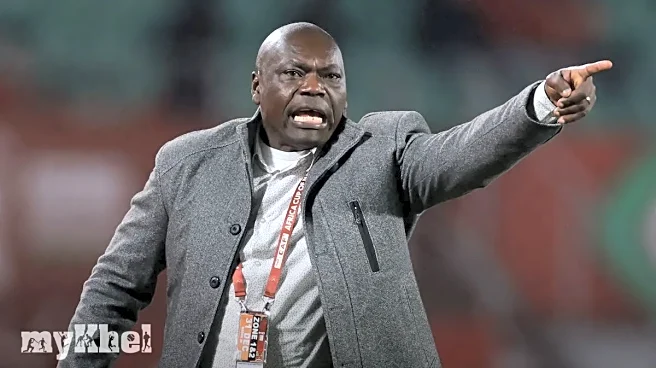

Morocco and Cameroon meet in a high‑stakes Africa Cup of Nations quarter-final on Friday in Rabat, with a semi-final against either Algeria or Nigeria on offer and many expecting the World Cup semi-finalists
to finally end a poor head‑to‑head record against the Indomitable Lions.
Despite Morocco’s strong recent tournament history and home advantage, Cameroon coach David Pagou is presenting his team as outsiders, using the chance to knock out the host nation as a psychological tool while reminding players that Cameroon’s last AFCON title came in 2017, after earlier wins in 2000 and 2002.
Both sides arrive in the last eight with seven points from their group campaigns, yet Morocco edged Tanzania 1-0 in the round of 16 while Cameroon needed a 2-1 victory over South Africa, and the contrast between Morocco’s expectations as 1976 champions and World Cup fourth-place finishers and Cameroon’s long knockout pedigree shapes the narrative around pressure and momentum.
Pagou stressed that the weight of expectation sits on the Atlas Lions, especially after criticism of Morocco’s displays despite progress, pointing to their home record and deep 2022 World Cup run while framing the tie as a mental contest in which Cameroon’s resilience and belief must counter Morocco’s technical quality and the atmosphere in Rabat.
Speaking to Sports le 360, Pagou underlined that Morocco’s recent achievements define the pre-match balance of power, yet Pagou also insisted that Cameroon’s identity is linked to mental strength, describing the quarter-final as a test of courage against hosts who rarely drop points at home and who feature dangerous individual players across the pitch.
As Pagou put it: "Morocco are the natural favourites. They were World Cup semi-finalists. It will be a very difficult match against a very good team. We will try to challenge them. What characterises Cameroonians is their courage, even when there's a mountain to overcome. It's the mental strength that makes the difference. It's a quarter-final against the host country, which has very strong individual players and a high-performing team. Morocco haven't lost at home for a very long time. That is an extra motivation. It will be a mental battle. "
Morocco coach Walid Regragui, however, remains calm about public criticism, arguing that many eventual champions do not start tournaments at full speed and instead build through the knockout rounds while maintaining a clear plan, confidence and focus on defensive security, which has seen Morocco concede only once at this AFCON.
Regragui told reporters: "We are still thinking the same way and have confidence in what we are doing. This is a tournament that requires staying grounded, even if people do not want to understand that. When you see the results and all the strong teams that have progressed, you realise what you are up against. "
Morocco vs Cameroon Africa Cup of Nations key stats and players
History in the Africa Cup of Nations favours Cameroon, who are unbeaten against Morocco in the competition with two wins and one draw, including a 1-0 group-stage victory in 1992 and a 1-0 semi-final success in 1988 decided by a Cyrille Makanaky goal in the 78th minute, though this is their first AFCON meeting since that 1992 clash.
Morocco’s defensive numbers at this tournament support the favourites’ tag, as no team has allowed fewer goals and Morocco have not trailed in any match, while their highest expected goals against figure was just 0.9 against Mali on matchday two, suggesting that Cameroon may need to be very efficient with any chances that appear.
Possession trends also highlight a stylistic gap, since Morocco have had more than 55% of the ball in four games and completed 22 open‑play passing sequences of at least 10 passes in the last‑16 win over Tanzania, compared with only 17 such sequences for Cameroon across the whole tournament, whose highest possession share was 49.3% against Ivory Coast.
Cameroon’s physical edge in duels could still trouble Morocco, with Carlos Baleba standing out after winning 18 of 27 duels, a 67% success rate that leads Cameroon players with at least 10 contests, and against South Africa, the Brighton midfielder won 10 of 11 battles for a 90.9% rate, the best Cameroon figure at AFCON since Aurelien Chedjou’s 10 from 10 versus Ivory Coast in 2015.
Morocco’s main attacking reference so far is Brahim Diaz, who has scored in each of Morocco’s four matches and already holds the record for most goals by a Moroccan at a single AFCON with four strikes, leaving only Ahmed Faras on six and Youssef En-Nesyri on five ahead in the country’s all‑time tournament scoring list.
The Opta model estimates win probabilities that lean towards Morocco yet still give Cameroon a substantial chance, with a draw after 90 minutes also viewed as a realistic outcome given Cameroon’s historical success in this fixture and the high-pressure nature of knockout football at the Africa Cup of Nations.
Your #TotalEnergiesAFCON2025 team of the group stage is here!#WePlayDifferent pic.twitter.com/7pOJ45TVF5Total Energies Afcon2025 Updates (@TotalAFCON2025) January 2, 2026
Across the numbers and the coaches’ words, Morocco enter the Africa Cup of Nations quarter-final as statistical and psychological favourites, yet Cameroon’s unbeaten AFCON record in this pairing, strong duel performance from Baleba and proven knockout experience ensure the contest in Rabat carries genuine jeopardy for the hosts despite their defensive solidity and Brahim Diaz’s scoring form.
/images/ppid_a911dc6a-image-177081110529020723.webp)

/images/ppid_a911dc6a-image-177081107284816998.webp)
/images/ppid_a911dc6a-image-177081102966228140.webp)
/images/ppid_a911dc6a-image-177081105353476482.webp)
/images/ppid_a911dc6a-image-177081068165096105.webp)

/images/ppid_59c68470-image-17708100384491046.webp)