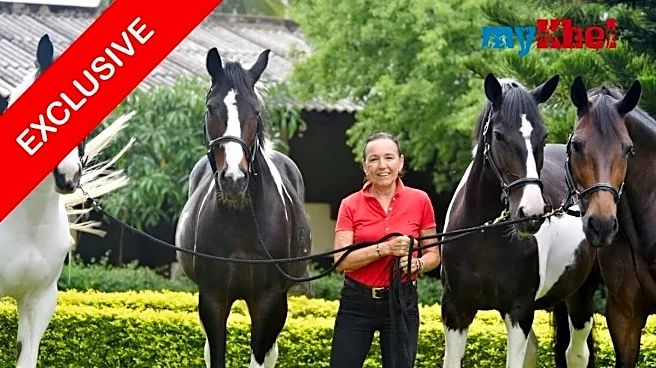

At Silva Storai's riding school in Bengaluru, horses don't just fill stables - they shape routines, relationships and careers. With more than 105 horses and a packed daily schedule, the school runs like a living ecosystem where patience, discipline and instinct define success.
For Storai, who spent 17 years as India's only woman jockey and won multiple classics, this space is more than a training ground. It is where experience meets the next generation - and where the sport continues to evolve through people willing to learn the craft properly.
"Yeah I'm at the writing [riding] school as always. I am think like you know I'm always here. We are having more than 105 horses and it's like a full full fulltime operation. "
Why Bengaluru Became the Perfect Base
Climate, according to Storai,
plays a bigger role in equestrian sport than most people realise. While several Indian cities struggle with extreme weather, Bengaluru offers conditions that allow horses and riders to train more consistently.
"Bangalore is just the best if you have to train horses in a city. I think Bangalore is an ideal places apart from the months which are coming up now like you know April May the rest of the year we have the climate to to have sporty people to have to train you know. "
She pointed out how difficult conditions in cities like Delhi, Mumbai and Chennai can limit training hours and affect the animals' recovery.
"Yeah especially when you are in place like let's say Chennai Mumbai and Delhi it's very extreme you know when it's too hot so you can really you might be able to ride one hour one and a half far in maybe one and a half hour in the evening and the two the horses look pretty miserable. "
For a sport where the animal's well-being is central, that difference can define performance outcomes.
The Riding School Philosophy: Horses Come First
While the riding school handles riders across age groups and experience levels, Storai's philosophy is clear - the horse must always remain the priority.
"I love horses and horses for me come first and then everything else will arrange itself in a very organic way. "
Instead of directly coaching daily riding sessions, she focuses on strategy and experience-based guidance while instructors handle routine training.
"That is not my job. I got four instructors here and they themselves compete at the national level and they themselves are the one that coach all these variety of young kids. "
Her role, she explains, comes into play when it is time to plan competition strategies or assess readiness.
"So I come into the picture more when we talk strategy the next show or you know things like this. "
Horsemanship - The Skill India Still Needs to Master
Beyond technical riding ability, Storai repeatedly stressed the importance of horsemanship - the deeper relationship between rider and horse.
"What distinguished us from Europe or America that saw so much ahead of us like he [Ashish] was saying out there you do the job yourself like everybody will have a horse. "
She believes Indian riders often miss out on the daily routines that create stronger bonds with animals - routines that include feeding, cleaning and caring for the horse independently.
"The connection is so much deeper. " That gap, she suggested, continues to influence performance standards.
Lessons From a Career in Racing
Storai's perspective is shaped by years spent in competitive racing, where she became the only woman jockey in India for nearly two decades and achieved milestone victories.
"I was the only woman jockey in India for 17 years and then I was the only woman jockey then win won two derby and one classic. "
From those years came one philosophy that still defines her outlook on competition.
"Well, you are as good as your last race is what I was told when I was racing like you know it doesn't matter even if you win a derby then you got one more race and it's one more challenge. "
For riders under her system, that mindset encourages consistency rather than complacency.
Understanding Horses: The True Partnership
One of the most striking parts of Storai's journey has been her deep belief that horse riding is unlike any other sport because of the living partner involved.
"What makes it so exceptional is to have this living being which you have to perform as a partner. "
She described horses as highly sensitive to human emotion, reacting instantly to a rider's mindset.
"Horses are so telepathic that the moment you sit on them they know if you are are afraid, if you are happy, if you relax, it's instant. "
That responsiveness, she believes, makes equestrian sport uniquely demanding - but also deeply rewarding.
A Wild First Ride That Started Everything
Her own entry into the sport began with what she described as a chaotic first experience at the age of 13.
"I never sat I never saw horses only on TV or in the books. "
Despite having no real experience, she convinced instructors to let her join a group ride - something she now laughs about.
"I was hanging on the horse neck and I could hear the instructor freaking out," she laughed.
But what mattered most was not technique - it was fearlessness.
"The only ingredient of the whole experience is that I was not scared at all. I love the adrenaline. "
That instinct eventually helped define her career as a jockey.
The Challenges Facing Equestrian Sport in India
While the riding school continues to produce strong riders, Storai acknowledges that equestrian sport in India still faces structural challenges - particularly in terms of access and awareness.
"Mostly only um economically welloff kids can afford horse riding because it is an expensive sport. "
Cost remains one of the biggest barriers to wider participation, limiting exposure for many talented athletes.
At the same time, she believes the country has enormous untapped potential.
"We have so much talent in India. "
She also pointed to a gradual cultural shift, with more families now recognising the value of sport alongside academics.
"Maybe five 10 years back things started shifting where Indian parents started giving priority to the kids sport. "
That change, she believes, could shape the future of the discipline.
Passion Still Drives the Journey
Even after decades in the sport, Storai's connection to horses remains rooted in passion rather than routine.
"Exactly. Uh what keeps you motivating? It's only your passion and your deep love for what you're doing. "
That love, she says, is what keeps her returning to the stables every day - long after her competitive career ended.
For Silva Storai, the riding school is not just about producing riders. It is about building relationships, nurturing discipline and preserving a way of working with horses that she believes defines the true spirit of equestrian sport.

/images/ppid_a911dc6a-image-177592102351460943.webp)

/images/ppid_a911dc6a-image-177592106108577656.webp)