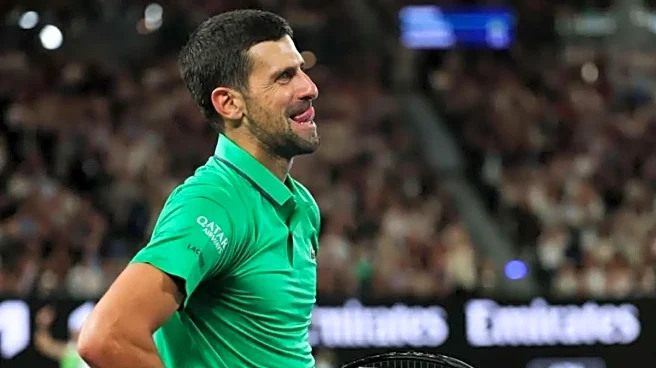


The Australian Open faced major disruption on Tuesday as soaring temperatures pushed the tournament into its highest "heat stress" category, forcing organisers to close stadium roofs and suspend outdoor matches across Melbourne Park.
With forecasts predicting temperatures as high as 45°C, officials activated the tournament's Extreme Heat Protocol for the second time this year. As a result, remaining quarterfinal encounters were shifted indoors at Rod Laver Arena and other main courts with retractable roofs, while play on outside courts was temporarily halted to safeguard players and spectators.
The Heat Stress Scale, introduced in 2019, assesses environmental conditions on a scale of one to five by factoring in air temperature, humidity, radiant
heat and wind speed. When the index reaches level five, outdoor play is suspended automatically and roofs are closed on covered arenas. That threshold was breached again on Tuesday, prompting immediate intervention.
Earlier in the day, Aryna Sabalenka completed her quarterfinal victory over Iva Jovic under open skies, with temperatures hovering around 38°C. Soon after her match concluded, organisers implemented stricter measures as conditions intensified, closing the roof ahead of the men's quarterfinal between Alexander Zverev and Learner Tien.
Reflecting on the heat, Sabalenka acknowledged the challenging conditions while welcoming the organisers' response. "I knew . . . that they won't let us play on crazy heat. If it would reach the 5, they would definitely close the roof, so I knew that they were protecting us, our health," she said. She also joked about the situation, adding, "we are stronger than the guys, so they had to close the roof for the guys so they don't suffer!"
The Extreme Heat Protocol allows officials to introduce additional cooling breaks, suspend matches or delay scheduled fixtures depending on the severity of conditions. When the index reaches four, extra rest periods may be granted, while the tournament referee retains the authority to stop or resume play based on safety assessments.
Tuesday's disruption was not an isolated incident. Just days earlier, on January 24, extreme temperatures nearing 40°C forced organisers to pause outdoor matches for nearly five hours. Junior events and several matches on outer courts were again interrupted on Tuesday as the heatwave tightened its grip on Melbourne.
As the tournament enters its decisive phase, organisers remain on high alert, with weather forecasts continuing to pose challenges. While the Australian Open prides itself on its ability to adapt to harsh summer conditions, this year's heat has once again underlined the fine balance between maintaining competition schedules and prioritising player welfare.