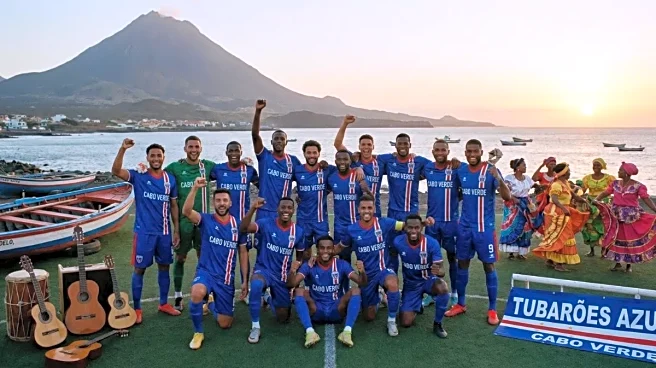

Cape Verde has made history by qualifying for the FIFA World Cup 2026, becoming the second-smallest nation by population after Iceland to achieve this feat. Their national team, the Blue Sharks, secured
the spot with a dominant 3-0 victory over Eswatini in Praia, finishing atop Group D with 23 points ahead of Cameroon.
Cape Verde entered their final qualifier with a two-point lead over Cameroon and delivered under pressure, scoring three second-half goals through Dailon Livramento, Willy Semedo, and Stopira despite a cautious first half.
The nation's entire population of around 600,000 received the day off to celebrate, turning the match into a national spectacle that capped a remarkable rise from obscurity 25 years ago. This marks their first World Cup appearance as one of nine African teams.
Cape Verde topped the group featuring Cameroon, Angola, Libya, Eswatini, and Mauritius despite a rocky start, including a 0-0 draw with Angola and a 4-1 loss to Cameroon. Coach Bubista's faith paid off with five straight wins, like narrow triumphs over Angola away and Cameroon at home, plus a crucial 3-2 in Libya that put them on the brink. This marked their first World Cup after independence in 1975 and limited prior international play.
Historic Milestone
As one of nine African qualifiers alongside Morocco, Tunisia, Egypt, Algeria, and Ghana, Cape Verde's feat with about 525,000-600,000 people underscores resilience from obscurity 25 years ago. Ranked 70th globally, the Blue Sharks join an expanded 48-team tournament in the US, Canada, and Mexico.
Cape Verde World Cup 2026 Group
Cape Verde has been placed in Group H along with Saudi Arabia, Spain and Uruguay. They will begin their campaign with a match against Spain on June 15 at the Mercedes-Benz Stadium in Atlanta.
Unique Things to Know about Cape Verde
Portuguese Colonization
Cape Verde, an archipelago off West Africa, gained independence from Portugal on July 5, 1975, without armed conflict, unlike many peers. Uninhabited until Portuguese discovery in 1456, the islands became a key slave trade hub by the 1460s, blending African, European, and later Brazilian influences.
Morna Music Legacy
Morna, a soulful genre akin to Portuguese fado but infused with African rhythms, expresses longing and saudade; the late Cesária Évora popularized it worldwide, earning Cape Verde global acclaim.
Morabeza Hospitality
Morabeza embodies an unparalleled welcoming spirit, where locals share meals like cachupa-a slow-cooked stew of corn, beans, fish, and meats-with strangers, fostering instant community bonds.
Batuque Women's Tradition
Batuque features women-led call-and-response dances with clapping and improvised drums, rooted in West African heritage, now revived at festivals to preserve female storytelling and solidarity.
Creole Language Evolution
Kriolu, a Portuguese-African hybrid spoken by nearly all, is standardizing in writing, powering literature, poetry, and daily life while bridging the archipelago's diverse islands.
Carnival Spectacles
Mindelo's Carnival rivals the world's best, with elaborate masked parades, batuku drumming, and syncretic processions blending Catholic saints' feasts and African rituals in explosive street celebrations.

/images/ppid_a911dc6a-image-177101752951095973.webp)

/images/ppid_a911dc6a-image-177101403147018469.webp)
/images/ppid_a911dc6a-image-177101053501199609.webp)
/images/ppid_59c68470-image-177101003680064644.webp)