


FIFA's new rule aimed at preventing players from hiding abusive or discriminatory language has sparked fresh debate at the 2026 World Cup after England midfielder Jude Bellingham escaped punishment for an action that recently earned Paraguay's Miguel Almiron a red card and suspension.
The contrasting decisions have left fans questioning the consistency of officiating at football's biggest tournament.
Why Miguel Almiron was sent off
The controversy began during Paraguay's Group D clash against Turkey.
Almiron became the first player in World Cup history to be sent off under FIFA's newly introduced "covering the mouth" rule after he concealed his mouth while confronting Turkey's Mert Mulder during a heated exchange.
Following a VAR review, the referee showed Almiron a straight red
card. FIFA later confirmed a one-match suspension, ruling him out of Paraguay's final group-stage fixture against Australia.
The regulation was introduced after several high-profile incidents in club football, with FIFA president Gianni Infantino describing it as an important measure designed to promote respect and accountability on the pitch.
"If you have nothing to hide, you don't cover your mouth when you speak to somebody," Infantino said while defending the new rule.
Why Jude Bellingham was not punished
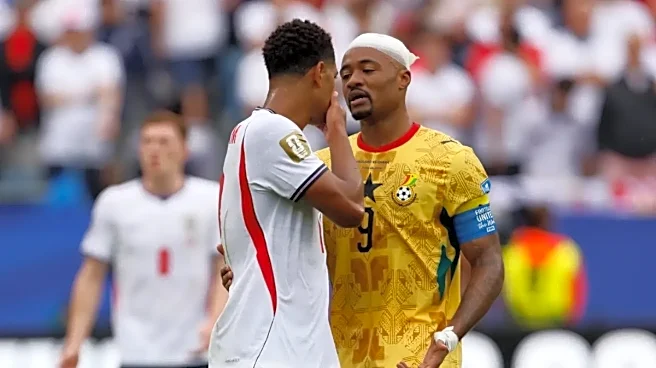
Just days later, Bellingham found himself at the centre of a similar discussion during England's goalless draw against Ghana.
The midfielder was involved in a heated half-time exchange with members of the Ghana coaching staff before appearing to cover his mouth while speaking to Ghana forward Jordan Ayew.
Unlike Almiron, however, Bellingham was neither booked nor sent off.
According to FIFA's interpretation, the key distinction was that Bellingham's interaction with Ayew was not considered confrontational. The law specifically targets situations where a player covers their mouth during an argument or verbal altercation with an opponent.
FIFA referees committee chairman Pierluigi Collina had clarified before the tournament that players would not be punished for covering their mouths during normal conversations.
"If the conversation is friendly, they can continue to do it without any problem," Collina explained.
"When the conversation is confrontational, covering the mouth means that you are doing something very wrong, potentially, and the sanction is the red card. "
Fans question consistency
Despite FIFA's explanation, the two incidents have generated significant backlash online, with supporters debating whether the rule is being applied uniformly.
Football content creator Micky Jnr highlighted the contrasting outcomes.
"Miguel Almirón covered his mouth and was shown a red card, plus an additional one-match suspension," he posted on X.
Miguel Almirón covered his mouth and was shown a red card, plus an additional one-match suspension. ❌🇵🇾
- Micky Jnr (@MickyJnr__) June 24, 2026
Meanwhile, Jude Bellingham covered his mouth against Ghana but walked away without a red. 🤔🏴
Same action, different outcomes… interesting debate on consistency in… pic.twitter.com/dYoKyHivwv
"Meanwhile, Jude Bellingham covered his mouth against Ghana but walked away without a red. Same action, different outcomes. interesting debate on consistency in decision-making at this World Cup. "
Journalist Owuraku Ampofo also questioned the application of the law.
Same World Cup, one was sent off. The other didn’t even get a warning.
- Owuraku Ampofo (@_owurakuampofo) June 24, 2026
New rule says: “Any player who covers their mouth with a hand, arm or shirt during a confrontation with an opponent can now be punished with a red card.” pic.twitter.com/RGmRyMTtux
"Same World Cup, one was sent off. The other didn't even get a warning. "
Others pointed to the wording of the regulation itself.
There lies the issue with the new rule they put in place. By the law both should’ve been sent off but both are completely different situations. https://t.co/AuhrBr8sHB
- Stewart ⚽️🧡🖤🏈🐅 (@stewart_buick) June 24, 2026
"There lies the issue with the new rule they put in place," wrote one fan. "By the law both should've been sent off but both are completely different situations. "
Some supporters felt Ghana had been hard done by, with one fan claiming: "Ghana have been robbed because Jude should be off for this. "
Nah ghana have been robbed because Jude should be off for this and the konsa foul as well https://t.co/oQxS3UPU0O
- Murree road Messi (@bklfifa) June 24, 2026
Others took a lighter approach, joking that England's underwhelming display may have provided an alternative explanation.
Given the performance by England, how can we be certain they weren’t just yawning? https://t.co/AGEy9cHRuV
- Gary Stanton (@GarySta24290777) June 24, 2026
"Given the performance by England, how can we be certain they weren't just yawning?" one supporter quipped.
FIFA faces growing scrutiny
While FIFA insists the difference lies in whether the interaction is deemed confrontational, the incidents have exposed the challenge of enforcing a rule that relies heavily on interpretation.
With the knockout stages approaching and pressure on officials increasing, the debate surrounding consistency is unlikely to disappear anytime soon.
For now, Almiron remains the only player punished under the regulation, but Bellingham's escape has ensured FIFA's newest law remains firmly under the spotlight.








/images/ppid_59c68470-image-178228506723584416.webp)

/images/ppid_59c68470-image-178228518811953974.webp)
/images/ppid_59c68470-image-178228512598636048.webp)