
/images/ppid_a911dc6a-image-177893242627076383.webp)
/images/ppid_59c68470-image-177893253230335937.webp)

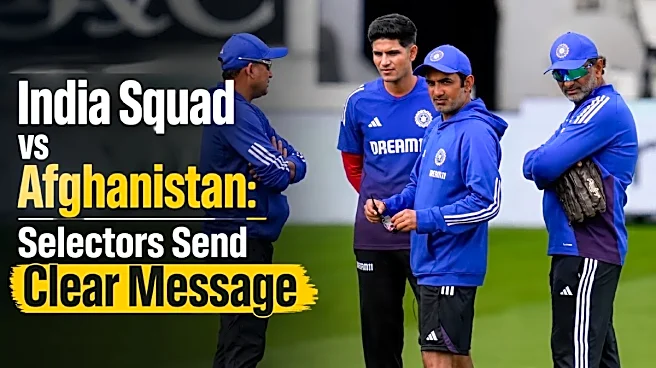
New Delhi, May 19: The Board of Control for Cricket in India has made its intentions crystal clear with the announcement of India's Test and ODI squads for the upcoming Afghanistan series. These are not merely squads picked for another home assignment - they are blueprints for the future.
With their bold selection call, the selectors have officially hinted towards India's transition into a new era, one that increasingly prioritises youth, succession planning and long-term squad building over loyalty to established veterans.
With Shubman Gill continuing as captain of India's ODI and Test sides, the selectors have reinforced their long-term commitment to the new leadership group while simultaneously accelerating the regeneration of the squad around
him.
The Afghanistan series squads are loaded with signals about where Indian cricket is heading next: senior stars being workload-managed, experienced bowlers being phased out despite strong performances, domestic performers getting fast-tracked opportunities and young prodigies being handled with far greater patience than public hype demands.
More than a routine bilateral assignment, the series feels like another major step in India's long-term rebuild for the next decade.
Gill Continues To Be The Face Of India's New Era
Unlike previous squad announcements that focused heavily on leadership transition, this selection confirms that India's new hierarchy is already firmly established.
Shubman Gill has now spent close to a year leading India's ODI and Test sides, and the Afghanistan series further strengthens his standing as the centrepiece of India's long-term plans.
The selectors clearly see Gill as the batter around whom the next generation will be built - technically sound across formats, tactically composed and mature enough to guide a young side through transition.
That stability at the top is important because the rest of the squad is evolving rapidly.
India is no longer operating with the same core that defined the Rohit Sharma-Virat Kohli era. Instead, the management appears focused on gradually reshaping the squad around Gill and a younger support system capable of carrying Indian cricket through the next cycle.
Rohit Sharma And Hardik Pandya Still Remain Important - But Carefully Managed
Despite the shift toward youth, India's senior stars still remain part of the larger picture.
Rohit Sharma and Hardik Pandya have both been included in the ODI squad, although their participation remains subject to fitness clearance from the National Cricket Academy.
That caveat reveals how carefully India is now handling workload management for senior players.
Coming immediately after a physically demanding IPL 2026 season, the selectors appear unwilling to risk burnout or recurring injuries during a home bilateral series. Instead, the priority is ensuring that senior figures remain fresh for more demanding assignments and ICC tournaments.
The approach reflects a major structural change in Indian cricket's thinking. Bilateral series are increasingly being used as developmental windows instead of automatically fielding the strongest possible senior XI.
No Pant, No Jaiswal - But Ishan Kishan Returns
Among the most notable calls in the ODI squad were the absences of Rishabh Pant and Yashasvi Jaiswal. Pant's omission is particularly significant because he remains one of India's most explosive white-ball match-winners. However, the selectors appear keen to widen competition within the wicketkeeper-batter pool instead of locking combinations too early.
That has opened the door for Ishan Kishan's return as the second wicketkeeper alongside KL Rahul.
Kishan's inclusion suggests India still values his aggressive left-handed batting profile, particularly in middle-overs acceleration phases where modern ODI cricket increasingly demands attacking intent.
Jaiswal's absence, meanwhile, seems more linked to workload management than any long-term concern. After an intense all-format workload and IPL campaign, the selectors appear determined to avoid overexposing one of India's most important young batters.
Shreyas Iyer Named ODI Vice-Captain - A Massive Vote Of Confidence
One of the most significant developments from the squad announcement is the elevation of Shreyas Iyer as India's ODI vice-captain.
The decision underlines how highly the management currently rates Shreyas not just as a middle-order batter, but also as a long-term leadership figure in India's white-ball setup. Over the past year, Shreyas has steadily strengthened his reputation as a tactically sharp leader through his captaincy in franchise cricket, while also evolving into one of India's most reliable ODI batters against both pace and spin.
By handing him the deputy role under Shubman Gill, the selectors appear to be building a younger leadership core that could potentially guide India through the next ODI cycle and towards the 2027 World Cup.
The move is also politically and structurally important within the squad hierarchy. With Rohit Sharma and Hardik Pandya still being workload-managed and monitored for fitness, India clearly wanted a stable leadership backup already embedded within the playing XI.
For Shreyas, this is more than just a designation - it is a strong indication that he remains central to India's long-term ODI plans both as a batter and as a future leadership candidate.
Bhuvneshwar Kumar And Mohammed Shami Omitted Despite Outstanding Form
The most debated decisions, however, revolve around the senior fast bowlers left out. Mohammed Shami and Bhuvneshwar Kumar both entered selection discussions with strong cases built on performance and experience.
Shami has enjoyed an excellent IPL 2026 campaign with Lucknow Super Giants while also excelling for Bengal in domestic cricket. His rhythm, fitness and wicket-taking form appeared strong enough to justify another opportunity in India colours. Yet the selectors once again chose to look beyond him.
Bhuvneshwar Kumar's omission has perhaps generated even stronger reactions. The senior Royal Challengers Bengaluru pacer has been one of IPL 2026's standout bowlers and currently leads the tournament's wicket charts. What has impressed experts most is his effectiveness across every phase of a T20 innings.
Bhuvneshwar has:
- Swung the new ball in the powerplay
- Controlled the middle overs
- Delivered accurately at the death
Several former players openly backed him for an ODI comeback, arguing that his experience, intelligence and versatility still make him one of India's most complete white-ball bowlers.
But India's selectors appear to have made a larger strategic decision.
Rather than revisiting experienced names during a transitional phase, the management is aggressively investing in the next generation of fast bowlers. The omissions of both Shami and Bhuvneshwar underline a clear shift toward future planning over short-term reliability.
It is a difficult but revealing selection philosophy.
Auqib Nabi's Omission Highlights India's New Selection Priorities
If there is one exclusion that truly highlights the changing nature of India's selection strategy, it is that of Auqib Nabi.
On pure red-ball merit, Nabi arguably had one of the strongest cases for Test selection among all available Indian fast bowlers.
The 29-year-old from Baramulla spearheaded Jammu & Kashmir's historic maiden Ranji Trophy triumph and completely dominated the domestic circuit throughout the season.
Nabi finished the 2025-26 Ranji Trophy campaign as the tournament's highest wicket-taker with a stunning 60 wickets in just 10 matches at an extraordinary average of 12.57. Importantly, this followed another impressive season in 2024-25 where he had already claimed 44 wickets.
What elevated his campaign further was his dominance in high-pressure knockout cricket.
He tore through Madhya Pradesh in the quarterfinal with match figures of 12/110, followed it with nine wickets against Bengal in the semifinal before producing a decisive 5/54 against Karnataka in the final.
Nabi repeatedly delivered when the stakes were highest. Add to that his spectacular double hat-trick in the Duleep Trophy and his ₹8.4 crore IPL deal with Delhi Capitals, and his Test credentials looked almost impossible to ignore. Yet India opted instead for the younger Gurnoor Brar.
The decision perfectly encapsulates India's current approach. The selectors are prioritising long-term upside, pace variety and future potential over domestic body of work alone.
It may feel harsh on Nabi, but it also clearly reflects how aggressively India wants to build its next-generation pace attack.
Vaibhav Sooryavanshi Handled With Patience, Not Hype
Few cricketers have generated more excitement in 2026 than teenage sensation Vaibhav Sooryavanshi.
The 15-year-old Rajasthan Royals opener has spent IPL 2026 dismantling international-calibre bowling attacks and smashing sixes at a record-breaking rate.
Naturally, public demand for an immediate India debut exploded. But the selectors resisted the temptation.
Instead of fast-tracking him directly into the senior squad, Sooryavanshi has been named in the India A squad for the Sri Lanka tri-series beginning June 9. It is arguably one of the smartest decisions made by the selection committee.
India A cricket provides a far healthier developmental environment for a 15-year-old phenom - exposure to longer formats, tactical adaptability and touring demands without the overwhelming pressure of senior international cricket.
Rather than rushing a generational talent, India appears determined to nurture him carefully.
Fresh Faces Continue To Shape India's Future
The Afghanistan squads also provide valuable opportunities to a new generation of domestic performers.
Prince Yadav has been fast-tracked into the ODI side as a seam-bowling all-rounder capable of contributing in multiple phases.
Harsh Dubey's consistency has earned him selection in both squads, while Gurnoor Brar's inclusion adds height, raw pace and variation to India's evolving seam attack.
In the Test setup, Manav Suthar gets an opportunity to shadow India's senior spin group and develop within the red-ball environment.
Each selection points toward the same broader idea: India is expanding its bench strength aggressively rather than relying on a fixed core.
India's Transition Is No Longer Coming - It Is Already Here
The most striking aspect of these squad announcements is how unapologetically forward-looking they are.
India's selectors are no longer choosing squads solely for immediate bilateral success. Instead, they are building:
- A new leadership core
- A younger pace attack
- Greater squad depth
- Better workload management systems
- Structured developmental pathways
The Afghanistan series may not appear massive on paper, but its long-term significance could be enormous.
Because this is no longer merely about winning another home series. It is about shaping what Team India will look like for the next decade.


/images/ppid_59c68470-image-177893252523314595.webp)