

/images/ppid_a911dc6a-image-177742955828656314.webp)

When the 2026 FIFA World Cup kicks off across the United States, Canada, and Mexico, the biggest opponent on the pitch might not be a defending champion or a tactical masterclass. It could very well be the weather.
Historically, July is the hottest month of the year across the contiguous United States. According to data from the National Oceanic and Atmospheric Administration (NOAA), average summer temperatures have steadily risen since record-keeping began in 1895. With 104 matches scheduled during the peak of the North American summer, global researchers and player unions are raising concerns about a highly technical yet extremely dangerous climatic metric: Wet Bulb Globe Temperature (WBGT).
If you are planning to travel to the tournament or
simply watching from home, "Wet Bulb" is a phrase you are likely to hear repeatedly from commentators, medical staff, and analysts. Here is what it means, why it matters, and how FIFA is attempting to manage the risks posed by extreme heat.
Decoding 'Wet Bulb' Temperature
Traditional weather forecasts mainly focus on air temperature, but for elite athletes running for 90 minutes, a standard thermometer tells only part of the story.
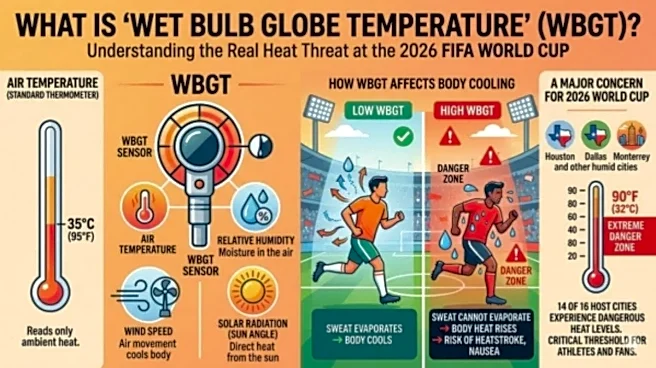
Wet Bulb Globe Temperature is a scientifically grounded measure of heat stress that considers four key environmental factors:
- Air Temperature: The standard ambient heat
- Relative Humidity: The amount of moisture present in the air
- Wind Speed: Airflow that helps cool the body
- Solar Radiation (Sun Angle): The intensity of direct sunlight
Why is this so dangerous? The human body cools itself primarily through the evaporation of sweat. However, when the air is already saturated with moisture - meaning high humidity - sweat cannot evaporate effectively. If the Wet Bulb temperature rises above the body's natural skin temperature, evaporative cooling stops entirely. At that stage, even young and highly trained athletes face serious risks such as nausea, dehydration, heatstroke, or worse, regardless of how much water they consume.
The 2026 World Cup 'Danger Zones'
Recent climate modelling of the 16 host cities presents a challenging scenario for tournament organizers. Research suggests that 14 of the 16 host locations regularly experience extreme heat levels capable of triggering FIFA's safety protocols.
The 32°C (90°F) Wet Bulb threshold is widely recognized as the "Extreme Danger Zone" for sustained physical exertion. Heading into the summer of 2026, three cities stand out as major hotspots for these conditions during afternoon kick-offs:
- Houston, Texas
- Dallas, Texas
- Monterrey, Mexico
While Dallas and Houston benefit from fully covered, climate-controlled stadiums that protect players during matches, the heat risk extends far beyond the field. Millions of traveling fans, match officials, broadcast crews, and security personnel will be navigating fan zones, transport hubs, and outdoor venues in historically high-risk summer conditions.
Additionally, open-air stadiums in humid locations such as Miami face significant Wet Bulb risks that could noticeably affect match intensity and playing tempo.
FIFA's Heat Mitigation Masterplan
Following a severe heatwave during the 2025 Club World Cup and the earlier decision to move the 2022 Qatar World Cup to winter, FIFA and local organizers are adopting strict precautionary measures. A specialized Heat Illness Mitigation and Management Task Force has been established to strengthen tournament safety systems.
Here is how the sport is adapting to protect both players and fans:
Mandatory Hydration Stoppages: FIFA has introduced universal three-minute hydration breaks midway through each half of every match, regardless of weather conditions or whether the stadium is indoors.
Climate-Controlled Sidelines: Substitute players and coaching staff will have access to actively cooled benches during outdoor matches.
Tactical Substitutions and Rest Periods: Teams will be allowed up to five substitutions, along with a mandatory minimum of three rest days between matches.
Fan Welfare Infrastructure: Host cities are introducing wide-ranging heat response systems. Vancouver plans to install temporary misting stations during official heat alerts, Los Angeles is developing a near real-time public heat dashboard, and New York City is preparing multilingual safety alerts through messaging platforms such as WhatsApp.
The 2026 World Cup is expected to be the largest and most commercially successful sporting event in history. However, as the tournament expands to 48 teams, the balance between peak athletic performance and rising global temperatures will test the limits of modern sports science and event planning.









/images/ppid_a911dc6a-image-177744002911992498.webp)
