
/images/ppid_59c68470-image-178185004467943309.webp)

/images/ppid_59c68470-image-178185011062320664.webp)


Cristiano Ronaldo's World Cup opener became less a story of an individual performance and more a reflection of football's impatience- where ninety difficult minutes were enough for critics to question a career built over two decades.
It was the fourth time in five World Cups that Portugal failed to win their opening game, and as so often happens, Cristiano Ronaldo became the story. His performance divided opinion, reigniting familiar questions about age, influence and whether Portugal's greatest icon can still inspire a team chasing its first World Cup crown.
Unlike Lionel Messi, whose opening-night hat-trick naturally dominated the headlines, Ronaldo's goalless outing invited inevitable comparisons. Yet such parallels are not only premature but
fundamentally flawed. Football remains a team sport shaped by tactical context, quality of opposition, and the support surrounding its biggest stars. One magical night and one frustrating afternoon are hardly enough to redraw the legacy of two men who have defined an era.
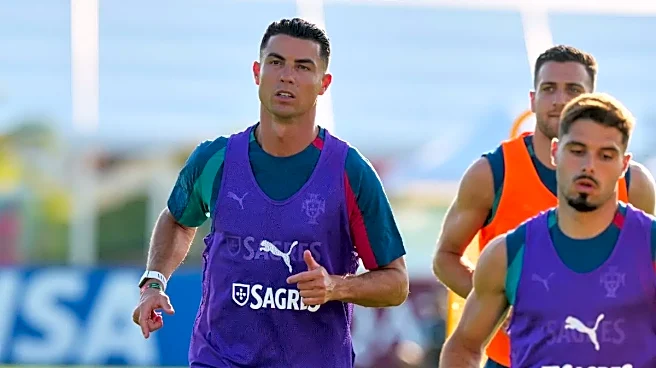
At 41, Ronaldo's desire was unmistakable. He constantly demanded the ball, pressed when Portugal were out of possession, encouraged teammates, and remained vocal throughout the contest. The Congolese defensive line deployed a five-man block featuring Chancel Mbemba as the primary center-back. Throughout the match, defenders, along with midfield support from the Belgian-born Ngal'ayel Mukau, effectively man-marked and contained Cristiano Ronaldo, limiting him to minimal touches inside the box.
His over 1 billion fans would like to believe that it was Ronaldo's movement inside the penalty area that led to JoÃo Neves finding the space to head home the opening goal in the 6th minute. The goal helped 21-year-old Neves earn the Player of the Match award on his FIFA World Cup debut.
Ironically, on a day when football history quietly turned another page, Cristiano Ronaldo added yet another remarkable chapter to a career that has redefined longevity. At 41 years and 132 days, the Portugal captain became the oldest outfield player ever to start a FIFA World Cup match, eclipsing the previous mark set by Atiba Hutchinson in 2022. Roger Milla, however, still retains the distinction of being the oldest outfield player to appear in a World Cup, coming off the bench at the age of 42 during the 1994 tournament, where he fittingly crowned the occasion by finding the net.
The evening also elevated Ronaldo into football's most exclusive fraternity. By stepping onto the field in Portugal's opening match, he joined his greatest contemporary rival, Lionel Messi, as only the second player in men's football history to feature in six FIFA World Cups. The two icons whose rivalry has defined an era now stand together on another summit that may never be matched.
These were remarkable milestones, but Ronaldo's performance did not quite match the occasion. Strip away the emotion and the unwavering admiration of his most devoted supporters, and a more nuanced picture emerges. CR7 managed only 25 touches during the match in Houston, the fewest by any starting outfield player for Portugal. Seventeen of his twenty-two attempted passes went backwards, isolating him from the midfield. Where Ronaldo struggled was in the decisive moments.
His admirers will argue for the paucity of clear-cut opportunities, but elite forwards are ultimately judged by what they do when those moments arrive. Ronaldo's evening was defined by the fine margins that have separated his present from his imperious past. The half-chances that once seemed destined to end in the back of the net now demanded a fraction more time, a yard more space, and a level of precision that DR Congo's disciplined defence simply refused to concede.
The defining moment came in the 69th minute when Francisco ConceiÇÃo's inviting cut-back finally found its intended target. Surrounded by defenders and rushed into a hurried finish, Ronaldo could only send his effort harmlessly off target. Ten years ago, few would have bet against him converting such an opportunity. Today, those fleeting moments have become the yardstick by which critics assess whether Portugal's greatest goalscorer can still decide matches on football's biggest stage.
Reuters described his display as "mostly anonymous", noting that two second-half misses reinforced the perception among critics that he is no longer the decisive force he once was.
It was an unfamiliar sight for a player who has built a career on punishing the slightest defensive lapse. With more than 970 official senior goals for club and country, Ronaldo stands alone as the highest goalscorer in the history of men's football, eclipsing the remarkable tallies of Lionel Messi, Josef Bican and Pele. Such is the brutal reality of football's highest stage. Years of greatness can be overshadowed by ninety difficult minutes, turning a lifelong hero into an overnight scapegoat.
The tactical picture only fuelled the post-match debate. Former Arsenal and World Cup-winning French striker Thierry Henry observed that Ronaldo's relentless instinct to hunt for a goal often saw him occupy spaces that clogged Portugal's passing lanes, making it easier for Congolese defenders to anticipate deliveries, intercept attacks and blunt the fluency of Roberto MartÍnez's side. For perhaps the first time in years, the game's most prolific goalscorer looked less like Portugal's greatest weapon and more like a prisoner of a tactical plan that failed him and his team.
A closer look will reveal that Portugal dominated possession but lost the duel because it lacked penetration. Bruno Fernandes, Bernardo Silva and Vitinha enjoyed long spells on the ball, yet DR Congo defended compactly, denying Ronaldo the opportunity to meet the early crosses and through balls that have defined so many of his international goals. The supply line was inconsistent, forcing Ronaldo to drift deeper in search of possession rather than occupying the penalty area where he remains most dangerous. Portugal's attacking rhythm became predictable, allowing DR Congo to defend comfortably for large spells.
This was perhaps the clearest reminder that Ronaldo is no longer the explosive winger who terrorised full-backs in his Manchester United and Real Madrid years. His game has evolved into that of a traditional centre-forward, reliant on movement, anticipation, aerial strength and intelligent positioning. When the service is poor, his influence naturally diminishes. Unlike Lionel Messi, who can drop into midfield and dictate play, Ronaldo depends far more on the team's ability to create opportunities around him. That distinction is crucial when evaluating his performance.
This was also the fourth time in five World Cups that Portugal failed to win their first match, and it was another referendum on the enigma that is Cristiano Ronaldo at this level in 2026. The criticism directed at Cristiano Ronaldo after the 1-1, in reality, is a collective tactical failure. Ronaldo certainly had a subdued game, but Portugal's shortcomings extended far beyond their captain.
That said, Thierry Henry's criticism was not without merit. He pointed to one second-half move where Ronaldo attacked the same passing lane as Bruno Fernandes instead of dragging defenders towards the near post. Had Ronaldo occupied the centre-backs differently, Fernandes might have had a simple finish. It illustrated an important tactical point: at this stage of his career, Ronaldo's movement should create opportunities for the team as much as for himself.
While Lionel Messi, Kylian Mbappe, Erling Haaland and Harry Kane lit up the FIFA World Cup in style, Cristiano Ronaldo and Portugal endured a frustrating evening that ended in disappointment. But to pin Portugal's disappointing draw solely on the 41-year-old would be a grave injustice, as it was primarily a team failure.
After Portugal broke the deadlock early in the sixth minute through JoÃo Neves, the team surprisingly appeared to lose intensity. Instead of pressing for a second goal, they looked conservative and happy to keep possession and rotate the ball. This allowed DR Congo to grow into the contest. The African side finished strongly, matched Portugal physically and even struck the post through Cedric Bakambu after the break. On chances created, DR Congo arguably looked the more dangerous side during long periods of the second half.
What Roberto MartÍnez must change against Uzbekistan and Colombia?
Roberto MartÍnez's foremost priority must be to reconnect his midfield with the attacking line, and unleash the fearless, high-tempo attacking intent that has long defined Portugal's football.
Vitinha and Bruno Fernandes must receive the ball facing forward rather than dropping alongside the centre-backs. Portugal need quicker vertical passing instead of sterile lateral possession and dominance. Ronaldo should spend almost the entire game between the opposition centre-backs, not drifting outside the penalty area searching for touches. His greatest value remains inside the box, where his movement and finishing are unmatched. MartÍnez himself acknowledged that Portugal failed to get sufficient service into their lead striker.
Secondly, Portugal needs greater pace on the flanks. Neto and ConceiÇÃo should attack defenders one-on-one more frequently, forcing the back line to spread rather than allowing them to remain compact. This would naturally create larger pockets of space for Ronaldo, Bruno Fernandes and spring surprises through their midfield and full-back runners.
Thirdly, MartÍnez should encourage more third-man runs into the penalty area. Too often, Ronaldo was isolated against multiple defenders. If Bruno Fernandes, Bernardo Silva and Vitinha consistently burst beyond him, defenders would face impossible choices instead of comfortably surrounding one striker.
Finally, Portugal must rediscover their trademark high press while injecting far greater purpose, creativity, and incision inside the opposition penalty area if they are to convert dominance into goals and win matches. After taking the lead against DR Congo, they retreated mentally as much as tactically. The urgency that characterises tournament-winning teams disappeared, allowing DR Congo belief and momentum.
Uzbekistan is now a must-win fixture. Victory would likely restore confidence and leave Portugal needing only a positive result against Colombia in their last group fixture to progress. But Colombia, having already defeated Uzbekistan, possess greater attacking quality and will punish the kind of defensive lapses and slow ball circulation Portugal displayed in Houston.
If Portugal continue to play at the tempo they showed against DR Congo, qualification could become precarious. However, if MartÍnez can restore the fluid interplay between Bruno Fernandes, Bernardo Silva, Vitinha, and combine with Ronaldo and the forward line, the combination that made Portugal one of Europe's most feared attacking sides will terrorise opposition any day. There is hardly any doubt that they still possess enough quality to top Group K and emerge as genuine contenders.
The draw with DR Congo should therefore be viewed not as evidence that Ronaldo is finished, but as a warning that even the greatest goalscorer in football history cannot score when the collective mechanism around him stops functioning.

/images/ppid_a911dc6a-image-178185026061086047.webp)
