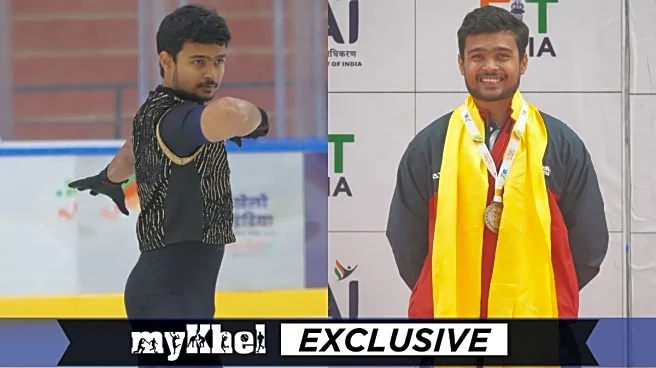

Leh (Ladakh): Winning gold at the Khelo India Winter Games 2026 was a defining moment for Abhijit Amal Raj, but the medal in Leh tells only part of the story. For the 24-year-old figure skater from Kerala, the top step of the podium came after years of navigating limited infrastructure, frequent travel abroad, and a constant struggle to fund a career in a non-mainstream sport.
Abhijit claimed gold in the Advanced Boys figure skating event at the Games, marking a successful return to competitive ice skating after focusing on roller skating at the international level.
An employee of the Income Tax Department (Mumbai region), he has built a rare dual career-balancing government service with elite sport-while continuing to pursue excellence in both
inline and ice skating.
In an exclusive conversation with myKhel, Abhijit reflected on competing at altitude in Leh, his journey from roller skating to ice, the lack of facilities in southern India, and the financial realities that remain the biggest hurdle for athletes like him.
Competing in Leh: A Physical and Mental Test
For Abhijit, the Khelo India Winter Games were not just another competition. It was his first visit to Leh, and the extreme conditions added an extra layer of difficulty to an already demanding event.
He admitted that adjusting to the altitude and low oxygen levels was one of the toughest challenges he has faced in recent years. "This was my first time in Leh, and for me it was a pretty hard competition because of the altitude change and low oxygen levels. It was really difficult to perform," he said.
Despite the physical strain, Abhijit was full of praise for the venue and the organisation of the event-something he believes is crucial for the growth of ice sports in India.
"The infrastructure here is absolutely wonderful. This is one of the best ice rinks we have in India. Even though the competition was tough, I really loved the venue and the way the championship was organised. I would love to see more championships like this hosted in India. "
A Journey That Began at Three
Abhijit's relationship with skating began long before medals and podiums entered the picture. Introduced to the sport at the age of three, skating has been a constant presence in his life for over two decades.
He started with roller skating and quickly rose through the ranks, eventually becoming a junior world champion in inline skating and later an Asian champion at the senior level.
"I started skating when I was three years old. I began with roller skating, and I am a junior world champion in inline skating. I'm also currently the Asian champion in the senior category," he said.
That strong foundation in roller skating later shaped his approach to ice skating as well. He added further, "Roller skating and ice skating are pretty much similar. That's why I have trained in both. I had to take a break from ice skating for a few years because I was concentrating on roller skating and world championships. Now I'm back and pursuing my dream in ice skating again. "
Training Without Ice: A Southern India Struggle
One of the recurring themes in Abhijit's career has been the lack of ice skating infrastructure-especially for athletes from southern India. While Leh and Dehradun currently house India's only international-standard ice rinks, Abhijit pointed out that this geographical concentration creates a major disadvantage for skaters from states like Kerala and Tamil Nadu.
"Infrastructure in ice skating in India is honestly not good. Leh has a very good rink, and we have another international-standard rink in Dehradun. But both are in the north. In the south, we don't have even a single ice skating rink. "
As a result, preparation often becomes reactive rather than structured. "We practise on roller skates, and when a championship comes, we reach two or three days early and practise on the competition rink. That's not really helping us. We need more ice time to improve. "
Training Abroad to Stay Competitive
To compensate for the lack of facilities at home, Abhijit has repeatedly travelled abroad to train on ice-often at his own expense. "As skaters from the south, we go to Malaysia and other countries to train ice skating. The last time I trained in Malaysia was about four years ago. They have a lot of international-standard ice rinks there. "
For Khelo India, his preparation relied heavily on adapting roller-based training to ice. "I do my programme training, choreography and design on roller skates and then implement that on ice," the Kerala athlete added further.
A Family-Driven Coaching Model
Behind Abhijit's technical consistency is a close-knit coaching structure led by his father, Biju Rajan, who has played a central role in his development. "My dad helps me with techniques and all the other aspects. He has attended many international seminars and has been training me for a very long time," Abhijit explained.
At the international level, he also trains under a nine-time world champion from Italy. "I go once every year to Italy and train with Luca Di Lellis in Rome. The exposure and quality there are on a completely different level. "
'Support Is What We Are Still Missing'
Comparing India's skating ecosystem with countries like Italy and Spain, Abhijit highlighted the importance of structured government support. "If you look at Italy or Spain, they have full support systems-physiotherapy, gyms, technical staff, and government backing. That's why they have been winning at the top level for so long. "
In contrast, he feels the athletes in the state are still waiting for promised systems to materialise. "The government has promised many things, but nothing has really come into place yet. If proper support and facilities are provided, I'm sure many international-level athletes will come up. "
The Financial Burden Behind the Medal
Perhaps the most sobering part of Abhijit's journey is the financial strain that continues despite his achievements. "Right now, most of my expenses are borne by my parents. I do get a small amount of support from the government, but it's not enough for an athlete competing at the international level. "
Finding sponsorship has been particularly challenging. "I've been searching for sponsors for a long time. Most of them say our sport doesn't have enough viewership. But if you go to international competitions, the stadiums are packed. Figure skating does have an audience. "
For Abhijit, the issue lies in low participation and visibility within India-not lack of global appeal.
What Lies Ahead
The Khelo India Winter Games marked the start of Abhijit's competitive season. "Khelo India was my first competition of the year. Next is the world championship in roller skating, and I'm yet to confirm the ice skating competitions. Hopefully, there will be two or three international events coming up. "
His gold medal in Leh is a testament to persistence, but also a reminder of how much potential remains untapped in Indian figure skating without sustained institutional support.
/images/ppid_a911dc6a-image-177060802130265096.webp)


/images/ppid_59c68470-image-177046504002345104.webp)

/images/ppid_59c68470-image-177043755627237185.webp)