

The Indian Premier League is built around explosive batting, fearless strokeplay and rapid scoring. But the same aggression that creates unforgettable innings also produces one of cricket's most unforgiving statistics - ducks.
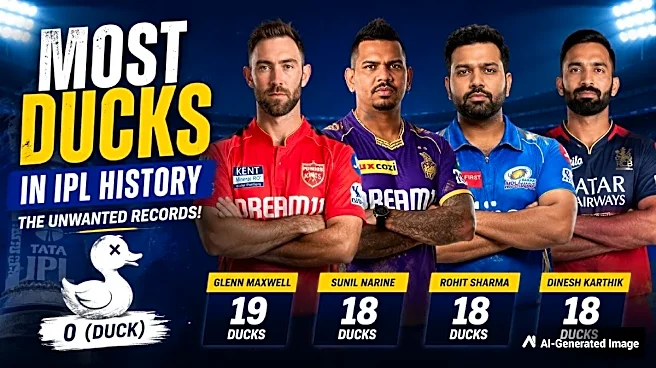
And sitting at the top of the all-time IPL ducks list is Glenn Maxwell, whose ultra-attacking style has resulted in 19 dismissals for zero across his IPL career.
While the number may appear alarming at first glance, the larger statistical picture actually reveals how modern T20 cricket rewards risk-taking even at the cost of consistency.
From and to and , many of IPL's biggest stars feature prominently on the unwanted list - not necessarily because they failed, but because they consistently embraced high-risk roles.
Maxwell's Boom-or-Bust IPL Legacy
Maxwell's
IPL career perhaps best represents the T20 risk-reward equation. The Australian all-rounder has smashed 2,819 IPL runs with 18 fifties despite never registering a century. But his willingness to attack from ball one has also led to 19 ducks in just 135 innings.
The numbers underline the paradox of Maxwell's career. On one hand, he remains one of the most destructive middle-order batters in IPL history. On the other, his aggressive intent naturally increases the chances of early dismissals.
Unlike traditional accumulators, Maxwell rarely spends time settling in. Every innings begins with boundary intent, making ducks almost an occupational hazard rather than an anomaly.
Why Narine's Presence Is Different
Narine's inclusion near the top of the list is statistically fascinating. Primarily known as one of T20 cricket's greatest mystery spinners, Narine has also reinvented himself as a powerplay destroyer for Kolkata Knight Riders over the years.
His 18 ducks have come while performing one of the toughest batting roles in T20 cricket - attacking immediately regardless of conditions or match situation.
What makes the statistic remarkable is that Narine also owns: an IPL century, seven fifties, and one of the best strike rates among unconventional openers.
KKR's strategy with Narine has never been about consistency. It has always been about maximizing impact within short bursts.
That naturally increases failure rates.
Rohit Sharma's Numbers Tell a Different Story
At first glance, Rohit Sharma's 18 ducks may appear surprising given his stature as one of IPL's greatest batters. But context changes everything.
The Mumbaikar has played 277 IPL matches (and counting) and batted in 272 innings, scoring over 7,200 runs with two centuries and 49 fifties.
That means his duck percentage is actually relatively low compared to others on the list.
Opening batters are statistically more vulnerable because they: face the new ball, encounter attacking fields, and often take risks early during powerplays.
The sheer longevity of Rohit's IPL career explains why his overall duck count appears high.
Dinesh Karthik and the Longevity Factor
Dinesh Karthik's presence further highlights how longevity impacts these numbers.
Having represented multiple franchises across 17 IPL seasons, Karthik has accumulated 18 ducks alongside nearly 5,000 runs and 22 half-centuries.
Middle-order finishers often operate in difficult situations where immediate acceleration is required, significantly increasing dismissal risk.
Unlike top-order anchors who can rebuild innings gradually, finishers are frequently judged entirely on strike rate and impact.
That naturally results in a higher frequency of failures.
IPL's Top 10 Players With Most Ducks
| Rank | Player | Ducks | Matches | Runs | Highest Score | 50s/100s |
|---|---|---|---|---|---|---|
| 1 | Glenn Maxwell | 19 | 141 | 2819 | 95 | 18/0 |
| 2 | Sunil Narine | 18 | 198 | 1820 | 109 | 7/1 |
| 3 | Dinesh Karthik | 18 | 257 | 4842 | 97* | 22/0 |
| 4 | Rohit Sharma | 18 | 277 | 7267 | 109* | 49/2 |
| 5 | Rashid Khan | 16 | 147 | 620 | 79* | 1/0 |
| 6 | Piyush Chawla | 16 | 192 | 624 | 24* | 0/0 |
| 7 | Mandeep Singh | 15 | 111 | 1706 | 77* | 6/0 |
| 8 | Ajinkya Rahane | 15 | 208 | 5250 | 105* | 34/2 |
| 9 | Manish Pandey | 14 | 176 | 3942 | 114* | 22/1 |
| 10 | Ambati Rayudu | 14 | 204 | 4348 | 100* | 22/1 |
The Aggression Era of T20 Cricket
The presence of aggressive players near the top of this list is no coincidence. Modern T20 cricket prioritizes: strike rate, intent, boundary percentage, and powerplay impact far more than traditional batting averages. Teams today are willing to accept higher failure percentages if players consistently produce match-winning cameos at elite strike rates.
That explains why players like Maxwell and Narine remain highly valued despite their duck counts. In many ways, ducks have become an unavoidable by-product of fearless T20 batting.
Ducks Don't Define IPL Greatness
Perhaps the biggest takeaway from these numbers is that ducks rarely diminish a player's overall IPL legacy. Rohit Sharma remains one of the tournament's greatest captains and batters despite 18 ducks.
Sunil Narine transformed T20 strategy forever despite his failures at the top. Maxwell continues to be among the most dangerous middle-order hitters in franchise cricket history.
In the IPL's high-risk ecosystem, failure is often simply the cost of ambition. And statistically, the players willing to fail spectacularly are often the same players capable of winning matches single-handedly.

/images/ppid_a911dc6a-image-177835842512958162.webp)


/images/ppid_a911dc6a-image-177835702681598317.webp)


/images/ppid_a911dc6a-image-17783535282665287.webp)
/images/ppid_a911dc6a-image-177835356034528970.webp)