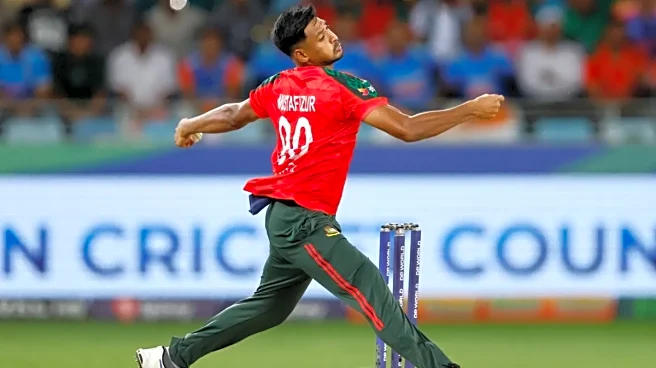

The BCCI's directive to Kolkata Knight Riders to release Mustafizur Rahman ahead of IPL 2026 has sparked a larger and far more consequential debate: could Bangladeshi cricketers face a fate similar to Pakistan
players, who have been barred from the IPL for nearly two decades?
Pakistan's absence from the IPL dates back to the aftermath of the 26/11 Mumbai terror attacks in 2008. While Pakistani players featured in the inaugural season, the attacks - carried out by a Pakistan-based terror group - fundamentally altered India's sporting ties with its neighbour.
Citing security and diplomatic concerns, the BCCI stopped Pakistani participation entirely. That ban remains in force, and following renewed India-Pakistan tensions in May 2025, even off-field roles such as coaching and commentary opportunities for Pakistani nationals were quietly phased out. On-field gestures between Indian and Pakistani players also became rare, reflecting the deep political chill.
The situation involving Bangladesh is different in scale but increasingly worrying in trajectory. The current strain can be traced back to 2024, when the Sheikh Hasina-led government collapsed following widespread student-led protests that escalated into nationwide unrest. The turmoil resulted in several deaths, with Hasina eventually fleeing the country. In the months that followed, relations between India and Bangladesh deteriorated, with Dhaka accusing New Delhi of sheltering the former prime minister.
Tensions escalated sharply again in late 2025 after the shooting and subsequent death of Bangladeshi activist and academic Osman Hadi, a prominent figure in youth movements that emerged after the July Revolution. Hadi, known for his vocal opposition to what he described as Anti-India movement in Bangladesh, died after being airlifted to Singapore for treatment. His death triggered widespread violence across Bangladesh, with attacks reported on media houses, cultural institutions and diplomatic properties and once again accused India of carrying out this particular attack.
The unrest took a deeply disturbing turn with the killing of Dipu Das, a member of the Hindu minority, who was accused by a mob of making derogatory remarks against Islam. Despite the absence of proven evidence, Das was allegedly handed over by police to the crowd, beaten to death and his body burned publicly. Images and reports of the incident led to strong reactions in India, triggering protests and calls for action against Bangladeshi representation in Indian platforms - including cricket.
Against this backdrop, the BCCI's decision to ask KKR to release Mustafizur Rahman has been widely interpreted as a response to public sentiment rather than purely sporting considerations. Notably, Rahman was the only Bangladeshi player bought at the IPL 2026 auction.
Does this signal an impending blanket ban on Bangladeshi players? At present, there is no official policy from the BCCI indicating a formal exclusion similar to Pakistan's case. However, the Rahman episode suggests that franchises may find it increasingly difficult to field Bangladeshi players amid domestic backlash and political pressure.
Much will depend on how diplomatic ties evolve in the coming months and whether cricketing relations can be insulated from broader geopolitical tensions. For now, Bangladeshi players are not banned from the IPL - but the precedent set by Mustafizur Rahman's removal has undeniably placed their future participation under a cloud of uncertainty.


/images/ppid_59c68470-image-17707175370479328.webp)
