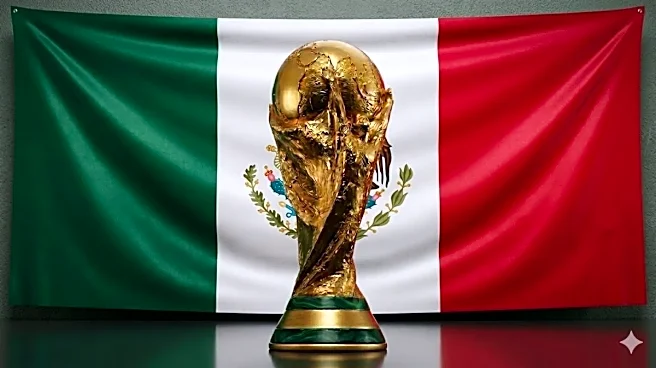



Structure first, flexibility always - that's the defining idea behind Mexico's current system. Under Javier Aguirre, the Mexico national football team are expected to approach the FIFA World Cup 2026 with a 4-3-3 at their core - but not one that stays rigid for long.
Instead, Mexico's tactical identity lies in how seamlessly that shape shifts depending on game state, opposition, and personnel.
The base system: Why the 4-3-3 remains Aguirre's foundation
Mexico's default structure is a 4-3-3 built on balance rather than flair.
At its heart sits Edson Álvarez, the single pivot who anchors transitions, protects the defence, and dictates tempo. Around him, the midfield is designed to be mobile rather than fixed - capable of pressing high or dropping into compact blocks.
The front three provide width and verticality.
Players like Hirving Lozano stretch defences, while a central striker - either Raúl Jimenez or Santiago Gimenez - operates as the focal point.
The result is a system that:
- Builds from the back
- Uses width to create space centrally
- Relies on controlled transitions rather than chaos
Tactical flexibility: How Mexico shift mid-game
Aguirre's biggest strength isn't the 4-3-3 itself - it's how easily Mexico move away from it.
Depending on the phase of play, the structure can morph into:
- 3-4-2-1: One full-back tucks in to create a back three, allowing wing-backs to push higher
- 4-2-3-1: A second midfielder drops deeper alongside Álvarez for added control
- 4-1-4-1 (defensive phase): Compact midfield lines to limit space between units
These transitions aren't cosmetic - they're functional. Against stronger teams, Mexico often prioritise defensive compactness. Against weaker opposition, they stretch the pitch and dominate possession.
Key roles that define Mexico's system
This setup works because of clearly defined roles within each unit.
In defence, players like Johan Vásquez and Cesar Montes provide stability, allowing full-backs such as Jesús Gallardo to push forward and create width.
In midfield, Álvarez acts as the anchor, while creative players like OrbelÍn Pineda operate between lines, linking defence to attack.
Up front, the system depends on movement rather than static positioning. Lozano and Roberto Alvarado stretch play, while the striker occupies central defenders and creates space for runners.
Building from the back: Mexico's controlled approach
A defining feature of Aguirre's Mexico is their insistence on building from the back.
Rather than bypassing midfield, the team:
- Circulates possession through centre-backs
- Uses Álvarez as the outlet under pressure
- Progresses through short, structured passing sequences
This approach reduces turnovers but demands composure - particularly against high-pressing teams.
The bigger question: Can structure translate into results?
Mexico's tactical setup is clear, modern, and adaptable. But systems alone don't win knockout games.
The challenge for El Tri at the 2026 World Cup will be execution under pressure - whether this flexible structure can hold against elite opposition when margins tighten. Because for all the tactical evolution, the objective remains unchanged:
Turn control into chances, and chances into the kind of moments that finally take Mexico beyond the Round of 16.







/images/ppid_a911dc6a-image-1778065464770694.webp)
