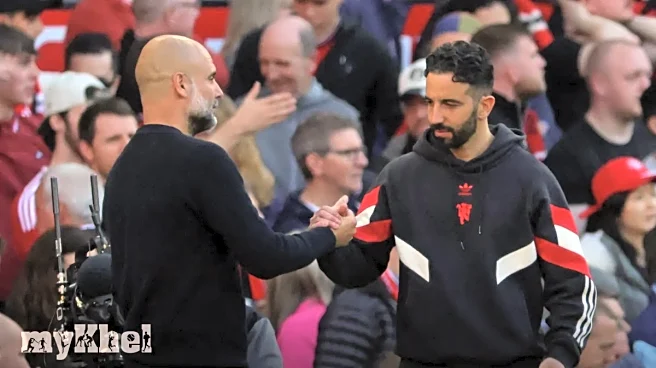

Pep Guardiola stressed that Ruben Amorim is "a top manager" while warning that Premier League managers now receive less patience. Guardiola’s comments followed Amorim’s dismissal by Manchester United and
Enzo Maresca’s departure from Chelsea, two major changes that again highlighted how quickly clubs in England’s top flight act when results or relationships turn.
Amorim left Old Trafford after 14 months in charge, with the decision confirmed on Monday, days after Maresca exited Stamford Bridge. Reports indicated that Amorim’s criticism of Manchester United’s hierarchy, following a 1-1 draw with Leeds United at Elland Road, played a key role in the outcome, alongside concerns over performances and defensive numbers.
Manchester United announced that former midfielder Darren Fletcher would serve as interim manager, closing Amorim’s short and turbulent spell. In Premier League matches, Amorim recorded the club’s lowest win percentage at 32 per cent, the highest goals conceded rate at 1.53 per game, and the lowest clean sheet figure at 15 per cent among United managers.
Maresca, appointed at Chelsea for the 2024-25 Premier League season, left after 57 league fixtures. Reports suggested a breakdown in Maresca’s relationship with senior club figures followed disappointing results. Amorim, who took over United in November 2024, led 47 league games, and both exits added weight to the wider debate about how long Premier League managers are trusted.
Asked directly whether Premier League managers are now allowed less time, Guardiola replied with a clear message. He said: "Yes, it's a fact. Less time. Like what happened with Enzo [Maresca]. I can't say anything out of respect for the players and the institutions of Chelsea and Manchester United. All I can say is Ruben is a top manager. The decision has been made by our neighbours, but I wish Ruben all the best for the future. "
Club statement: Ruben Amorim.Manchester United (@ManUtd) January 5, 2026
Guardiola is now the longest-serving manager currently working in the Premier League, having taken charge of Manchester City in 2016. During that time, Guardiola has managed 362 league games and collected 18 trophies in all competitions, yet questions were still raised about Guardiola’s position during a difficult spell last season.
After a fourth-round EFL Cup exit to Tottenham in October, Manchester City entered a poor sequence across competitions. City won only one of 13 fixtures during that spell, which also included five straight defeats, a first for Guardiola in any managerial role. Despite that slide, City recovered well enough to finish third in the Premier League table.
| Manager | Club | Premier League matches | Win ratio | Goals conceded per game | Clean sheet ratio |
|---|---|---|---|---|---|
| Ruben Amorim | Manchester United | 47 | 32% | 1.53 | 15% |
| Enzo Maresca | Chelsea | 57 | Not specified | Not specified | Not specified |
Guardiola has never been dismissed in previous posts with Barcelona and Bayern Munich, yet argued that the pressure in England is no lighter than top leagues elsewhere. He stated: "It is quite similar. I don't think there is another country where you are safe if you don't win games. If you don't get results, it doesn't matter. The past or present. Every manager is hired for their ideas, and they are sacked for their results. You need a process and time. "
Using Manchester United’s recent form to underline small margins, Guardiola pointed to specific draws against Everton and Bournemouth at Old Trafford. Guardiola said those opponents "did an incredible job" and argued that with different results, United’s points total could have been close to Arsenal’s. Guardiola highlighted that United also faced many absences in their last game, which made performances harder to manage.
Guardiola accepted that the true reasons for Amorim’s dismissal remained unclear from the outside, stating: "But, the reason why? To be honest, I don't know. " The recent exits of Amorim and Maresca, together with Guardiola’s experiences at Manchester City, underline how Premier League managers operate under intense, constant judgement based on results and dressing room stability.



/images/ppid_59c68470-image-177090253948689009.webp)


/images/ppid_59c68470-image-177090263892442922.webp)
/images/ppid_59c68470-image-177090260766158912.webp)
/images/ppid_59c68470-image-17709025718378487.webp)