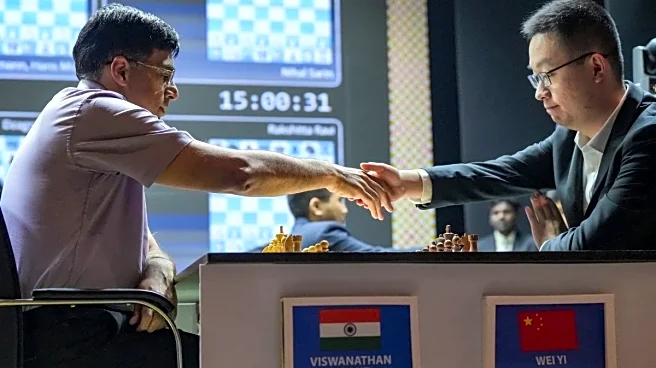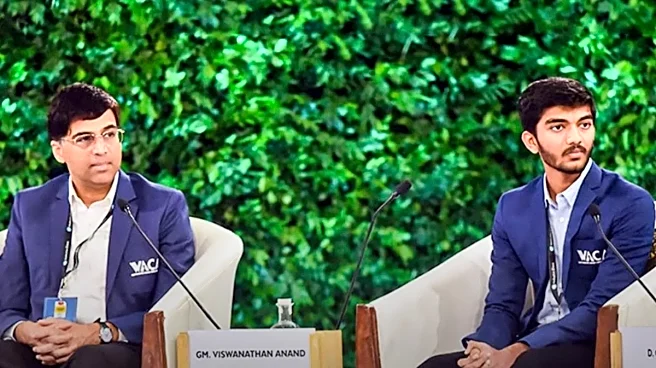

Indian chess is set for a landmark moment as five-time world champion Viswanathan Anand prepares to step back into competitive action after a six-year absence. The legendary grandmaster will return to the
board at the seventh edition of Tata Steel Chess India, scheduled to be held from January 7 to 11, where he will come face to face with reigning world champion D Gukesh and several other members of India's new-generation elite.
Anand last competed in this tournament in 2019, and his comeback adds a historic layer to the event, marking the first individual chess tournament in India where two world champions - from different eras - will compete against each other.
The clash between Anand and Gukesh carries added significance, with the young champion having trained under Anand's guidance at the WestBridge Anand Chess Academy, making the encounter a symbolic "master versus apprentice" battle.
The tournament will be hosted at Kolkata's Dhono Dhanyo Auditorium and will feature both Open and Women's categories in rapid and blitz formats. In a notable move, organisers have ensured equal prize money across both sections, reinforcing the event's commitment to parity in the sport.
The Open section boasts a formidable international lineup, including FIDE World Cup runner-up Wei Yi, former US champion Wesley So, American grandmaster Hans Niemann, and rising star Volodar Murzin. India's challenge will be led by R Praggnanandhaa and Arjun Erigaisi, along with experienced campaigners Vidit Gujrathi and Aravindh Chithambaram.
The Women's event is equally competitive, headlined by World Cup winner Divya Deshmukh. She will be joined by former world championship challenger Aleksandra Goryachkina, Kateryna Lagno, Nana Dzagnidze, D Harika, Carissa Yip, Vaishali R, Vantika Agrawal and Rakshitta Ravi.
Speaking about his return, Anand acknowledged the rapid evolution of the chess landscape, particularly in India, where a surge of young talent has reshaped the global hierarchy. Tournament officials echoed the sentiment, describing Anand's participation as a defining moment for the competition and a reflection of Indian chess's generational transition.
As anticipation builds, the tournament promises not just elite competition but a powerful narrative - one that captures the passing of the torch in Indian chess.

/images/ppid_a911dc6a-image-177060802130265096.webp)