

World No.1 Carlos Alcaraz turned to Formula 1 for inspiration after surviving one of the most physically punishing matches of his career, referencing Fernando Alonso in his celebration following his dramatic Australian Open semi-final victory over Alexander Zverev.
Cramping heavily and repeatedly pushing the brink, Alcaraz dug into his deepest physical and mental reserves to prevail 6-4,7-6 (7-5), 6-7 (3-7), 6-7 (4-7), 7-5 after a marathon five hours and 27 minutes in Melbourne. The scoreline, extraordinary as it is, barely captures the tension and attrition of a match that swung relentlessly between dominance and survival.
With the win, Alcaraz reached his first Australian Open final and became the youngest player in tennis history to make the final of
all four Grand Slams - a milestone that mirrors double F1 champion Fernando Alonso's reputation as a generational outlier who redefined what was considered at a young age in F1.
- Carlos Alcaraz (@carlosalcaraz) January 30, 2026
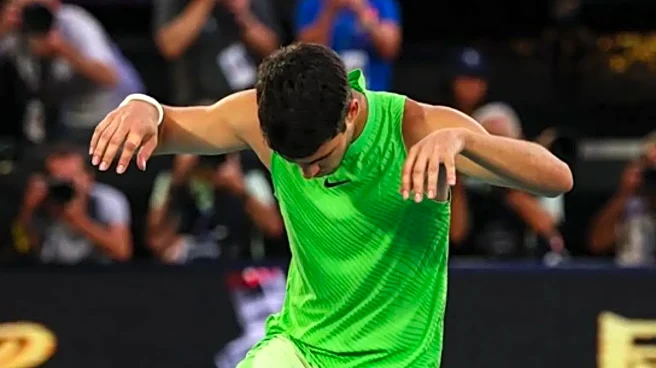
As he sealed victory, Alacaraz struck Alonso's famed "samurai" pose, a gesture deeply embedded in Spanish sporting culture.
What Fernando Alonso's samurai pose meant and why Carlos Alcaraz chose it
The pose Alcaraz echoed dates back to one of the defining moments of Alonso's career. During a crucial F1 race in the 2006 World Championship fight, Alonso inherited the lead after Michael Schumacher's engine failure on lap 37- Schumacher's first such retirement in six years. Alonso went on to win the race, putting himself a point away from the title, which he secured at the final round.
That victory was about more than speed. It was about endurance, timing, and surviving when the margins collapsed - themes that resonated unmistakably with Alcaraz's Melbourne ordeal. Like Alonso, then, Alcaraz did not dominate uninterrupted. He absorbed pressure, endured physical limits, and emerged standing when the contest finally broke.
Carlos Alcaraz: The ultimate Fernando Alonso fan
Alcaraz's admiration for Alonso is not new. During the Miami Open two seasons ago, he famously wrote "33 → soon" on a TV camera, a nod to Alonso's pursuit of his 33rd F1 win.
"To me, it's crazy what he's doing at his age," Alcaraz said at the time. "He's basically in the fight for the F1 championship. It's great to have him there. "
Alonso, a two-time world champion, has publicly inspired Alcaraz before. The Spaniard even credited Alonso's performances, motivating his own title run at Indian Wells, writing on Instagram: "You motivated me for the Indian Wells final! You're an animal!"
Now, in Melbourne, that inspiration came full circle. Alonso once survived the chaos of a title race to tilt history in his favor. Alcaraz, cramping and cornered, did the same and celebrated accordingly.
In elite sport, icons borrow from icons. And in that samurai pose, Alcaraz wasn't just celebrating a win - he was placing himself firmly in Spain's lineage of athletes who endure, adapt, and outlast when everything is on the line.