
/images/ppid_a911dc6a-image-177521122426797713.webp)
Leh (Ladakh), January 25: The decision of the ice skating federation and the Khelo India Winter Games 2026 organising committee to ratify the results of the women's 1000m long track final at Guphuk's Pond on Thursday (January 23) has raised serious questions over fairness, athlete safety and consistency, particularly after the men's race was cancelled citing adverse weather conditions.
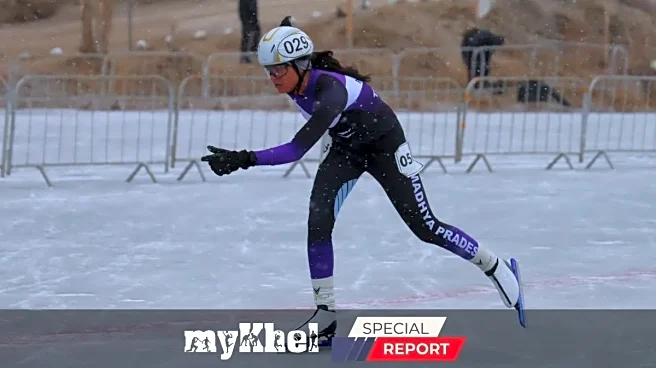
The women's final, held on the frozen lake at Guphuk's Pond, was conducted in a time-trial format, with skaters racing in pairs. While the first set of competitors completed their races under relatively stable conditions, the weather changed dramatically midway through the event, severely impacting the latter half of the field. The race coincided with the first significant
snowfall in Leh in recent days.
This reporter was present at the venue on Thursday afternoon when strong winds swept across the frozen pond, making balance and forward momentum extremely difficult, especially in the latter stages of the race. Soon after, snowfall reduced visibility, leaving athletes struggling to clearly identify the marked track on the frozen surface.
Despite the rapidly deteriorating conditions, the women's race was allowed to continue.
As many as 16 athletes completed their runs before the weather turned hostile. However, every skater who raced thereafter failed to reach the finish line. In total, eight athletes were disqualified, while five sustained injuries during the event. The update on the condition of athletes wasn't provided by the federation officials, when myKhel reached out to them.
Given the stark contrast in racing conditions between the early and later heats, there was a widespread expectation among athletes and coaches that the event would either be re-run or declared void, as conditions were no longer uniform for all competitors.
That, however, did not happen.
While the men's 1000m long track race was cancelled outright due to the same weather concerns, the Games Technical Conduct Committee (GTCC) chose to uphold the women's results, effectively ignoring the unequal conditions under which the latter half of the field competed.
The decision has drawn particular attention due to the disqualification of Udreka Singh of Madhya Pradesh, who had won the gold medal in the women's 500m long track race just a day earlier at the same venue. The only difference then was that weather conditions were calm and conducive, allowing all athletes a fair contest.
Athletes and team officials privately questioned how the same venue and conditions were deemed unsafe for the men's race, yet acceptable for the women's results to stand. "If weather conditions were severe enough to cancel the men's event, the same yardstick should have been applied to the women's race," a team official said, requesting anonymity.
None of the participating team managements lodged a formal protest, with several officials privately expressing concerns over possible repercussions for their athletes.
Long-track speed skating on natural ice is heavily dependent on visibility, wind direction and surface stability. Even marginal changes can significantly affect timing, balance and safety-critical factors in a time-trial-based event.
By proceeding with the women's race despite worsening conditions, the organisers have opened themselves to scrutiny over whether competitive equity and athlete welfare were compromised.
When myKhel reached out to Ice Skating Association of India (ISAI) president Amitabh Sharma, he said the results were upheld because the federation intended to announce the men's and women's 1000m events together.
"In Winter Games, inclement weather does not get too much consideration, so there was no point in re-hosting the women's race. We released the results after a gap of 24 hours because we wanted to announce the men's and women's 1000m races together," Sharma told myKhel.
He added that the men's race was postponed because the field of play (FOP) required re-preparation. "The men's race was rescheduled as the track needed fine-tuning before it could be started," he said.
However, it is worth noting that the women's results were released on Saturday (January 24) around 8 pm, while the men's 1000m race was eventually held on Sunday (January 25), making the explanation less convincing.
With Khelo India positioned as a flagship development platform for winter sports, and significant government investment aimed at creating a credible pathway for young athletes, the events at Guphuk's Pond underline the need for clear weather protocols, transparent decision-making and consistent safety standards.
When medals, athlete safety and competitive fairness are at stake, ambiguity in governance risks undermining the credibility of the competition and demotivating the juniors to pick up a different sport.