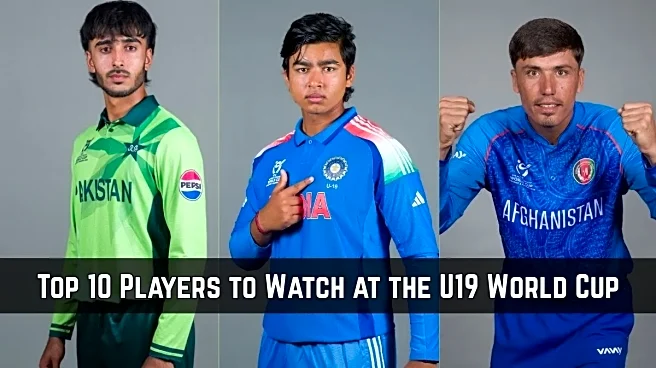


The ICC U19 Men's Cricket World Cup 2026 has long been a proving ground for future international stars. From Virat Kohli and Kane Williamson to Shubman Gill and Yashasvi Jaiswal, the tournament has consistently offered an early glimpse of players ready to step onto the global stage.
With the 2026 edition set to begin on January 15 across Zimbabwe and Namibia, the focus once again turns to identifying who could define this cycle. Based on recent performances in qualifiers, continental tournaments, domestic competitions and age-group tours, here are 10 players who enter the tournament with form, momentum and expectation firmly on their side.
Sameer Minhas (Pakistan)
No player arrives with stronger numbers than Sameer Minhas. His U19 Asia Cup campaign was dominant: 471 runs
at an average of 157, capped by a match-winning 172 in the final against India. Nearly 200 runs clear of the next best batters, Minhas looks primed to anchor Pakistan's campaign and is an early favourite for the tournament's leading run-scorer.
Khalid Ahmadzai (Afghanistan)
Afghanistan's rise at the youth level continues, and Khalid Ahmadzai has been central to it. He amassed 202 runs at an average of 101 in the World Cup qualifiers, guiding his side through pressure situations. His ability to build innings gives Afghanistan rare batting stability.
Nitesh Samuel (Australia)
Australia's battling depth is underlined by Nitesh Samuel, who finished as Player of the Tournament at the National U19 Championships with 364 runs at 91. Domestic dominance at this level often translates well in World Cups, especially for batters comfortable playing long innings.
Abdul Subhan (Pakistan)
While Pakistan's batting headlines grab attention, their bowling attack could be just as decisive. Abdul Subjand was devastating in the Asia Cup, claiming 13 wickets at under 10. In tournaments where early breakthroughs shape games, his strike rate makes him a constant threat.
Deepesh Devansh (India)
India's pace stocks are deep, but Deepesh Devendran stands out for his consistency across conditions. A regular wicket-taker on tours of England, Australia and the UAE, Devendran has taken wickets on every overseas U19 tour India has played in over the past six months, underlining his adaptability on unfamiliar African surfaces.
Iqbal Hossain Emon (Bangladesh)
Returning from the 2024 U19 World Cup, Iqbal Hossain EMon brings experience and discernment. Two five-wicket hauls against Afghanistan and a four-for against Zimbabwe underline his role as Bangladesh's pace spearhead.
Vaibhav Sooryavanshi (India)
At just 14, Vaibhav Sooryavanshi arrives with a level of exposure rare for his age, having already featured in the IPL ecosystem. He scored 240 runs in the 2025 IPL season at a strike rate of 188.97, showing an ability to score quickly without reckless shot-making. That grounding alongside senior professionals has sharpened his game awareness. While the U19 World Cup will test his temperament, India backed his adaptability to translate early promise into impact on the global stage.
Tom Jones (New Zealand)
Leadership matters at youth World Cups, and Tom Jones offers both authority and runs. Fresh off a debut first-class hundred for Otago, Jones brings composure and game awareness that can steady New Zealand in tight moments.
Sethmika Seneviratne (Sri Lanka)
Spin frequently decides matches in U19 tournaments, and Sethmika Seneviratne has already shown his match-winning potential. His Asia Cup figures - eight wickets, including a five-for - mark his out as Sri Lanka's key middle overs enforcer.
Zawad Abrar (Bangladesh)
Rounding out the list is Zawad Abrar, whose back-to-back fifties in Asia Cup build-ups have given Bangladesh much-needed middle-order reliability. In youth cricket, stability often proves as valuable as flair.
This ranking prioritises recent output over reputation. Runs scored under pressure, wickets taken consistently, and exposure to senior or high-intensity domestic cricket are often better indicators of World Cup impact than raw potential alone.
While the U19 World Cup inevitably throws up surprise performers, history suggests that players arriving with momentum tend to shape the tournament narrative. As the next generation gathers in Zimbabwe and Namibia, these ten names look best placed to define what the future of international cricket might look like.


/images/ppid_a911dc6a-image-177092774715746114.webp)

/images/ppid_a911dc6a-image-177092767520012684.webp)
/images/ppid_a911dc6a-image-177092763347449403.webp)
/images/ppid_a911dc6a-image-177092652580356823.webp)