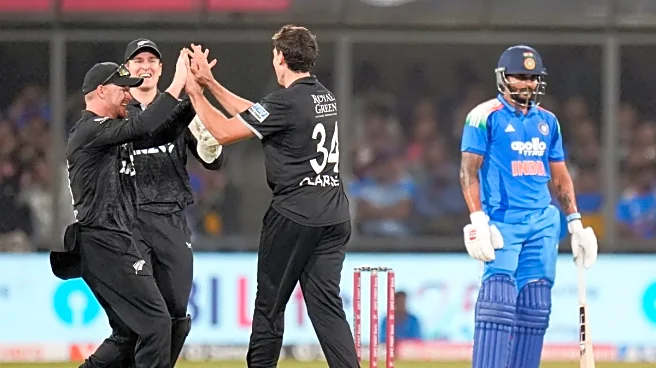

In a contest that swung violently between early devastation and middle-order dominance, New Zealand completed a landmark breakthrough at the Holkar Cricket Stadium on Sunday. A 41-run defeat in the third
and final ODI condemned India to a 2-1 series loss, handing the Black Caps their first-ever bilateral ODI series victory on Indian soil. The result, achieved despite a defiant 54th ODI century from Virat Kohli, underlined a series where India's structural flaws outweighed individual brilliance and intensified scrutiny on head coach Gautam Gambhir.
India's night began with promise bordering on domination. The new-ball pairing of Arshdeep Singh and Harshit Rana tore into the New Zealand top order, reducing the visitors to 5/2 inside the opening two overs and igniting hopes of a rout. Henry Nicholls fell without scoring and Devon Conway soon followed, the early collapse reflecting both pressure and movement under lights. Yet the optimism proved fleeting, as New Zealand's middle order delivered a counter-punch that reshaped not only the match but the entire series narrative.
What followed was an exhibition of resilience and controlled aggression from Daryl Mitchell and Glenn Phillips. Calm in the face of collapse, the pair absorbed the early storm before methodically dismantling India's bowling plans. Their 219-run partnership was built on clarity of roles-Mitchell anchoring the innings with authority and placement, Phillips injecting tempo with fearless stroke-play. Mitchell's 137 was a study in balance and discipline, while Phillips' explosive 106 ensured that India never regained control once the momentum shifted. By the time New Zealand reached 337/8, a total shaped from near disaster, the psychological edge had decisively swung away from the hosts.
Chasing a daunting target, India's response lacked the foundation required for a record pursuit. Early dismissals of Rohit Sharma and Shubman Gill exposed the middle order far too soon, leaving the scoreboard reading a fragile 71/4. Into this uncertainty walked Kohli, carrying not just expectation but the weight of a series slipping away. With assured footwork and impeccable judgment, he once again demonstrated why high-pressure chases remain his domain.
Kohli's innings was a masterclass in control under duress. He paced the chase expertly, finding boundaries without reckless risk and rotating strike to keep the asking rate within sight. His 124 off 108 balls, adorned with eight fours and two sixes, brought up his 54th ODI century, his 85th international hundred, and a seventh against New Zealand. Crucially, he found meaningful support when India needed it most. Nitish Kumar Reddy played his part, but it was Harshit Rana who provided the spark that briefly reignited belief. Rana's blistering 52 was remarkable not merely for its speed but for its intelligence-turning potential sixes into twos, absorbing pressure, and ensuring Kohli could hold one end with assurance. As long as the partnership endured, India remained in the hunt.
The decisive blow arrived in the 46th over, a moment that encapsulated the fine margins of the chase. With the required rate climbing, Kohli attempted to lift pacer Kristian Clarke over long-off, only to mistime the shot. Mitchell, fittingly at the heart of New Zealand's triumph, completed the catch, and with it went India's last realistic hope. The end that followed was swift and unforgiving, New Zealand's discipline matching their earlier boldness.
Fittingly, it was Phillips who applied the final seal. Already the standout performer, he produced a sharp direct hit to run out Kuldeep Yadav, bowling India out for 296 and completing a performance worthy of Player of the Match honours. The sharpness in the field mirrored New Zealand's clarity throughout the series-alert, aggressive, and unyielding in key moments.
Beyond the immediate result, the defeat carries deeper implications for India. While Kohli's form remains imperious, the series exposed persistent vulnerabilities at the top of the order and a bowling unit that struggled to adapt once early breakthroughs failed to translate into sustained pressure. The inability to disrupt the Mitchell-Phillips partnership in Indore, much like earlier moments in the series, highlighted a lack of tactical flexibility at crucial junctures.
For New Zealand, the victory represents far more than a series win. It is a statement of evolution and belief, forged through resilience after early setbacks and sustained by decisive performances under pressure. For India, the loss is a rare home humiliation, one that leaves searching questions in its wake and reinforces the urgent need to bridge the gap between individual excellence and collective execution.