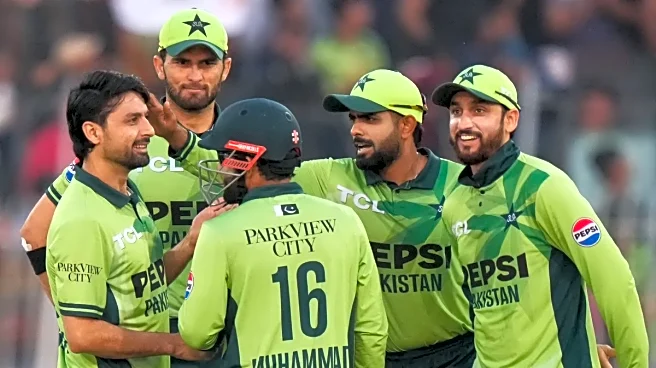

New Delhi, January 24: With the Pakistan Cricket Board (PCB) casting doubt over its participation in the ICC Men's T20 World Cup 2026 following Bangladesh's exclusion, the focus has shifted to a key contingency
question: who would replace Pakistan if they decide to pull out of the tournament?
The uncertainty stems from PCB chairman Mohsin Naqvi's statement that Pakistan's participation will be decided by the government, not the cricket board.
Naqvi, who also serves as Pakistan's Interior Minister, said the PCB would comply with whatever directive comes from Islamabad, effectively placing Pakistan's World Cup future in political hands and prompting the ICC to prepare fallback options.
Naqvi's remarks came despite the fact that the ICC had cleared a hybrid hosting model well in advance, allowing Pakistan to play their matches in Sri Lanka-a concession similar to previous ICC events held in India. In contrast, Bangladesh's request to shift matches away from India came at a very late stage, creating significant logistical challenges related to scheduling, travel, broadcast planning and ticketing.
Financial Stakes for Pakistan
If Pakistan were to withdraw, the PCB would forfeit the USD 500,000 participation fee allotted to each team. While not as severe as the financial hit faced by Bangladesh, the loss would still be a tangible setback, particularly when coupled with the reputational and sporting implications of missing a global ICC event.
ICC Replacement Protocol: Rankings First
Should Pakistan formally pull out, the ICC is expected to apply the same replacement mechanism used in the Bangladesh-Scotland swap. Under ICC regulations, a vacant spot is filled by the highest-ranked team in the ICC Men's T20I Team Rankings that has not already qualified.
This approach was adopted to maintain competitive balance and minimise disruption to an already finalised tournament structure.
Who Are the Leading Candidates?
If Pakistan were to withdraw from the ICC Men's T20 World Cup 2026, the spot would very likely go to the highest-ranked non-qualified team under the ICC's established criteria - and based on the most recent T20I rankings, Uganda and Papua New Guinea emerge as the strongest candidates, followed by Kuwait, Hong Kong and Malaysia.
With Scotland already drafted in, the next teams in line based on current rankings and qualification outcomes are:
Uganda Lead the Race
Based strictly on the current ICC Men's T20I rankings, Uganda emerge as the highest-ranked non-qualified team, placing them at the front of the queue should Pakistan withdraw. Uganda's rise in T20Is over the last two years has been steady, and their ranking now puts them ahead of several traditional Associate contenders.
PNG Next in Line
Papua New Guinea (PNG) are next in contention. The East Asia-Pacific side narrowly missed qualification during the regional finals and have previous T20 World Cup experience, which could work in their favour from a readiness and logistics standpoint.
Kuwait, Hong Kong Also in Contention
Following Uganda and PNG, Kuwait feature prominently in the rankings among non-qualified teams, while Hong Kong and Malaysia remain further down the order.
While rankings are the primary criterion, the ICC may also consider travel readiness and squad availability, especially with the tournament approaching.
What Happens Next?
The replacement process would be triggered only if Pakistan officially notify the ICC of their withdrawal. No deadline has been publicly set, but with the tournament scheduled to begin in India and Sri Lanka, the ICC is expected to act swiftly should a formal decision be communicated.
For now, Pakistan remain officially part of the T20 World Cup 2026. However, with the PCB deferring the call to the government, the ICC's contingency planning-and the race among Associate nations-remains very much alive.
/images/ppid_a911dc6a-image-177101053501199609.webp)

/images/ppid_59c68470-image-177101003680064644.webp)



/images/ppid_59c68470-image-177100753350744656.webp)
/images/ppid_a911dc6a-image-17710070301901476.webp)
/images/ppid_a911dc6a-image-177100572282276854.webp)