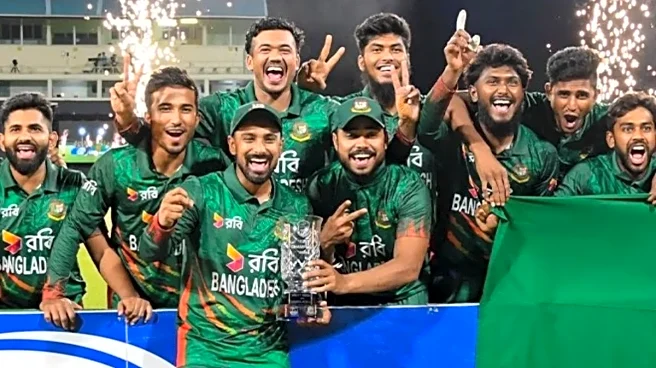


Bangladesh have hardened their stance over participation in the upcoming ICC T20 World Cup, with sports advisor Asif Nazrul making it clear that the country will not bow to pressure if unreasonable conditions are imposed on the Bangladesh Cricket Board (BCB).
Speaking to the media on Tuesday, Nazrul warned that Bangladesh would not accept any diktats if the ICC caves in to external influence.
The controversy centres on Bangladesh's refusal to play their group-stage matches in India due to security concerns. The team has formally requested the ICC to shift their fixtures to co-host Sri Lanka, but talks held over the weekend in Dhaka failed to produce a breakthrough. According to reports, the BCB raised concerns following the BCCI's directive to IPL
franchise Kolkata Knight Riders to release Mustafizur Rahman amid ongoing political tensions between the two countries.
Nazrul also dismissed speculation that Scotland could replace Bangladesh if they opt out of the tournament. "I am not aware that Scotland will be included in our place (in the upcoming ICC T20 World Cup). If the ICC bows to pressure from the Indian Cricket Board and tries to impose pressure on us by setting unreasonable conditions, we will not accept those conditions," he said.
Citing past precedents, Nazrul pointed out that venue changes have been approved by the ICC under similar circumstances. "In the past, there were examples where Pakistan said that they would not travel to India and ICC changed the venue. We have asked to change the venue on logical ground and we can't be pressurised to play in India by putting illogical pressure," he added.
As per a report in Cricbuzz, the ICC has set January 21 as the deadline to resolve the impasse, with tournament timelines tightening rapidly. Should Bangladesh be replaced, Scotland - the highest-ranked team to miss qualification - would require at least 15 days of preparation.
Bangladesh are currently placed in Group C alongside England, West Indies, Italy and Nepal, with matches scheduled in Kolkata and Mumbai. With the deadline approaching, the ICC now faces a delicate balancing act as it attempts to resolve the dispute without further escalation.