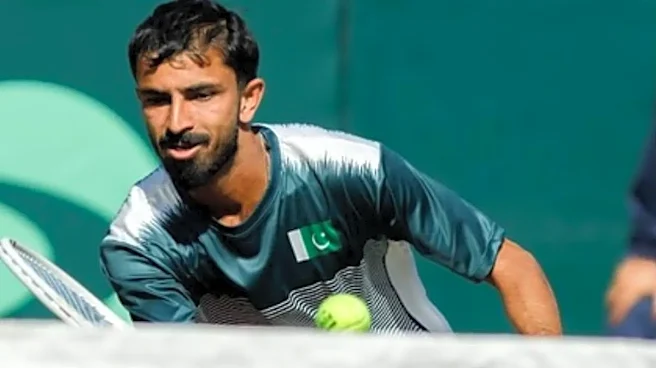



Pakistan tennis gained a rare singles champion in men's tennis when Muhammad Shoaib captured an ITF Futures title in Islamabad, ending a 20-year wait since Aqeel Khan's win in Lahore in 2007 and Aisam-ul-Haq Qureshi's Challenger success in Delhi, and the former ball boy from Peshawar is now set to become Pakistan's top-ranked singles player.
The victory, at the lowest tier of the Pro Circuit, still carries weight for Pakistan tennis, which usually celebrates doubles success through Aisam rather than singles results, and Shoaib's 15 ATP points from the event move the 20-something from no ranking to national No. 1 in one week, altering the conversation around the sport's future in the country.
Pakistan tennis milestone and ITF Futures title significance
For Pakistan tennis followers, Shoaib's success stands
as only the third international singles title by a player from the country, placing the Peshawar native alongside Aisam-ul-Haq Qureshi and Aqeel Khan, and while the trophy is modest in global terms, it represents a rare local breakthrough and a story that began far from professional academies or structured support.
The ITF Futures event in Islamabad gave Pakistan tennis players a rare chance to compete at home, and Shoaib arrived with one goal, not a title dream, telling PTI, "My goal was just one ATP point. I just wanted to start my journey," a line that underlines how limited his expectations were before the week unfolded in his favour.
Pakistan tennis revival and ranking rise for Shoaib
The context around Pakistan tennis has shifted slightly since Aisam-ul-Haq Qureshi took charge of the Pakistan Tennis Federation, with more home tournaments and better scheduling, and Shoaib says this has made a real difference, adding, "He thinks like a player. That has helped us a lot," because decisions now factor in what travelling professionals actually need across a season.
Those changes mean Shoaib's jump from unranked to Pakistan's No. 1 singles player arrives at a delicate moment for Pakistan tennis, as the sport still struggles for attention and funding, yet his run in Islamabad offers the federation a live example of what can happen when domestic players receive main-draw places, ranking points and competition without expensive foreign travel.
Muhammad Shoaib And Pakistan Tennis
Long before Pakistan tennis officials discussed rankings and circuits, Shoaib's life revolved around basic survival in Peshawar, where his father Haider Hussain worked on daily wages of Rs 500-600 on farms, income that disappeared whenever rain stopped work, and the family sometimes worried about meals, while Shoaib helped as a ball boy and watched others play from the court's edge.
Haider Hussain saw education as a safer path than Pakistan tennis and repeatedly pushed Shoaib towards it, saying, "He told me to study, to become a teacher or engineer. Tennis was too expensive for us. " Still, Shoaib's mother refused to let that dream die, insisting, "She always said, if you work hard, you will prove everyone wrong. "
With limited money, the basics of Pakistan tennis training became a daily challenge for Shoaib, who bought second-hand rackets and used shoes in local markets when he could, and when he could not, he still trained, saying, "I used to play in slippers and wear Salwar Kameez. We didn't have money for anything," describing how the sport began as a luxury he could barely touch.
The conditions were harsh at Peshawar Club, where Shoaib and other hopefuls often trained at midday because courts were empty only in extreme heat, old balls were dipped in water to slow them on worn surfaces, and his footwear fell apart, leading him to recall, "There were holes in them. When I slid, my feet would bleed. But I kept on playing. "
Pakistan Tennis: Future, ATP Points & Financial Reality
By the time the Islamabad tournament began, years of narrow losses against higher-ranked rivals had left Shoaib wary of bold targets in Pakistan tennis, and he entered thinking mainly of that single ATP point, yet once he secured it, his tennis loosened, his confidence returned, and wins followed, including a fearless upset of the top seed sealed with an ace in a tense moment.
Through the week, Shoaib adjusted his mindset, telling himself before key matches, "I told myself I will give 100 percent so that I don't regret about anything," and as he moved into the final, the thought of ending Pakistan tennis's 20-year singles drought never entered his head; instead, he played each point on its own terms and allowed momentum to carry him.
When match point landed and the ITF Futures title was his, Shoaib needed time to absorb what Pakistan tennis fans already understood, saying, "When I won, I couldn't believe it. People told me I had broken a 20-year record. That was never in my mind," and only later did the scale of his 15 ATP points and historic status truly sink in.
Shoaib's new ranking, however, does not automatically fix the long-standing financial problems around Pakistan tennis, and he states the situation plainly: "We don't have sponsors. Even playing one tournament is difficult," because travel, accommodation and entry fees add up quickly, especially if a player wants to build on fresh points and chase more events abroad.
His plan is simple on paper and complex in reality for Pakistan's tennis structures, as he wants to play 15-20 tournaments in a year and move further up the rankings, yet funding remains unclear, leading to his blunt question, "What will I do with these 15 points if I don't get a sponsor?" which highlights how fragile this breakthrough could be without backing.
The win has also reawakened memories and ambitions beyond Pakistan tennis borders for Shoaib, who recalls being praised by Leander Paes during the India-Pakistan Davis Cup tie in Kazakhstan and now wants to travel to India for tournaments, and despite every obstacle, he repeats the belief that drove his journey, saying, "I always believed that if I work hard, I will be rewarded," a belief now reflected in a trophy that may shape Pakistan tennis plans in the months ahead.



/images/ppid_a911dc6a-image-177789159705682475.webp)

/images/ppid_a911dc6a-image-177789155720727075.webp)
/images/ppid_a911dc6a-image-177789152788033520.webp)