
/images/ppid_a911dc6a-image-177090209934057401.webp)
/images/ppid_a911dc6a-image-177090206860094611.webp)
/images/ppid_a911dc6a-image-177090203309067592.webp)
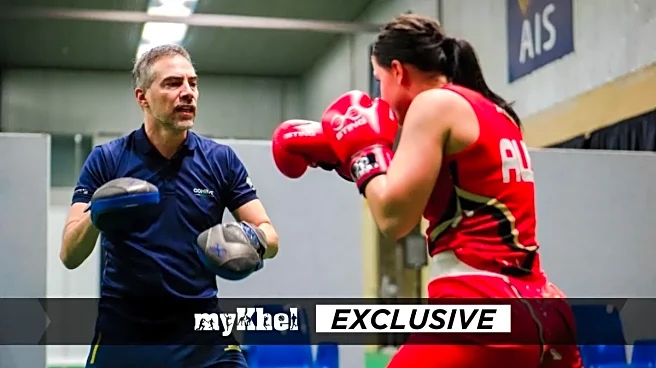
New Delhi, Dec 11: The first time Santiago Nieva walked into an Indian national boxing camp in 2017, he came as an outsider, an accomplished Swedish coach entrusted with rebuilding a fragmented system.
By the time he left in 2021, he had become the quiet architect of a new high-performance culture: medals at world championships, India's largest-ever Olympic boxing contingent, and the emergence of a deeper, more structured pipeline.
Four years later, he returns, not as a newcomer this time, but as a matured person with new lessions, perspective, and a lingering sense of unfinished business.
Appointed as the Head Coach of the Indian Women's National Boxing Team, Nieva reunites with the Boxing Federation of India (BFI) at a moment of both momentum
and fragility for Indian boxing.
Short and long-term goals in sight
While the women's program is soaring; the men's program is searching for revival; the expectations of the nation for another Olympic medal are heavier than ever; and the sport itself is transitioning into a new qualification and ranking ecosystem.
For Nieva, the challenges ahead stretch across both the immediate and the long term goals leading to Los Angeles 2028. In a telephonic conversation with myKhel, he makes it clear that he has returned with purpose, not nostalgia. "I always kept a good relation. so yes, I was interested," he begins.
Talking about the relation with the BFI and Indian Boxing, Nieva's voice carries the familiarity of someone who never truly severed ties. "I had many good years in India," he tells myKhel. "I always kept a good relation with the boxers, the coaches, the Federation people. So yes, when they contacted me, I was interested. And I'm really happy to be back. "
His tone suggests that the bond with India never really faded. It merely paused. Nieva's return, however, comes at a turbulent yet exciting time for the sport.
While Indian women have surged into a global force, sweeping medals at the 2025 World Boxing Cup Finals in Greater Noida, the sport's long-term challenge remains Olympic conversion.
And that, he understands, is where the scrutiny will be sharpest. "My main task," he says, "is to transform all the success to also be having Olympic success in LA 2028. "
Immediate Pressure: Delivering Results in a Crowded Competitive Calendar
Nieva will walk back into the system with barely a moment to settle. The national championships await him almost on arrival, and the Commonwealth Games and Asian Games loom right after.
"Every competition we go to, we want to do well," he says. His voice steadies as he outlines expectations. "At the Commonwealth Games, I think we have a chance to even break the previous records. "
Then comes a sharper reminder of past setbacks. "At the Asian Games, the main target is to get gold medals. Last time there was no gold. So definitely we'll be looking to get some. "
A Second Innings in a System He Now Knows from the Inside
Nieva often reflects on how unfamiliar India felt when he first arrived in 2017. "I didn't know the system," he tells myKhel. "But it didn't take too long to learn. "
His role grew quickly from elite men's coach to high performance director, because he was thrust into a federation in transition, with strong government support and a need to build long-term structures. "I had a little more of an overall responsibility," he says, recalling work across both men's and women's camps.
This time, the advantage is different: he returns not to learn India, but to refine it. "In theory, definitely I should be better prepared with all my experience now," he says. "I'm ready to take on that tremendous project, which is to lead Indian boxing. "
Australia: The Chapter That Strengthened Him
Nieva's years with Boxing Australia changed him as a high-performance leader. What he encountered there was not abundance, but necessity. "When I came here, I realised we had much less resources than in India," he says. But a strong boxing tradition and a receptive environment helped his methods take root.
The results were remarkable: six world medals, two Olympic medals, and the largest Australian Olympic boxing team ever qualified. "We won the first women's world championship ever," he says, still sounding quietly proud. "It went beyond my expectations. "
A New Generation, a Familiar Belief
In his first innings, Nieva worked with icons like Mary Kom and Sarita Devi. Now, he returns to a generation shaped by Lovlina Borgohain, Nikhat Zareen and a youth pipeline producing world-level talent at speed.
"The Indian team is really strong," he says. "Always coming up good boxers from the youth level-it's really exciting. "
But the men's program has drawn concern in recent years. Nieva counters that narrative firmly. "There's no reason why the men can't win medals. India won three medals at the men's world championships in 2023. We have won plenty before, including the Olympic medal. " His belief is not motivational. It is empirical.
A System That Must Evolve Without Losing Its Balance
World Boxing's switch to a ranking-based selection model is one of the many transitions Nieva must now guide. He chooses caution over certainty. "The important thing is to pick the best boxers," he tells further. "I need to experience the system. If it works well, there is no need to change. If not, maybe we have to see. "
His reply is pragmatic, grounded in the understanding that selection is not a process-it is a foundation.
Toward the end of the call, the conversation turns personal. He is reminded that expectations on him are high, higher than before, and India hopes he can take its boxers to new heights. There is a pause on the line, then a soft, certain reply: "That's why I'm coming back. "
He is expected to arrive in India by late December or early January. But his sense of purpose has already landed.
Santiago Nieva's second innings begins not as a return to what he left behind-but as a return to what he believes India can still become.

/images/ppid_59c68470-image-177090253948689009.webp)

/images/ppid_59c68470-image-177090263892442922.webp)
/images/ppid_59c68470-image-177090260766158912.webp)
/images/ppid_59c68470-image-17709025718378487.webp)
/images/ppid_59c68470-image-177090252752740734.webp)