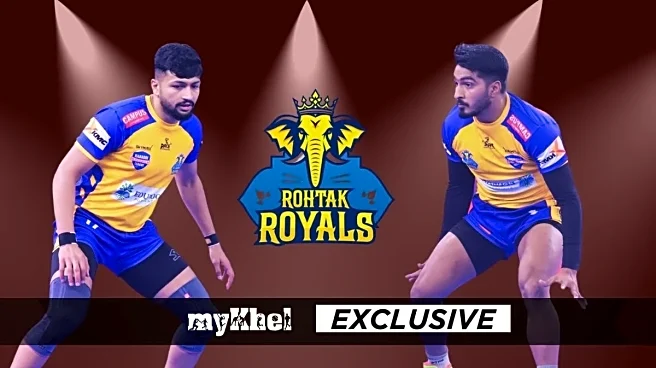



They are still early in their careers, still learning how to live inside the demands of elite sport, but Rohtak Royals' star raiders Milan Dahiya and Ankit Rana already speak like players who understand what Kabaddi asks of them. Not just physically, but mentally, and how it tests patience, discipline, and belief long before it offers reward.
Both are products of environments where sport was never treated lightly. Their paths differ, but the questions they faced: when to commit, how to convince family, and how to handle expectations, are strikingly similar.
For Milan Dahiya, that journey began in Kidoli, a village where kabaddi is less a sport and more a rhythm of daily life. Asked whether the game was ever a conscious choice, he resists the idea
of a defining moment.
"No, it was not like that. Earlier, I used to play other games. But after that, I started playing kabaddi. After that, day by day, I kept improving. I kept growing in the game," he explained. There is no dramatic turning point in his memory, no moment of revelation.
Instead, kabaddi crept through consistency. Interest followed opportunity, and opportunities suggested possibility. "Day by day, my interest kept increasing automatically. I kept getting events. That is why I thought kabaddi is a good career. It will be good in the future. "
For his teammate, Rohtak local Ankit Rana, the foundation was laid far from any professional arena. Growing up helping on his family's farm in Pakasma, his understanding of effort and failure was shaped long before he stepped onto a kabaddi mat. "Since childhood, I have seen that I have struggled and come this far.
"I don't feel like anything is big. I feel like I can do anything," he told myKhel.
That grounding has carried into how he handles success and defeat: without exaggeration, without intimidation. Struggle, for him, is not a setback, but a baseline.
Yet Ankit's sporting journey did not begin early. He started playing Kabaddi seriously at 1, an age that often invites doubt in a system that rewards early bloomers. There was no anxiety about being late, only the clarity of commitment.
"At the age of 15, it happened that I wanted to play. Then I realized that I wanted to make a career in this, and then I became serious. "
That seriousness, however, was not immediate. "In the beginning, I was not so serious for four or five months to a year. In the beginning, I used to play kabaddi to avoid studying, so I was not serious. "
A refreshingly honest admission: sport not as some noble pursuit but as an escape. What followed was confrontation. When academics failed to hold his attention, kabaddi demanded accountability, and convincing his family was harder than convincing himself.
"I ran away from home for two days," he smiles. His parents searched for him while he stayed at a friend's house. Eventually, the standoff ended with a compromise, and he was dropped off at an academy.
For Milan, rebellion wasn't the strategy. "Not like this!" he chuckles at Ankit's story. However, he too was looking for an escape. "My father told me to study, but I wasn't interested. I wanted to play the game and make a career in the game. So, in the beginning, my father refused a lot. "
But like his attacks, Milan was patient. "I told him, you will put so much money (in my studies), but I have no interest. Your money will be wasted, time will be wasted,d and what's the use of that?
"My interest is here, I am a player": an argument that convinced his father to let him follow his heart.
Despite their beginnings, expectation has never arrived as pressure imposed from above. Instead, it exists internally- quiet, demanding, and self-directed.
"The expectations are automatic, I have to play my best, get a gold medal," Ankit explains.
He also shares how the family that was once unsure of this pursuit now shares his passions with the same vigour, keeping their expectations quiet. "My family says, 'We will not tell you anything about your game. You have your own expectations, think about yourself, whatever your goals are, and achieve them. '"
But with Ankit still only 19 and Milan just 20, the question of sacrifice inevitably surfaces. Elite sport is often framed as a trade-off: discipline in exchange for youth, routine in place of recklessness. Surely, there are late nights missed, moments of carelessness left behind.
Ankit laughs at the idea. "Where!? All the players live together here, and the players are more chill here than back home. So all the fun happens. "
The answer is not denial, but reframing. What they have given up is not joy, but distance from home, from family, from familiarity. "There is a lot of sacrifice, ma'am - staying away from home, staying away from the family, staying alone and practicing, struggling, playing with injury, or coming back to the field after getting injured," Ankit added.
Yet within the team environment, ambition is never framed as conflict. Kabaddi, they explain, does not reward individual brilliance in isolation. "If our performance is best, then the team will play well automatically," Milan argues. A raider cannot succeed without defense. Defense cannot win without points. The system forces balance.
As kabaddi continues to evolve, with leagues like the Kabaddi Champions League and the Pro Kabaddi League bringing visibility and scrutiny, the pressure on young players has shifted. Ankit explained, "When we play nationals, it is a little different. There is no public or live streaming. Here everyone is watching, coaches have come, so there is more pressure. "
Still, when asked how they want to be remembered years from now, neither speaks first about titles or fame. "The main thing is that a person's behavior should be good. Whoever is small or big, respect him. "
They want to be known not just as good kabaddi players, but as good people: approachable, grounded, and unchanged by hierarchy.
In a sport that rewards strength and aggression, Milan and Ankit measure success differently. Not by how loudly they announce themselves, but by how consistently they show up for their team, for their families, and for the game that slowly, stubbornly became their life.
/images/ppid_a911dc6a-image-177104902795770968.webp)



/images/ppid_59c68470-image-177104753116157906.webp)