




For nearly three decades, Japan's World Cup story has been one of promise.
There have been famous wins, unforgettable moments and enough near-misses to suggest that the Samurai Blue belong among football's elite. Yet whenever expectations rose, Japan often reverted to caution, content to compete rather than dominate.
On Saturday night in Monterrey, that felt different.
In what happened to be the 1,000th match in FIFA World Cup history, Japan produced arguably the most complete World Cup performance in the nation's history, dismantling Tunisia 4-0 to record their biggest-ever victory at football's biggest tournament.
The scoreline alone was historic.
Never before had Japan won a World Cup match by four goals. Previous victories over Tunisia in 2002
and Denmark in 2010 had been by two-goal margins. This was new territory.
More importantly, it reflected a shift in mentality.
More Than Just Another Group Stage Win
Japan have built a reputation as giant-killers over the years.
The victory over Germany at the 2022 World Cup remains one of the tournament's defining upsets. Beating Spain in the same campaign reinforced their ability to frustrate and punish elite opponents.
Yet those performances often came as underdogs.
Against Tunisia, Japan entered as favourites. Historically, these have been the matches where caution sometimes crept into their game.
Instead, Hajime Moriyasu's side played with conviction from the opening whistle.
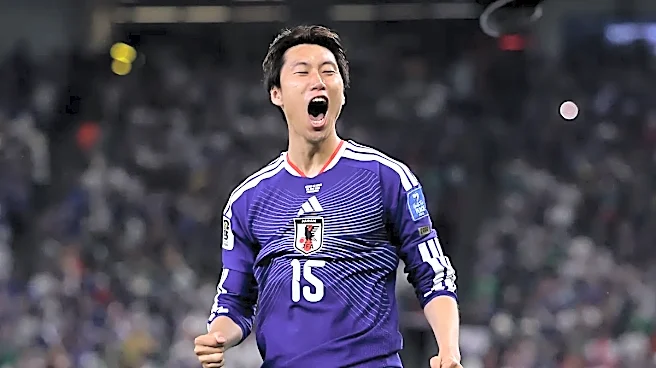
The breakthrough arrived after just four minutes when Daichi Kamada bundled home from close range. Rather than retreat and protect the advantage, Japan continued to attack.
Within ten minutes they could easily have been three goals ahead.
That relentless approach ultimately proved to be the most encouraging aspect of the performance.
Ayase Ueda Shows Why Europe Took Notice
While the goals will dominate headlines, much of Japan's display revolved around striker Ayase Ueda.
The former Eredivisie Golden Boot winner delivered the type of centre-forward performance that modern elite teams rely upon.
He held up play, linked attacks, stretched Tunisia's defensive line and led the press from the front.
His first goal showcased individual quality, driving forward from deep before rifling a precise finish into the bottom corner. His second demonstrated pure striker's instinct, stretching every muscle to guide a looping header into the far corner.
The numbers were impressive.
The influence was even greater.
Japan have often produced technically gifted midfielders and wide players, but elite international tournaments are frequently decided by strikers capable of turning dominance into goals. Ueda looked every bit that player.
A New Version Of Japan?
Perhaps the biggest takeaway was how Japan behaved with a lead.
For years, critics have argued that Japanese football occasionally lacks ruthlessness when controlling matches. Even during successful tournaments, game management often meant dropping deeper and protecting advantages.
Against Tunisia, Japan kept pushing.
Ao Tanaka nearly added a third shortly after half-time before Junya Ito eventually made it 3-0 after another excellent contribution from Ueda.
Even then, Japan refused to settle.
The fourth goal arrived with seven minutes remaining, completing a performance that suggested the team is evolving from one capable of producing shocks into one capable of imposing itself consistently.
That distinction matters.
The gap between quarter-final hopefuls and genuine title contenders is often found in these types of matches.
Chasing Bigger Dreams
Japan's football federation has never hidden its ambition of eventually winning the World Cup.
For years, that objective has sounded aspirational rather than realistic.
One dominant group-stage victory does not suddenly place Japan alongside traditional powers such as Argentina, France, Brazil or England.
But it does provide evidence that the gap may be shrinking.
The 4-0 win leaves the Samurai Blue firmly in control of their qualification hopes, with a draw against Sweden enough to secure progression from Group F.
Yet qualification now feels like the minimum expectation.
In the tournament's landmark 1,000th match, Japan created a milestone of their own.
Whether it ultimately becomes remembered as the night they announced themselves as genuine contenders remains to be seen. But for the first time, Japan did not merely win a World Cup match.
They dominated one. And that could be far more significant.



/images/ppid_a911dc6a-image-178202507264695996.webp)

/images/ppid_a911dc6a-image-178202501950615582.webp)




/images/ppid_59c68470-image-178202502546492126.webp)

/images/ppid_59c68470-image-178202502384534259.webp)