


Japan's Kyosuke Matsuyama and Kazakhstan's Irina Bakaldina claimed the final individual gold medals at the 26th Asian Senior Fencing Championships in New Delhi, closing Day 3 with two results that reshaped the mood of the competition before the team events. The action at Bharat Mandapam on 21 June 2026 also brought encouraging signs for India, with Prachi Lohan and Sachin Sachin producing the home squad's best finishes of the day.
The third day featured men's foil and women's epee, two weapons that demand very different tactical skills. Foil rewards precision, timing and right-of-way judgement. Épee, with the whole body as target, often becomes a test of patience and nerve. Both events delivered upsets, long tactical exchanges and fresh storylines
for the Asian field.
Matsuyama leads Japanese one-two in men's foil
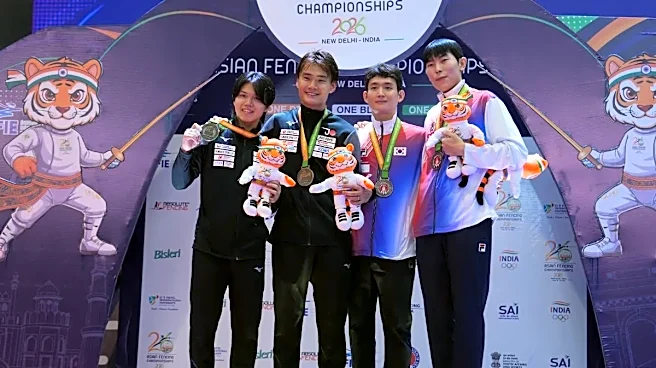
Matsuyama gave Japan its third gold medal of the championships by winning an all-Japanese men's foil final against Kazuki Iimura. The result underlined Japan's depth in a weapon where margins are often decided by small changes in distance, preparation and tempo. Iimura took silver, while South Korea's Im Cheolwoo and Jeonghyun Youn finished with bronze medals.
The gold was made more significant by the route Matsuyama took through the draw. He defeated defending Asian champion Choi Chun Yin Ryan of Hong Kong in the quarterfinals, ending Choi's title defence and pushing him down to fifth place overall. For Japan, the win was not only about the medal table. It was also a statement before the team foil competition.
The biggest shock in the men's foil draw came in another quarterfinal. Hong Kong's Cheung Ka Long, the reigning back-to-back Olympic champion, was beaten by South Korea's Im Cheolwoo. Cheung eventually finished sixth, a rare early exit for one of the sport's most recognisable names. Im's run to bronze became one of the defining performances of the day.
For India, Sachin Sachin led the men's foil group with a 25th-place finish. Sanasam Hemash Singh finished 37th, Tejas Manoj Patil was 47th and Aditya Aditya took 57th place. The positions did not bring a medal challenge, but they gave the Indian camp useful competition mileage against established Asian opponents on home pistes.
Bakaldina creates Kazakhstan history in women's epee
Irina Bakaldina produced Kazakhstan's standout moment of the championships by winning the women's epee gold. She defeated Hong Kong's Kaylin Sin Yan Hsieh in the final, securing Kazakhstan's first-ever individual women's epee title at the Asian Senior Fencing Championships. Hsieh took silver after a strong run through a difficult draw.
Bakaldina's title charge included a major semifinal victory over South Korea's Song Se-ra, the defending champion. Song, one of the most experienced epee fencers in the region, had to settle for bronze. Japan's Tamaki Terayama also finished on the podium, sharing bronze after reaching the semifinals.
Women's epee often rewards fencers who can manage long phases without overcommitting. Bakaldina handled those pressure points well across the knockout rounds. Her success also gives Kazakhstan a major boost in a discipline where medals are usually contested by the region's traditional fencing powers, including South Korea, Japan, Hong Kong and China.
India's best finish in women's epee came from Prachi Lohan, who placed 22nd. Taniksha Khatri followed in 29th, continuing her steady rise at senior level. Mitva Jesangbhai Chaudhari finished 35th, while Yashkeerat Kaur Hayer placed 43rd. For a young Indian group, the day offered a valuable measure of the gap to Asia's medal contenders.
Indian fencers gain experience on home pistes
The Indian results on Day 3 must be read in the wider context of development. Hosting a senior continental championship gives emerging fencers exposure to high-pressure bouts without the travel burden usually attached to international events. It also allows coaches to assess decision-making, footwork discipline and bout management against world-class Asian opposition.
For Lohan and Sachin, finishing as the top Indians in their respective events offers a platform to build from. Neither draw was easy, given the strength of the field and the presence of Olympic and Asian champions. Their performances showed that Indian fencing has athletes capable of competing deeper into pools and knockout rounds when execution improves.
The day's results also carried ranking and qualification importance. The championships are a key part of the competitive pathway towards the upcoming Asian Games and the Los Angeles 2028 Olympic cycle. Strong finishes here can influence confidence, selection discussions and seeding positions in future continental assignments.
After three days, Japan remain at the front of the championship race with three gold medals from the first four individual events. South Korea, Hong Kong and Kazakhstan have also made major podium statements. The spread of medal winners shows the growing depth of Asian fencing across weapons.
The focus now shifts from individual titles to team events, where tactics change sharply. Depth, substitution calls, recovery between bouts and scoreboard management become decisive. For India, the home crowd and recent bout experience could help in the next phase. For Japan and Kazakhstan, Day 3 has already delivered momentum that their teams will look to carry forward.