



Grand Railway Terminus
Completed in 1887 and recognized as a UNESCO World Heritage Site, Chhatrapati Shivaji Maharaj Terminus (formerly Victoria Terminus) stands as a testament to exquisite architecture. Designed by Frederick
William Stevens, this railway station masterfully blends Victorian Gothic Revival styles with indigenous Indian decorative elements, featuring domes, turrets, and intricate stone carvings. Its construction coincided with Bombay's ascent as a pivotal colonial trading hub, and it continues to function as one of India's most heavily trafficked rail junctions. This location vividly illustrates the juxtaposition of Mumbai's historic splendor and its perpetual, dynamic motion.
Legal Heritage Edifice
Established in 1862, the Bombay High Court moved into its current impressive neo-Gothic structure in 1878. Situated near Oval Maidan, this civic landmark boasts distinctive sloped roofs, pointed arches, and extensive corridors. For well over a century, the High Court has played a crucial role in shaping the legal landscape of western India and remains an active judicial center. Its imposing architecture and continued function underscore its enduring significance in the city's historical and administrative fabric.
Scholarly Cultural Hub
The Asiatic Society Town Hall, erected in 1833, is an easily recognizable heritage building in Mumbai, distinguished by its grand staircase and classical columns. It has long served as a vital center for learning, housing a library with a collection of rare books and manuscripts. The building's striking facade, particularly its prominent stairway, has been a familiar sight in numerous films and photographs for many years, solidifying its place in popular culture and historical discourse.
Victorian Venetian Gem
Inaugurated in 1870 and named in honor of the philanthropist David Sassoon, this Venetian Gothic-style building near Kala Ghoda is a cherished cultural institution. Constructed from stone and adorned with decorative arches and balconies, it reflects the 19th-century prosperity and charitable spirit of Bombay. The Sassoon family was instrumental in the city's commercial and civic advancements, and the library itself stands as a beautiful monument to that era of development and philanthropic endeavor.
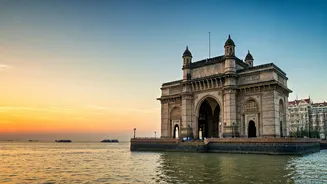
Monumental Welcome Arch
The Gateway of India, completed in 1924 at Apollo Bunder, was initially erected to commemorate the royal visit of King George V and Queen Mary in 1911. Its design employs the Indo-Saracenic architectural style. Later, it gained profound symbolic meaning as the departure point for the last British troops in 1948. Today, it remains one of Mumbai's most recognizable and cherished landmarks, a testament to its historical significance and enduring appeal.
Pioneering Hospitality Icon
Opened in 1903, the Taj Mahal Palace Hotel is renowned globally as a premier Indian hospitality establishment. Conceived by Jamsetji Tata, it symbolized Indian entrepreneurial achievement during the colonial period. Its distinctive red dome and waterfront setting have become synonymous with Mumbai's identity. Over the decades, it has hosted countless monarchs, heads of foreign states, artists, and international visitors, cementing its status as a landmark of luxury and history.
Bustling Historic Market
Widely recognized as Crawford Market, this historic marketplace was constructed in 1869 and opened its doors in 1871. It continues to be one of Mumbai's most active commercial centers. The building's architecture incorporates Norman and Flemish styles, while its interior teems with vendors selling fruits and wholesale spices. It serves as a vibrant hub of trade and a living piece of Mumbai's commercial past, attracting shoppers and traders alike.
Gothic Clock Tower
The Rajabai Clock Tower, completed in 1878 as part of the University of Mumbai's campus, is a striking example of Gothic architecture in the city. Modeled in part after European clock towers, it stands majestically overlooking the Oval Maidan. The construction was funded by Premchand Roychand and dedicated to his mother, Rajabai. This magnificent tower remains a prominent and beautiful feature of Mumbai's architectural heritage.