
Comet Unveiled
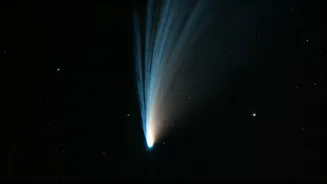
The European Space Agency's (ESA) Juice spacecraft has successfully captured striking new images of Comet 3I/ATLAS, showcasing its active coma and the distinct features of its plasma and dust tails. Though
the mission was originally designed to explore Jupiter's moons, the navigation camera, or NavCam, provided an early visual of the comet's behaviour. The five specialized instruments onboard gathered crucial data, expected to be fully analyzed by February 2026. This data promises deeper insights into this interstellar visitor. The initial observations mark an exciting step in studying distant comets and enhancing the overall understanding of interstellar objects.
Early Imagery
The mission, the Jupiter Icy Moons Explorer, or Juice, observed Comet 3I/ATLAS in November 2025. The spacecraft employed five of its scientific instruments, collecting essential information on the comet's activities, structure, and composition. The NavCam provided an initial visual, revealing the shape, surface features, and potential outgassing regions. This early imagery is helping researchers to guide their expectations for more detailed data collected by the other instruments. The aim of this research is to enhance the existing knowledge of interstellar objects. This observation occurred shortly after the comet's closest approach to the Sun. Scientists anticipate that the data from Juice's scientific instruments will reveal these processes in even greater detail, including the composition and behaviour of the cometary material.
NavCam's Role
The NavCam, primarily designed for navigation, unexpectedly provided preliminary data on Comet 3I/ATLAS. During November 2025, the spacecraft shifted its focus. The observation was made in the days leading up to Juice’s closest approach to the comet, which occurred on November 4 at a distance of approximately 66 million kilometres. The team was able to extract a quarter of a single NavCam image to provide an early look at the comet. This preview revealed the comet with a glowing halo of gas, the coma. Evidence of two distinct tails was also visible: the plasma tail, extending upwards, and a fainter dust tail, stretching to the lower left. This observation occurred shortly after the comet’s closest approach to the Sun, meaning 3I/ATLAS was in a highly active state.
Key Instruments
Juice is equipped with five essential instruments that were activated to study 3I/ATLAS. JANUS is the high-resolution optical camera, capturing detailed images. MAJIS, a spectrometer, analyzes the light emitted and reflected by the comet, revealing its chemical composition. The UVS is an ultraviolet spectrometer that helps detect specific gases in the coma. SWI is the Sub-millimetre Wave Instrument, which provides information on the comet’s temperature and molecular composition. PEP, or the Particle Environment Package, measures charged particles around the comet. These tools provide comprehensive information, paving the way for deeper scientific analysis.
Data Challenges
The raw data collected by the scientific instruments is anticipated for Earth in February 2026. This data will be crucial for understanding the processes within the comet. Scientists expect detailed information about the composition and behaviour of the cometary material. The data will be pivotal in enhancing the current knowledge of comets and space exploration. This information will provide greater insights, not just into comets, but also into interstellar objects, ultimately enhancing our understanding of the universe.