





Kolkata's Near Parity
Kolkata, a city often characterized by its typically lower voter engagement, demonstrated a remarkable surge in participation during the recent elections, coming almost in line with the overall turnout
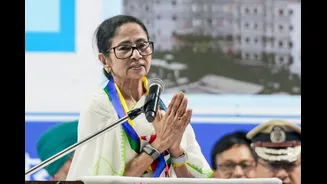
figures for the state of Bengal. Election Commission data indicated that by 9 pm, Kolkata recorded an impressive polling percentage exceeding 88.4%. This stands in stark contrast to the 2021 Assembly elections, where Kolkata's turnout was a mere 60.2%, marking it as the lowest in Bengal. Specifically, the Kolkata South constituency, encompassing areas like Kolkata Port, Bhowanipore, Rashbehari, and Ballygunge, witnessed a substantial 87.7% turnout. Even more impressively, Kolkata North achieved an 89.3% polling percentage. The Bhowanipore constituency, a focal point of intense political contestation involving Chief Minister Mamata Banerjee and Suvendu Adhikari, recorded 86.6% polling by the 9 pm cutoff. To provide context, Bhowanipore, which had 2,06,319 registered electors in 2021, saw its electorate reduce to 1,60,313 this time around, a notable change.
Electors and Turnout Shifts
The electoral landscape in Kolkata saw a considerable reduction in the number of eligible voters between the 2021 Assembly elections and the current polls. In 2021, the 11 constituencies falling under the Kolkata North and South electoral districts collectively had 23,94,993 electors. However, this number significantly decreased to 17,63,345 for the current elections, representing a substantial drop of 6,31,648 electors. In the 2021 polls, 14,42,480 voters had cast their ballots across these constituencies. Looking at specific areas within Kolkata North, Chowringhee, which experienced the highest number of deletions from the electoral rolls in the state (87,725), still managed to achieve a strong 86.6% voter turnout by 9 pm. This constituency's electorate also saw a significant reduction, from 2,08,172 in 2021 to 1,26,349 this year, compared to a 53.2% turnout in 2021. Similarly, Jorasanko, which underwent substantial deletions of 77,993 voters, recorded 86.6% turnout, a dramatic increase from its 49.8% turnout in the previous Assembly polls. Jorasanko's elector count also decreased from 1,97,931 in 2021 to 1,22,686 currently.
Constituency-wise Participation
The constituencies within Kolkata North and South districts exhibited varied but generally high turnout figures in the recent elections. For Kolkata North, the remaining five constituencies – Entally, Beleghata, Shyampukur, Maniktala, and Cossipore-Belgachhia – which recorded turnouts of 67.6%, 62.7%, 57.8%, 62.6%, and 59.6% respectively in 2021, all saw significant increases. This time, they registered turnouts of 92%, 90.7%, 88%, 90.2%, and 88.9% by 9 pm, despite substantial deletions from the voter rolls. In Kolkata South, Rashbehari constituency recorded 86.5% polling by 9 pm, even with approximately 47,000 fewer electors compared to 2021, when its turnout was 59.7%. Kolkata Port, which saw 78,208 deletions, achieved 89.6% polling with 1,71,615 voters, a marked improvement from its 64.4% turnout in 2021 among 2,35,861 electors. Ballygunge recorded 87.8% polling by 9 pm after 71,855 deletions, compared to 60.7% in the 2021 elections. Additionally, Kasba, Behala East, and Behala West, which are under the jurisdiction of DEO, South 24 Parganas, reported turnouts of 89.7%, 88%, and 86.7% respectively by 9 pm.
Drivers of Increased Turnout
Several factors appear to have contributed to the substantial rise in voter participation in Kolkata. A significant reason cited is the extensive process of Special Summary Revision (SIR) of electoral rolls, which led to the deletion of names. This process, while causing concern for some voters who feared their names might be removed, also motivated them to ensure they voted. Instances like Nasim Ali and Manwar Ali, who traveled from Pune to cast their vote, and Sayan Bhattacharya, who voted for the first time after moving from Bangalore and reading about SIR, highlight this phenomenon. Political observers and former election officials also pointed to the impact of anti-incumbency sentiments playing a role alongside the corrections in voter lists. Prasanta Roy, former HoD of political science and sociology at Presidency, suggested that while SIR was a definite driver, a public desire for political change or an 'experiment with the right' might also have influenced voting decisions. Former Bengal CEO Jawhar Sircar echoed this sentiment, stating that the angst over names being struck off the rolls likely compelled many individuals to vote who might not have otherwise participated.