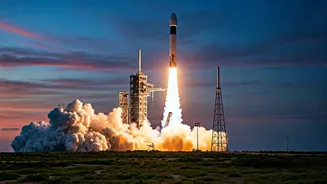







Launch Details Unveiled
SpaceX has confirmed the highly anticipated return of its potent Falcon Heavy rocket, marking its first flight in a substantial 18-month interval. The mission, designated for the Viasat-3 F3 payload, is scheduled
to ascend from NASA's Kennedy Space Center in Florida. An initial launch window is slated to open at 10:21 a.m. ET (which translates to 8:00 p.m. IST) on April 27th, spanning 85 minutes. Should circumstances necessitate, a secondary opportunity exists the following day, Tuesday, April 28th, with an 85-minute window commencing at 10:17 a.m. ET (also 8:00 p.m. IST). Live coverage of the event will commence approximately 15 minutes before the scheduled liftoff, accessible via webcasts and the X platform (@SpaceX), including the X TV app. This launch represents a significant milestone, underscoring the rocket's powerful capabilities and its essential role in deploying advanced communication satellites.
Rocket's Impressive Power
The Falcon Heavy stands as one of the most formidable rockets currently operational, a testament to engineering prowess. Its design ingeniously integrates three Falcon 9 first-stage boosters, generating an astonishing output of over 5 million pounds of thrust. This colossal power is instrumental in its capacity to transport substantial payloads, extending their reach to geostationary orbit and even further into space. Consequently, it serves as an indispensable asset for a wide array of missions, catering to both commercial enterprises and governmental requirements. The scheduled April 27th launch is particularly noteworthy as it signifies the rocket's first flight since October 2024, highlighting the critical importance of its re-entry into active service and its readiness for complex space endeavors.
Booster Landing Maneuvers
In alignment with SpaceX's core strategy of fostering rocket reusability, the Falcon Heavy's recent mission showcased a spectacular synchronized landing of its two side boosters. This awe-inspiring aerial ballet concluded at Cape Canaveral Space Force Station in Florida, specifically on Landing Zones 2 and 40. This precision landing has become a signature element of Falcon Heavy missions, demonstrating the technological advancements in reusable rocket systems. However, the mission's demanding trajectory, necessitated by the specific orbital requirements for the Viasat-3 F3 satellite, meant that the rocket's center core booster was intentionally expended, a calculated decision to ensure mission success. This approach balances the drive for sustainability with the operational demands of complex deployments.
Viasat-3 F3 Payload
The primary objective of this mission was the successful deployment of the Viasat-3 F3 satellite, a sophisticated piece of technology designed to significantly broaden broadband internet coverage. Its operational reach is intended to span across the Americas, Europe, and Africa, addressing the burgeoning global demand for high-speed internet access. This expansion is particularly vital for reaching underserved regions that currently lack adequate connectivity. SpaceX confirmed the successful placement of the Viasat-3 F3 satellite into its designated orbit, thereby achieving all the mission's critical objectives and paving the way for enhanced global communication services.