






Cross-Border Electoral Influence
An intriguing political scenario is unfolding along the Andhra Pradesh-Tamil Nadu border, where residents of border villages are poised to significantly impact the results of the Tamil Nadu Assembly elections.
Spanning approximately 150 kilometers from Tada to Kuppam, this border region hosts numerous villages where inhabitants maintain voter identification in both states. Political analysts suggest that a substantial bloc of between 5,000 and 10,000 such voters could cast their ballots in each constituency within Tamil Nadu. This cross-border electorate's presence is particularly noteworthy in more than ten Tamil Nadu Assembly constituencies that share boundaries with Andhra Pradesh, including areas like Gummidipoondi, Thiruvallur, Tiruttani, Ranipet, Katpadi, Gudiyattam, Ambur, Vaniyambadi, and Krishnagiri. In constituencies where the electoral race is expected to be tight, the votes from these individuals possessing dual voter registrations could prove decisive, potentially altering the final tally for candidates vying for office.
Targeted Campaign Strategies
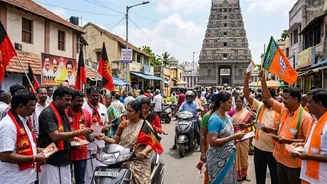
Recognizing the strategic importance of this dual-voter population, major political parties such as the DMK, AIADMK, and BJP are actively campaigning to court these individuals. Campaign efforts are concentrating on border villages where communities exhibit strong social and economic ties that transcend state lines. For instance, a candidate from the NDA in the Ambur constituency recently conducted an election rally in Bramadevachenulu village, aiming to appeal to voters who are registered to vote in Tamil Nadu. This proactive engagement underscores the parties' awareness that these voters can be swayed. Candidates are thus tailoring their messages and outreach to resonate with the specific concerns and identities of these cross-border communities, understanding that winning their support is crucial for electoral success in closely fought contests.
Dual Voter IDs Explained
The practice of holding voter registrations in both Andhra Pradesh and Tamil Nadu is common in these border regions, as explained by residents like Ponne Balakrishnan from Sathravada village. He notes that many families maintain dual voter IDs and ration cards, often to secure advantages such as local reservation benefits for their children's education, even while primarily residing in Andhra Pradesh. This dual registration allows individuals to vote in both the Nagari constituency in AP and the Tiruttani constituency in TN, for example. Candidates, particularly in keenly contested constituencies, are making deliberate efforts to connect with these voters. M Sathya Kumar, a candidate for the Tiruttani constituency, notably organized campaigns in border villages like Kurmamangalam and RKM Peta to rally Telugu-speaking voters originating from Andhra Pradesh.
Persistent Electoral Irregularities
This electoral dynamic extends to numerous villages across Chittoor and Tirupati districts in Andhra Pradesh, including Nayanur, Devarajapuram, Bramadevachenulu, Medamuru, Thimmampeta, Pedduru (89), Aremanupenta, Sathravada, Kanakamma Satram, Surutupalli, Nagalapuram, Pichaturu, Vijayapuram, Varadaiahpalem, Bhimulivaripalem, and Sathyavedu. The issue of dual voter registrations, while a violation of election regulations, persists due to delays in the Special Intensive Revision (SIR) of electoral rolls, according to a senior district official in Tirupati. This delay has unfortunately allowed such discrepancies to continue. The official emphasized that a simultaneous SIR implementation across both Andhra Pradesh and Tamil Nadu is vital to eliminate voter duplication and prevent future electoral irregularities, ensuring the integrity of the election process.