


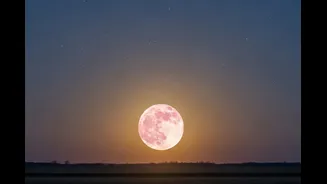
Catching the Pink Moon
Mark your calendars for April's celestial event, the first full moon of the spring season, traditionally known as the 'Pink Moon.' While it reaches its zenith of illumination on Thursday, April 2nd, at precisely
3:12 am, the optimal time for observing its grandeur is actually the preceding evening, Wednesday, April 1st. Aim to step outside as the moon begins its ascent over the horizon for the most visually striking experience. This period offers the best chance to capture its beauty before it reaches its absolute peak illumination in the early hours of Thursday. The entire night of Wednesday into the early hours of Thursday provides an extended window to appreciate this lunar spectacle.
The Deceptive Name
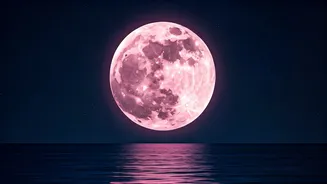
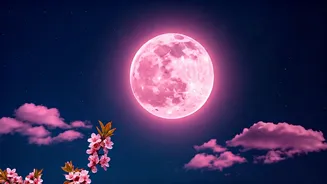
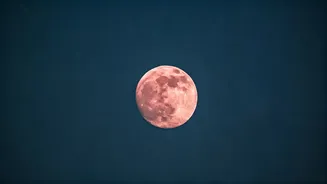
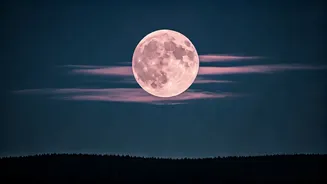
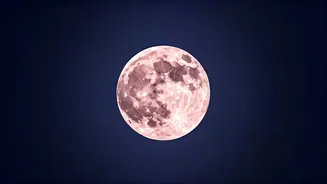
Contrary to its vibrant moniker, April's 'Pink Moon' will not actually appear in shades of pink. The name's origins are deeply rooted in the traditions of early Native American tribes. These communities meticulously tracked the passage of time and seasons by observing the lunar cycles. They bestowed the name 'Pink Moon' upon this particular full moon to commemorate the blooming of early spring wildflowers, most notably the wild ground phlox, which would carpet the landscape in delicate pink hues. Therefore, the name is a historical nod to nature's reawakening rather than an accurate description of the moon's actual color during this phase.
Why the Copper Glow?
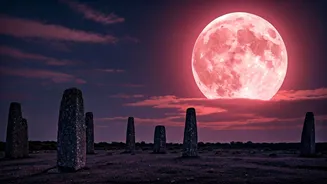
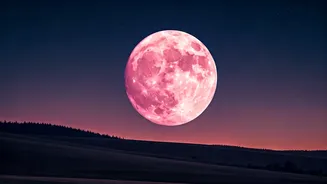
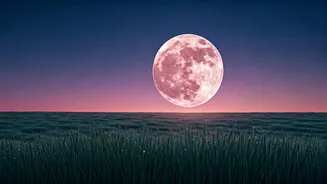
The captivating orange or golden hue often observed during the 'Pink Moon' is a result of atmospheric physics. When the moon is positioned low on the horizon, as it is during moonrise, the light reflecting off its surface must travel a considerably longer path through Earth's atmosphere to reach our eyes. The atmosphere contains numerous particles that scatter light. Shorter wavelengths of light, such as blues and violets, are dispersed in various directions, making them less visible. Conversely, the longer wavelengths, encompassing reds, oranges, and yellows, are more adept at penetrating this atmospheric veil. This process allows these warmer colors to dominate, imparting the moon with its characteristic coppery or golden tint, akin to the optical phenomenon that creates vivid sunsets.
Virgo's Bright Companion
This month's full moon offers an added treat for stargazers by gracing the night sky alongside a remarkably bright celestial object. Positioned in close proximity to the 'Pink Moon' within the Virgo constellation is Spica, an exceptionally luminous binary star system. The presence of Spica, so close to the illuminated moon, creates a particularly dynamic and aesthetically pleasing view. Observing these two brilliant bodies together enhances the overall spectacle of the night sky, providing a fascinating dual point of interest for anyone looking upwards.
Holiday Calendar Trigger
Beyond its visual splendor, the timing of April's 'Pink Moon' holds significant cultural and religious importance, serving as a pivotal marker for major holidays. The dates for both Easter and Passover are intrinsically linked to this lunar event, following an ancient calculation. Specifically, Easter is celebrated on the first Sunday that occurs after the first full moon following the spring equinox. Given that the astronomical spring equinox for the year took place on March 20th, this April full moon directly determines the timing of the upcoming Easter celebrations. Its appearance effectively locks in the dates for this important religious holiday weekend.
Weather's Impact on Viewing
As with any outdoor astronomical event, the visibility of the 'Pink Moon' is entirely dependent on prevailing weather conditions. For observers in the UK, the forecast for April 1st presents a mixed outlook. Reports suggest that England and Wales may experience cloudy skies and intermittent rain, which could obstruct the view of the moon. However, the northern regions of Scotland and Northern Ireland are anticipated to be under clearer, colder air masses, offering a higher probability of unobstructed viewing opportunities. Regardless of the specific conditions, taking a moment to step outside on Wednesday evening is encouraged, as the spring sky begins its seasonal awakening.